
Analyst price targets project where a stock trades in 12 months. Learn the DCF, comps, and SOTP methods Wall Street uses—and why consensus targets matter most.
In the short run, the market is a voting machine. In the long run, it is a weighing machine.

An Analyst Price Target is the projected price level a financial analyst believes a stock will reach within a specific timeframe, typically 12 months. Think of it as a professional’s educated prediction on where the stock is headed. When an analyst at a firm like Goldman Sachs or Morgan Stanley initiates coverage on a stock with a ‘Buy’ rating, they almost always attach a price target. This target is the tangible number behind their thesis, representing the upside (or downside) they foresee. For investors, price targets are one of the most widely cited data points, but understanding how they are made and how to use them correctly is key to avoiding common pitfalls.
How Are Price Targets Calculated? The Art and the Science
A price target isn’t just a number pulled from thin air. It’s the end result of a rigorous (though subjective) valuation process. Analysts build complex financial models to forecast a company’s future earnings and cash flows.
Common Valuation Methods Used
- Discounted Cash Flow (DCF): This is a bedrock technique. Analysts project a company’s cash flows far into the future and then ‘discount’ them back to what they would be worth today. This gives them an estimate of the company’s intrinsic value.
- Comparable Company Analysis (‘Comps’): Analysts will look at a company’s peers in the same industry. They’ll compare valuation multiples like the P/E (Price-to-Earnings) ratio. If similar companies in the sector trade at an average P/E of 25, and the target company is only trading at 15, the analyst might set a price target that assumes its P/E will rise to meet its peers.
- Sum-of-the-Parts Analysis (SOTP): For large conglomerates with multiple business segments (like Amazon with its e-commerce, cloud computing, and advertising divisions), analysts will value each part separately and then add them together to get a total company valuation and price target.
The Human Element
While the methods are quantitative, the inputs are not. The analyst’s personal assumptions about future growth rates, profit margins, and market sentiment play a huge role. This is why two analysts looking at the same company can arrive at wildly different price targets. It’s a blend of math and a story about the future.
The Importance of the ‘Consensus’ Price Target
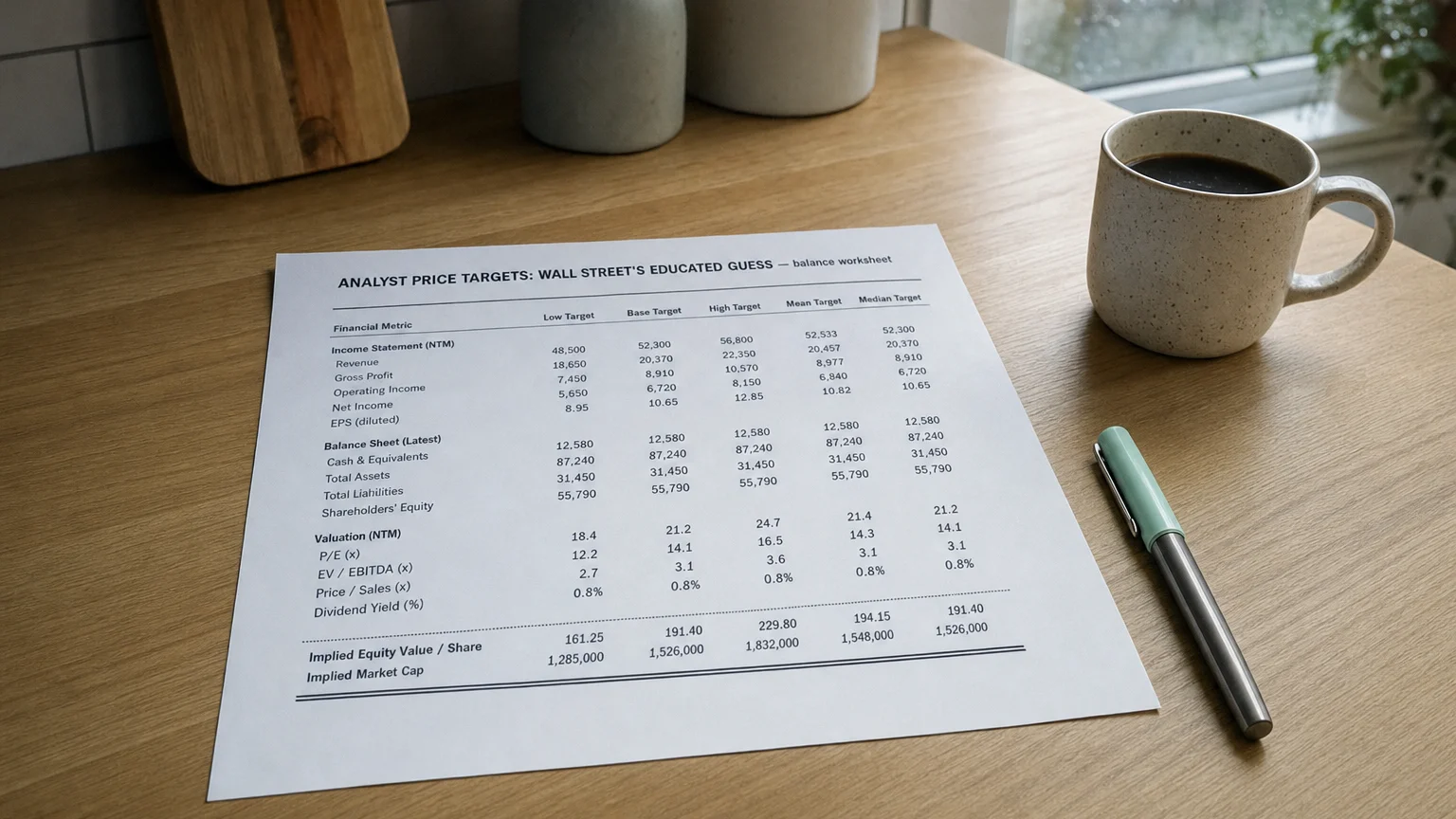
While any single price target can be an outlier, the consensus (or average) price target is a much more powerful piece of data. This number represents the average of all price targets issued by the Wall Street analysts covering a particular stock.
What the Consensus Target Tells You
- Market Expectation: It gives you a clear sense of Wall Street’s collective expectation for the stock’s performance over the next year.
- Potential Upside/Downside: You can quickly compare the current stock price to the consensus target to see how much upside (or downside) the average analyst expects. If a stock is trading at 100, Wall Street sees a 25% upside.
- Sentiment Trend: Just like with recommendations, the change in the consensus price target over time is critical. A rising consensus target suggests that analysts are becoming progressively more bullish on the company’s prospects.
“In the short run, the market is a voting machine. In the long run, it is a weighing machine.”
— Benjamin Graham, Author, The Intelligent Investor Security Analysis (1934)
How to Use Price Targets in Your Analysis (And How Not To)
A price target is a tool, and like any tool, it can be misused. The biggest mistake an investor can make is treating a price target as an infallible prophecy.
Price Targets are Not Guarantees
An analyst’s price target is their opinion based on a model with many assumptions. Economic conditions can change, a new competitor can emerge, or a company can deliver an unexpectedly bad quarter—all of which can make the original price target instantly obsolete. Never buy a stock solely because an analyst has a high price target.
A Smarter Approach
- Use it as a Sanity Check: After you’ve done your own research and valuation, you can compare your conclusions to the analyst consensus. If your valuation is wildly different, it forces you to ask: ‘What do the analysts see that I don’t?’ or vice-versa.
- Understand the ‘Why’: The number itself is the least interesting part. The real value is in the analyst’s research report, which explains the assumptions behind the number. That research can provide invaluable insights into the industry and the company.
- Look for Revisions: Pay close attention to when analysts raise or lower their price targets. This is often more significant than the target itself. A flurry of analysts raising their targets after an earnings report is a very strong bullish signal.
Q · 01 How do analysts calculate a stock's 12-month price target? +
Q · 02 What does the consensus analyst price target mean? +
Q · 03 Should I buy a stock just because analysts raised the price target? +