
A critical financing activity on the cash flow statement representing the cash outflow used to pay back the principal amount of borrowed funds, signaling a comp
Should you find yourself in a chronically-leaking boat, energy devoted to changing vessels is likely to be more productive than energy devoted to patching leaks.

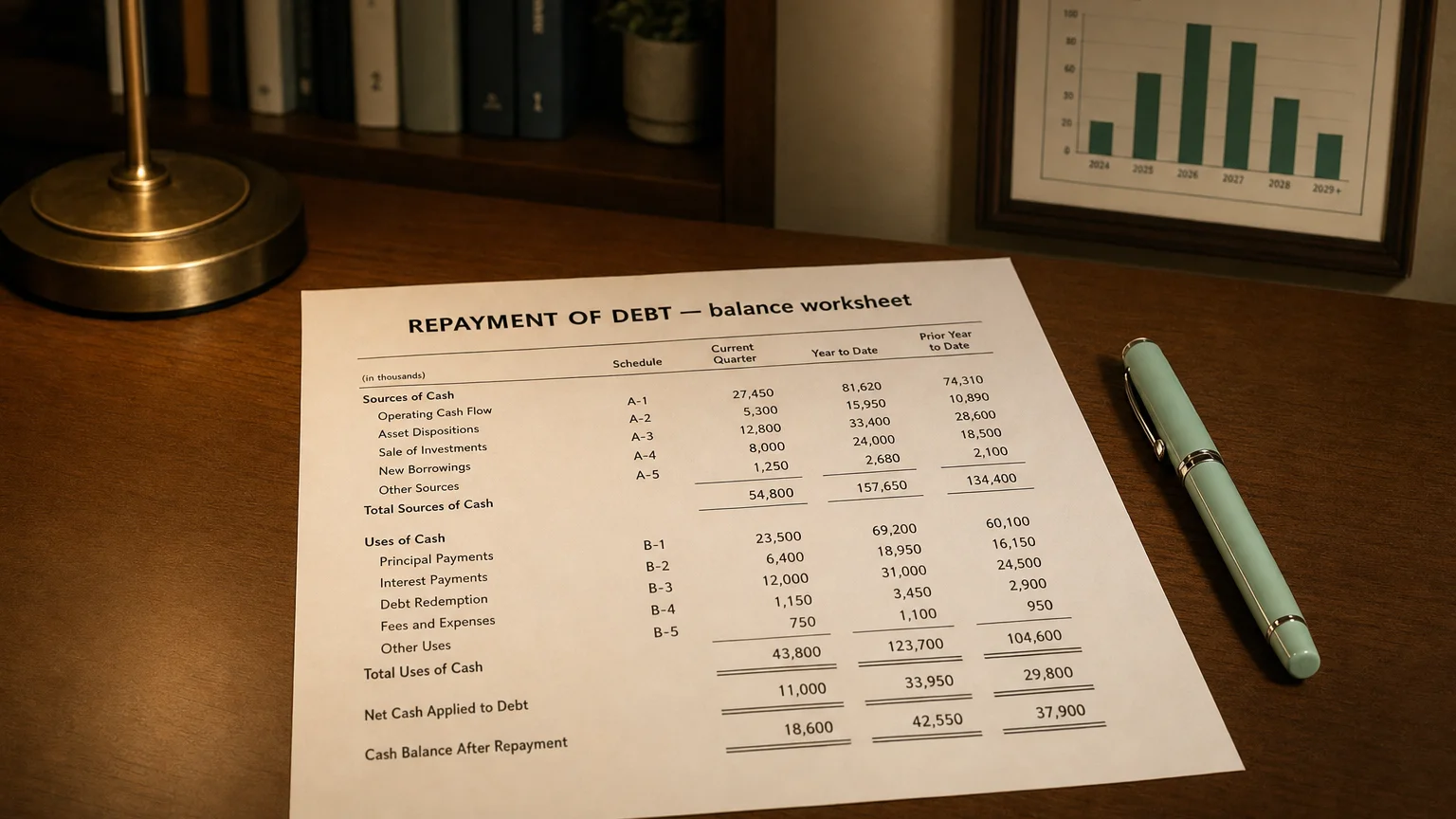
In financial reporting, repayment of debt refers to the cash outflow for paying back the principal amount of borrowed funds. This means the company is returning money to its lenders (such as paying off loans, bonds, or other borrowings). On the cash flow statement, it is recorded when debt investors or creditors are paid back, and it represents cash leaving the company to reduce its debt obligations. In simple terms, it’s the amount of cash a business uses to pay down its loans or other debt, excluding the interest expense (interest is usually reported separately). Any time a company uses cash to settle part of its debt, that transaction is a repayment of debt.
Presentation on the Statement of Cash Flows
Repayment of debt is a key line item within the Cash Flow from Financing Activities section of the cash flow statement. This section measures the flow of cash between a firm and its owners and creditors. Within this section, cash inflows from new borrowings (debt issued) are listed as positive amounts (sources of cash), while any repayment of debt is shown as a cash use (outflow), typically indicated by a negative number or in parentheses.
A Sign of Deleveraging
Analysts and investors look at this section to see if the company is raising new capital or paying it back. A significant outflow for debt repayment indicates that the company is actively reducing its leverage, which can be a sign of financial strength if supported by strong operating cash flows.
Short-Term vs. Long-Term Debt Repayment
The cash flow statement can reflect repayments of both short-term debt (due within one year) and long-term debt (due after one year), and their presentation can differ.
Short-term debt, such as a revolving credit line, is often used for working capital and may be borrowed and repaid frequently. Because of this, financial statements might show the net change in short-term debt for the period rather than listing every individual transaction. For instance, a line item like ‘Decrease in short-term debt’ would represent a net cash outflow for repayments.
Repayments of long-term debt, like a term loan or a bond, are typically larger and less frequent. These are usually reported explicitly as a distinct line item, such as ‘Repayment of long-term debt.’ This provides a clear view of significant strategic decisions to reduce long-term liabilities, like retiring a bond issue or making a large principal payment on a loan.
“Should you find yourself in a chronically-leaking boat, energy devoted to changing vessels is likely to be more productive than energy devoted to patching leaks.”
— Warren Buffett, Chairman & CEO, Berkshire Hathaway Berkshire Hathaway Chairman’s Letter 1985 (1985)
The Dual Impact on a Company’s Financials
Repaying debt directly reduces a company’s cash balance. It is a cash outflow that lowers the cash on hand in exchange for lowering the debt owed on the balance sheet. For every dollar used to repay debt, the cash asset decreases by a dollar, and the corresponding debt liability also decreases by a dollar. While this reduces a company’s liquid assets, it simultaneously strengthens the balance sheet by lowering leverage and financial risk.
A Simple Transaction
If Company A uses 10,000 outflow in the financing section. On the balance sheet, its ‘Cash’ asset account will decrease by 10,000. The company is now less leveraged but also has less cash for other purposes.
Importance for Financial Health and Analysis
The repayment of debt line item is a crucial indicator of a company’s financial discipline, solvency, and strategic priorities.
- Indicates Solvency and Reliability: Regularly scheduled debt repayments demonstrate that a company is meeting its legal commitments to creditors. This is a fundamental sign of solvency and good financial management. Failure to make these payments can lead to default.
- Reveals Liquidity Management: The amount of cash used for debt repayment impacts a company’s liquidity. Analysts assess whether operating cash flows are sufficient to cover these repayments without straining the company’s ability to fund daily operations and investments. A large debt repayment that is easily covered by incoming cash is a sign of strength.
- Signals a Stronger Balance Sheet: Consistently paying down debt reduces a company’s overall leverage, which lowers financial risk and can improve its creditworthiness over time. This deleveraging process is viewed favorably by investors and credit rating agencies.
- Provides Insight into Strategy: The pattern of debt repayment reveals management’s strategy. Large, one-time ‘bullet’ repayments may signal the retirement of a major bond issue, while steady repayments suggest the orderly servicing of amortizing loans. This helps analysts forecast future cash needs and understand the company’s financial commitments.
Interpreting Debt Repayment in Context
If a company has negative cash flow for a period, it’s essential to check if a large debt repayment was the cause. A negative cash flow driven by a strategic decision to reduce debt is often viewed more positively than one caused by operational losses.
Q · 01 What is Repayment Of Debt? +