Quantitative Investing A Mathematical Approach
Master quantitative investing from first principles: statistical analysis, risk metrics, portfolio analytics, algorithmic trading, factor models, and
Overview
Master quantitative investing from first principles: statistical analysis, risk metrics, portfolio analytics, algorithmic trading, factor models, and
What Is Quantitative Analysis?
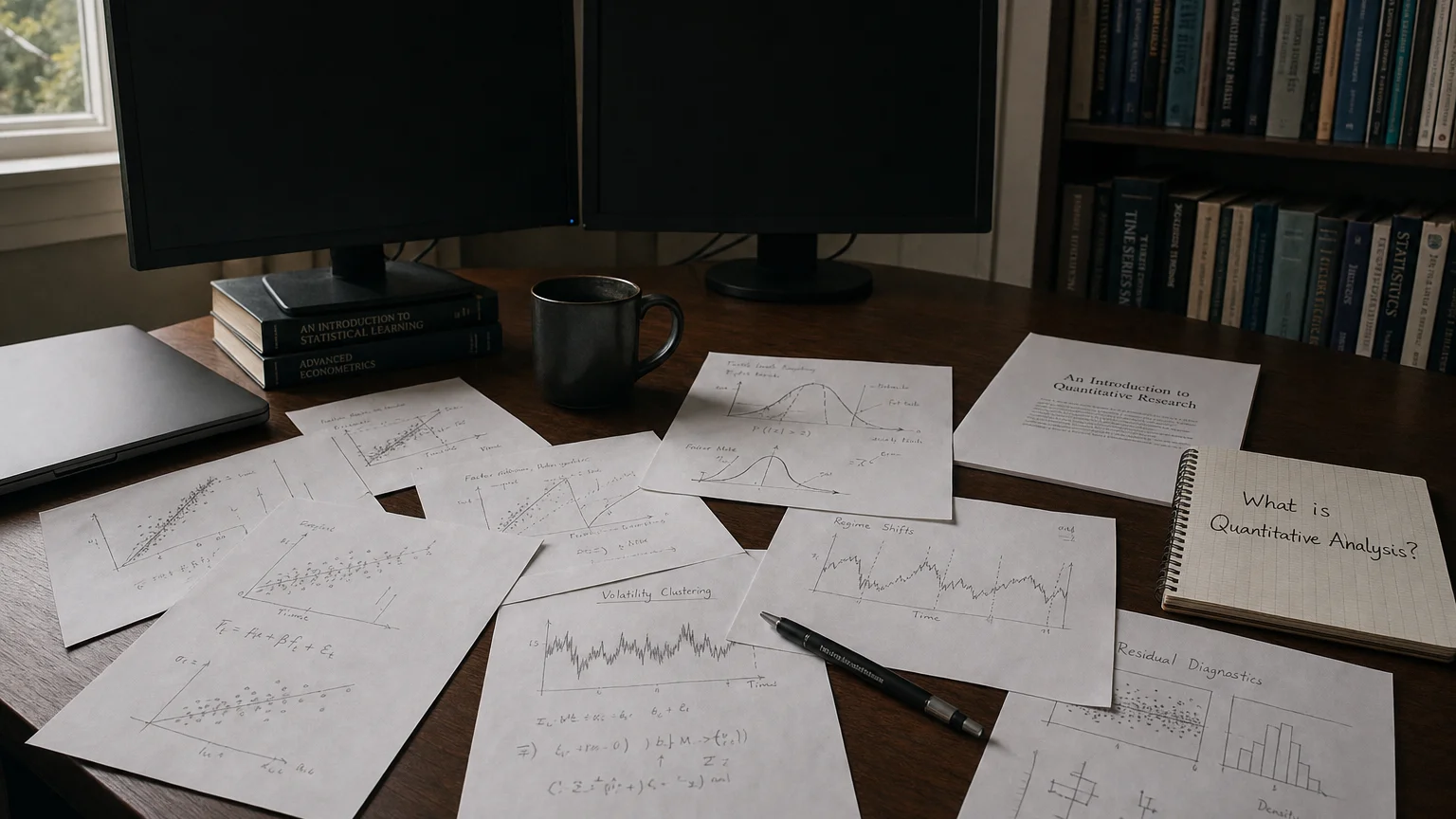
Quantitative analysis is the application of mathematical models, statistical methods, and computational algorithms to financial markets. Investors use it to identify pricing inefficiencies, measure risk, optimize portfolios, and execute systematic strategies. Core disciplines include factor modeling, time-series analysis, backtesting, and alternative data integration — replacing intuition with reproducible, data-driven processes.
Unlike discretionary investing, where individual judgment drives each decision, quantitative investing encodes decision rules into systematic frameworks that can be tested against historical data, scaled across hundreds or thousands of securities, and executed with minimal emotional interference. The discipline draws from mathematics, statistics, computer science, and economics — making it one of the most technically demanding areas of modern finance.
This guide covers every major pillar of quantitative analysis: statistical foundations, risk metrics, portfolio analytics, algorithmic trading, factor models, and the emerging role of alternative data.
"A good portfolio is more than a long list of good stocks and bonds. It is a balanced whole."
— Harry Markowitz, Nobel Laureate in Economics, Father of Modern Portfolio Theory Portfolio Selection: Efficient Diversification of Investments (1959)
<!-- quote-id: markowitz-002 verified -->
Part 1 — Statistical Foundations
Descriptive Statistics for Financial Data
The first step in any quantitative analysis is understanding the distribution of returns. Unlike many other domains, financial return distributions are not perfectly normal. They exhibit fat tails (kurtosis greater than 3), negative skewness (large losses occur more frequently than large gains), and serial correlation over short time horizons.
Key descriptive statistics every quant analyst must master:
- Mean return — the arithmetic average of period returns, often misleading over long horizons due to compounding effects
- Standard deviation — the primary measure of return dispersion, used as a proxy for total risk
- Skewness — asymmetry in the return distribution; negative skew implies more extreme losses than gains
- Kurtosis — excess kurtosis above 3 indicates fat tails and a higher probability of extreme events
- Autocorrelation — the correlation of a return series with its own lagged values, indicating short-term momentum or mean reversion
Regression Analysis
Regression is the workhorse of quantitative finance. Ordinary Least Squares (OLS) regression fits a linear relationship between a dependent variable (typically asset returns) and one or more independent variables (risk factors, macroeconomic indicators, or other securities).
The Capital Asset Pricing Model (CAPM) is itself a single-factor regression:
R_i = α_i + β_i × R_m + ε_i
Where R_i is the return of asset i, R_m is the market return, β_i is the sensitivity of the asset to market movements (beta), α_i is the excess return unexplained by market exposure (alpha), and ε_i is the idiosyncratic error term.
Multi-factor regressions extend this framework by adding exposure to additional systematic factors — size, value, momentum, quality — to explain more of the return variance.
Time-Series Analysis
Financial prices and returns are time-series: observations ordered sequentially in time. Time-series methods are essential for modelling return dynamics and volatility:
- ARMA models (AutoRegressive Moving Average) capture short-term serial dependencies in returns
- GARCH models (Generalized Autoregressive Conditional Heteroskedasticity) model time-varying volatility — the tendency for large price moves to cluster together
- Cointegration identifies pairs of non-stationary price series that move together over time, forming the theoretical basis for pairs trading strategies
Hypothesis Testing and Statistical Significance
A critical discipline in quantitative research is distinguishing genuine signals from noise. The standard framework:
- Null hypothesis — typically that the observed effect is zero (no alpha, no predictive relationship)
- Test statistic — computed from sample data to measure the distance from the null
- P-value — probability of observing a result as extreme as the data, assuming the null is true
- Significance threshold — conventionally p < 0.05, but in finance, p < 0.01 or even p < 0.001 is preferred given the number of tests performed (multiple testing problem)
The multiple testing problem is endemic to quantitative research. If you test 100 strategies and use p < 0.05 as your threshold, you expect five false positives by chance alone. Corrections like Bonferroni adjustment, Benjamini-Hochberg procedure, or out-of-sample testing are essential guard rails.

Part 2 — Risk Metrics
Quantitative analysis places risk measurement at the center of the investment process. Understanding the full distribution of outcomes — not just expected returns — is what separates quant from discretionary practice.
Volatility and Standard Deviation
Realized volatility is the standard deviation of historical returns, annualized by multiplying by the square root of the number of trading periods per year (approximately 252 for daily data):
σ_annual = σ_daily × √252
Implied volatility is derived from options prices and reflects the market's forward-looking expectation of price fluctuations. The VIX index — often called the "fear gauge" — measures implied volatility on the S&P 500 over a 30-day horizon.
Value at Risk (VaR)
Value at Risk answers a specific question: what is the maximum loss expected with 95% (or 99%) confidence over a given time horizon?
Three main approaches:
- Historical VaR — uses the empirical return distribution over a historical window to identify the 5th or 1st percentile return
- Parametric VaR — assumes returns follow a normal distribution and computes the loss at the specified confidence interval analytically
- Monte Carlo VaR — simulates thousands of return scenarios using modelled distributions (often including fat tails) and identifies the loss at the specified percentile
VaR has known limitations: it does not tell you how bad losses in the tail will be, and it can be unstable across market regimes. It is most useful as a risk budgeting tool, not a worst-case scenario measure.
Expected Shortfall (CVaR)
Expected Shortfall (also called Conditional Value at Risk, CVaR) corrects VaR's blind spot by averaging all losses that exceed the VaR threshold:
CVaR_95% = E[Loss | Loss > VaR_95%]
CVaR is a coherent risk measure — it satisfies properties of monotonicity, sub-additivity, homogeneity, and translation invariance that VaR violates. Regulators in the Basel III/IV framework have shifted from VaR toward CVaR as the primary risk metric for trading books.
Maximum Drawdown
Maximum drawdown measures the peak-to-trough decline in portfolio value over a specified period. It captures the worst cumulative loss an investor would have experienced without selling:
MaxDD = max[(Peak Value - Trough Value) / Peak Value]
Maximum drawdown is particularly important for systematic strategies because it reflects the lived experience of volatility — how much pain a real investor would endure through a bad period. Strategies with high Sharpe ratios but catastrophic drawdowns are often unacceptable in practice.
Risk-Adjusted Return Metrics
The most widely used risk-adjusted performance metrics:
| Metric | Formula | Interpretation |
|---|---|---|
| Sharpe Ratio | (R_p − R_f) / σ_p | Excess return per unit of total risk |
| Sortino Ratio | (R_p − R_f) / σ_downside | Excess return per unit of downside risk only |
| Calmar Ratio | Annualized Return / Max Drawdown | Return per unit of maximum historical loss |
| Information Ratio | α / Tracking Error | Active return per unit of active risk vs benchmark |
| Treynor Ratio | (R_p − R_f) / β | Excess return per unit of market (systematic) risk |
A Sharpe ratio above 1.0 is generally considered acceptable; above 2.0 is excellent for a diversified systematic strategy.
Part 3 — Portfolio Analytics
Mean-Variance Optimization
Harry Markowitz's 1952 framework revolutionized portfolio construction by formalizing the trade-off between expected return and variance. The efficient frontier describes the set of portfolios that maximize expected return for each level of risk (or equivalently, minimize risk for each level of return).
Formally, the minimum-variance portfolio solves:
minimize   w^T Σ w
subject to w^T μ = target_return
           w^T 1 = 1
           w_i ≥ 0 (if long-only)
Where w is the vector of portfolio weights, Σ is the covariance matrix of returns, and μ is the vector of expected returns.
Covariance Matrix Estimation
The covariance matrix is the central object in modern portfolio theory. For a universe of N assets, it contains N(N+1)/2 unique parameters to estimate — which quickly becomes a statistical challenge as N grows.
Estimation approaches:
- Sample covariance matrix — straightforward but noisy for large N relative to the time-series length
- Ledoit-Wolf shrinkage — shrinks the sample covariance matrix toward a structured target (often the identity or single-factor matrix) to reduce estimation error
- Factor-based covariance — decomposes the covariance into systematic (factor) and idiosyncratic components, requiring far fewer parameters
Risk Factor Decomposition
Portfolio risk can be decomposed into:
- Systematic risk — exposure to broad market factors (market beta, sector, size, style) that cannot be diversified away
- Idiosyncratic risk — company-specific risk that can be reduced through diversification
- Factor exposure contributions — the share of total portfolio variance attributable to each factor
Risk decomposition allows portfolio managers to understand precisely where their risk is concentrated and to make deliberate decisions about which risks to carry.
Part 4 — Algorithmic Trading
Systematic Strategy Architecture
A systematic trading strategy consists of four interconnected components:
flowchart LR
    A[Signal Generation] --> B[Signal Combination]
    B --> C[Portfolio Construction]
    C --> D[Execution & Risk Control]
    D -->|Feedback| A
Signal generation transforms raw data into predictive scores. Signal combination aggregates multiple signals into a single composite forecast. Portfolio construction translates forecasts into target weights, subject to risk and turnover constraints. Execution converts target weights into actual trades while minimizing market impact.
Strategy Types
| Strategy Type | Time Horizon | Core Signal | Representative Models |
|---|---|---|---|
| Statistical Arbitrage | Intraday to weeks | Mean-reversion in cointegrated pairs | OLS spread, Kalman filter |
| Momentum | 1–12 months | Trend continuation | Cross-sectional rank, time-series momentum |
| Mean Reversion | Days to weeks | Reversion after large moves | RSI extremes, Z-score of price vs moving avg |
| Market Making | Milliseconds to minutes | Bid-ask spread capture | Avellaneda-Stoikov model |
| Factor Investing | Months to years | Systematic factor premia | Long/short factor portfolios |
Transaction Cost Modeling
No systematic strategy survives contact with the market without accounting for transaction costs. The key cost components:
- Commission — brokerage fees per share or per trade
- Bid-ask spread — the cost of crossing the spread on each trade
- Market impact — the adverse price movement caused by the trade itself, increasing with order size
- Slippage — the difference between the expected execution price and actual fill price
A realistic cost model for equities typically applies 10–30 basis points per round-trip for mid-cap stocks, falling to 2–5 bps for large-cap liquid names.
Walk-Forward Testing
A single backtest on the full historical dataset is insufficient for validating a strategy. Walk-forward testing (also called time-series cross-validation) divides the historical data into sequential train/test windows:
- Train on the first N years of data
- Test on the next M months (out-of-sample)
- Roll forward, expanding or sliding the training window
- Aggregate out-of-sample results across all test periods
Walk-forward testing provides a realistic estimate of how the strategy would have performed if deployed live, because each out-of-sample period uses only information available at that point in time.
Part 5 — Factor Models
The CAPM and Its Limits
The Capital Asset Pricing Model predicts that the only systematic risk that earns a premium is exposure to the market portfolio (beta). Empirically, this is demonstrably incomplete. Stocks with certain characteristics — small size, low valuation multiples, recent price momentum, high profitability — earn returns that cannot be explained by beta alone.
These unexplained return patterns are the raw material of factor investing.
Fama-French Three-Factor and Five-Factor Models
Eugene Fama and Kenneth French extended CAPM with empirically documented factors:
Three-factor model (1992):
- Market (MKT) — excess return of the broad market above the risk-free rate
- Size (SMB, Small Minus Big) — return premium of small-cap stocks over large-cap stocks
- Value (HML, High Minus Low) — return premium of high book-to-market stocks over low book-to-market stocks
Five-factor model (2015) adds:
- Profitability (RMW, Robust Minus Weak) — premium of high operating profitability firms
- Investment (CMA, Conservative Minus Aggressive) — premium of low-investment firms over high-investment firms
Together these five factors explain the majority of cross-sectional return variation in U.S. equities.
Momentum and Other Factors
Beyond Fama-French, several additional factors have been extensively documented:
- Momentum (UMD, Up Minus Down) — stocks that have outperformed over the past 12 months (excluding the last month) continue to outperform over the next 3–12 months (Jegadeesh and Titman, 1993)
- Low volatility anomaly — low-beta and low-volatility stocks earn risk-adjusted returns superior to high-beta stocks, contradicting the CAPM's prediction
- Quality — firms with high profitability, stable earnings, low debt, and strong cash conversion earn persistent excess returns
Factor Crowding and Decay
A critical risk in factor investing is crowding: when too many investors tilt toward the same factors, the associated premium is arbitraged away, or the factor becomes vulnerable to sharp reversals when crowded positions unwind.
Monitoring factor crowding requires tracking:
- Position concentration among institutional investors (13F filings)
- Valuation spreads between long and short legs of factor portfolios
- Return drawdown speed — sudden sharp reversals often signal crowding rather than factor regime change

Part 6 — Alternative Data
What Is Alternative Data?
Alternative data refers to information sets that fall outside the traditional financial data universe of price/volume histories, financial statements, and economic indicators. The term encompasses satellite imagery, credit card transaction records, web scraping and sentiment signals, mobile device location data, job postings, patent filings, and many other unconventional sources.
The rise of alternative data reflects a broader transformation in quantitative investing: as traditional factors become more crowded, information advantages accrue to those who can source, process, and analyze non-traditional signals at scale.
Categories of Alternative Data
| Category | Examples | Edge Type |
|---|---|---|
| Sentiment | Social media NLP, news sentiment scores | Behavioral momentum / contrarian signals |
| Transactional | Credit card spend, e-commerce data | Real-time revenue tracking ahead of earnings |
| Geospatial | Satellite parking lot imagery, ship tracking | Physical activity proxy for economic output |
| Web/App | Search trends, app downloads, web traffic | Consumer demand and competitive positioning |
| HR/Workforce | Job posting counts, employee reviews | Operational momentum, cost pressure signals |
Evaluating Alternative Data Quality
Not all alternative data is investment-grade. Before incorporating a dataset into a systematic strategy, analysts assess:
- Coverage — what fraction of the investment universe does the data cover?
- History length — is there sufficient historical depth to evaluate strategy performance across market regimes?
- Frequency — is the data available at the cadence required for the strategy's rebalancing period?
- Survivorship and look-ahead bias — does the historical dataset accurately represent what would have been available in real time?
- Signal uniqueness — does the dataset add information beyond what is already captured by existing signals?
Machine Learning Applications
The data processing demands of alternative data have accelerated the adoption of machine learning in quantitative finance. Key applications include:
- Natural Language Processing (NLP) — sentiment scoring of earnings calls, analyst reports, news articles, and social media
- Computer vision — automated analysis of satellite imagery to count cars, measure crop health, or track shipping container flows
- Gradient boosting (XGBoost, LightGBM) — nonlinear feature combination for cross-sectional return prediction
- Recurrent neural networks (LSTM) — sequence modelling for time-series forecasting
The practical challenge with ML in finance is generalization: models trained on historical data often overfit to regime-specific patterns that do not persist out-of-sample. Regularization, ensembling, and strict walk-forward validation discipline are essential mitigants.
The Quantitative Workflow
A systematic quant process typically follows a disciplined research pipeline:
flowchart TD
    A[Data Acquisition & Cleaning] --> B[Feature Engineering]
    B --> C[Signal Research & Hypothesis Testing]
    C --> D{Statistical Significance?}
    D -- No --> B
    D -- Yes --> E[Portfolio Construction & Simulation]
    E --> F[Walk-Forward Backtesting]
    F --> G{Out-of-Sample Performance Acceptable?}
    G -- No --> C
    G -- Yes --> H[Transaction Cost Modeling]
    H --> I[Risk Analysis & Stress Testing]
    I --> J[Paper Trading / Live Pilot]
    J --> K[Full Deployment]
Each stage acts as a filter that removes strategies with weak statistical foundations, unacceptable risk profiles, or prohibitive implementation costs. The pipeline philosophy is deliberately conservative: it is better to reject ten viable strategies than to deploy one that fails catastrophically in live trading.
Key Quantitative Figures
The theoretical foundations of modern quantitative finance rest on the work of a small number of pivotal researchers:
- Harry Markowitz (1952) — Modern Portfolio Theory: the efficient frontier and mean-variance optimization
- William Sharpe (1964) — Capital Asset Pricing Model: systematic vs idiosyncratic risk
- Fischer Black & Myron Scholes (1973) — options pricing theory: continuous-time mathematics in finance
- Eugene Fama & Kenneth French (1992, 2015) — multi-factor models: systematic sources of equity return premia
- James Simons — founder of Renaissance Technologies, pioneer of data-driven systematic trading; Medallion Fund achieved ~66% gross annual returns from 1988 to 2018
- Clifford Asness — co-founder of AQR Capital; extended factor research into practical multi-asset systematic strategies
Frequently Asked Questions
What is quantitative analysis in investing?
Quantitative analysis in investing uses mathematical models, statistical techniques, and computational algorithms to evaluate securities, measure risk, and construct portfolios. Rather than relying on qualitative judgment, quant analysts extract signals from structured data — price history, financial statements, macroeconomic series — to generate systematic, repeatable investment decisions.
How does quantitative analysis differ from fundamental analysis?
Fundamental analysis evaluates a company's intrinsic value through financial statements, management quality, and competitive position. Quantitative analysis uses statistical models to process large datasets and identify patterns across many securities simultaneously. In practice, the two approaches are complementary: fundamentals provide the economic rationale, while quant methods provide the rigor to test and scale it.
What statistical methods are most important in quantitative finance?
Key statistical methods include regression analysis (linear, multiple, and logistic) for modelling relationships between variables; time-series analysis (ARIMA, GARCH) for forecasting returns and volatility; principal component analysis (PCA) for dimensionality reduction; and hypothesis testing to distinguish genuine signals from noise. Monte Carlo simulation is widely used for risk modelling and options pricing.
What is a factor model and how is it used?
A factor model decomposes security returns into exposures to systematic risk factors — such as market beta, size, value, momentum, and quality — plus an idiosyncratic residual. Factor models like the Fama-French three-factor and five-factor frameworks let investors identify the sources of portfolio return, control for unwanted risk exposures, and construct tilted portfolios that target specific premia.
What is backtesting and why does it matter?
Backtesting simulates how a trading strategy would have performed using historical data. It lets quant investors assess signal validity, measure risk-adjusted performance, and identify failure modes before deploying capital. Rigorous backtesting accounts for transaction costs, survivorship bias, look-ahead bias, and regime changes. A strategy that survives these checks in out-of-sample testing has genuine predictive potential.