
Interest Expense (Non-Operating) is a financial concept covered in this article.
You can't take the same actions as everyone else and expect to outperform.
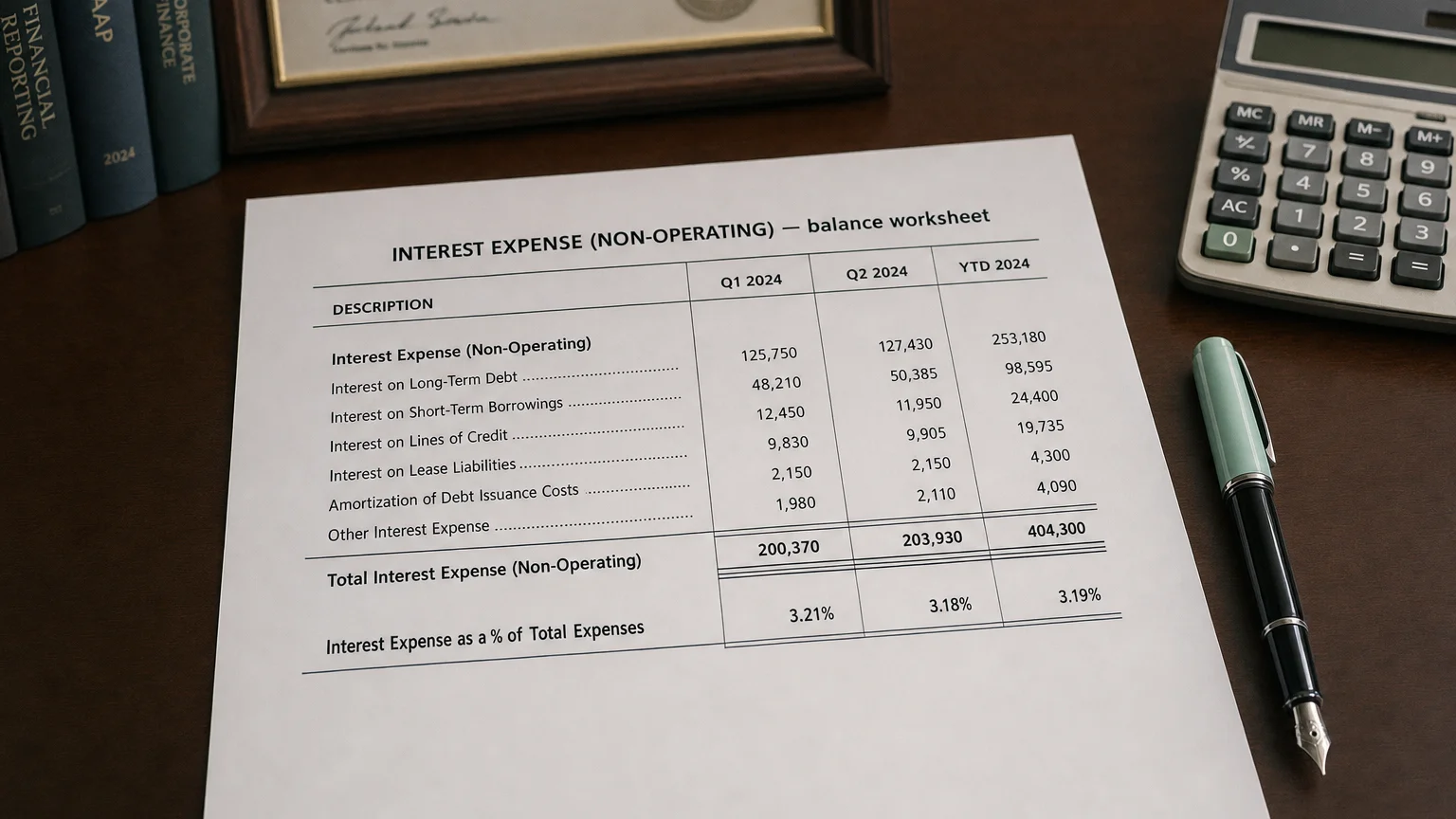
Interest expense is the cost of borrowing money (the interest a company pays on its debts). Unlike expenses directly tied to producing goods or services, interest expense is usually not part of a company’s core operations. Therefore, it is classified as a non-operating expense on the income statement. In practical terms, this means interest expense is listed separately from operating expenses and typically appears below the operating income line on a multi-step income statement. It is often shown in a section labeled “Other Income and Expenses” or “Non-Operating Items.”
Operating vs. Non-Operating Classification
For most businesses, borrowing money is incidental to their main revenue-generating activities. As such, interest paid on loans is treated as a non-operating expense. It differs from operating expenses (like salaries, rent, or cost of goods sold) because it doesn’t arise from the company’s primary operations but rather from how the company is financed.
A manufacturer’s core business is making and selling products, not lending or borrowing money. Any interest the manufacturer pays on a bank loan is outside its manufacturing operations, so it’s a non-operating expense.
Exception: Financial Companies
In certain industries, interest expense can be part of operating activities. For example, for banks or lending institutions, interest expense (e.g., interest paid to depositors) is a core part of doing business and is considered an operating expense.
Common Sources of Interest Expense
Non-operating interest expense usually comes from the interest on various forms of debt that the company has incurred. Typical sources include:
- Bank Loans and Credit Lines: Interest on short-term or long-term loans from banks.
- Corporate Bonds and Notes Payable: Interest on bonds or debt securities the company has issued to investors.
- Mortgages or Equipment Loans: Interest on loans for property or major equipment.
- Other Debt Instruments: Interest on any other borrowed funds, such as lines of credit.
“You can’t take the same actions as everyone else and expect to outperform.”
— Howard Marks, Co-Founder & Co-Chairman, Oaktree Capital Management The Most Important Thing (2011)
Impact on Net Income and Financial Analysis
Interest expense has a direct impact on net income and is a key indicator of financial risk.
- Reduction of Net Profit: Every dollar of interest expense lowers a company’s net earnings. Heavy interest burdens can significantly eat into profits.
- No Impact on Operating Income: Because interest is non-operating, it does not affect operating income (EBIT). This allows for a clear evaluation of core business performance before financing costs.
- Indicator of Leverage and Risk: A large interest expense signals that the company has substantial debt. Analysts use the interest coverage ratio (EBIT / Interest Expense) to measure a company’s ability to cover its interest payments. A low ratio can be a warning sign of financial distress.
Why Is It Categorized as Non-Operating?
Interest expense is categorized as non-operating because it stems from a company’s financing activities, not its core business operations. It relates to the company’s capital structure (how the business is funded through debt and equity) rather than the day-to-day process of selling products or services. By placing interest expense in the non-operating section, financial statements clearly separate the results of operational performance from financing costs, allowing for better transparency and analysis.
Q · 01 What is Interest Expense? +