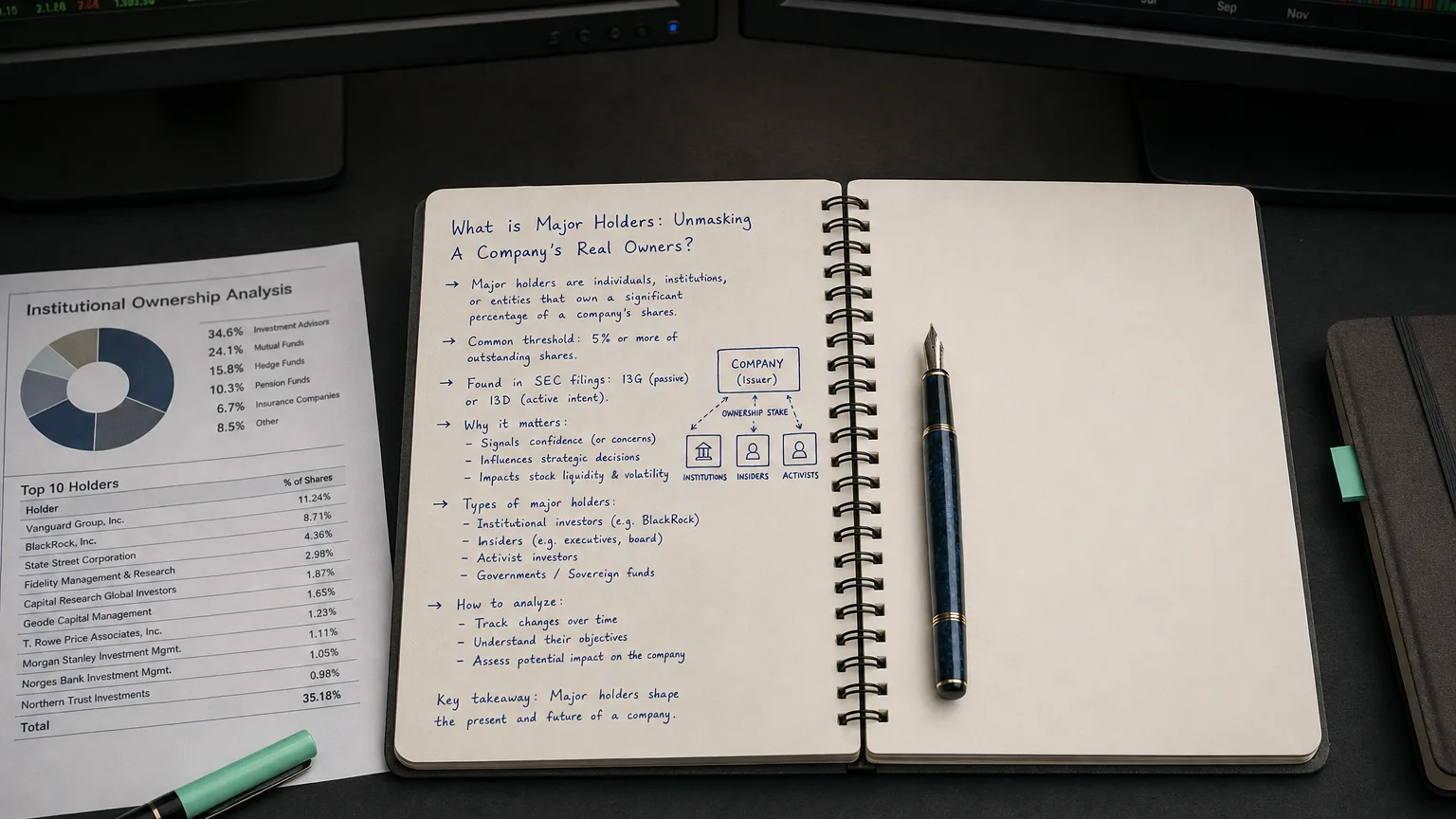
Major Holders is a financial concept covered in this article. How to Analyze the 'Whales' That Can Make or Break a Stock
The intelligent investor is a realist who sells to optimists and buys from pessimists.

Major Holders data reveals the individuals and institutions that own the largest stakes in a public company. Think of it as the shareholder VIP list. While millions of retail investors might own a few shares, the major holders are the ‘whales’—the giant investment funds, company insiders, and public institutions whose buying and selling decisions can significantly move the stock price. Analyzing who these major holders are provides a powerful lens into a company’s stability, credibility, and strategic direction. It helps answer a critical question for any investor: ‘Who am I investing alongside?’
The Anatomy of Ownership: Who Holds the Shares?
The ownership of a public company is typically broken down into a few key categories. Understanding the differences between these groups is crucial for proper analysis.
“The intelligent investor is a realist who sells to optimists and buys from pessimists.”
— Benjamin Graham, Author, The Intelligent Investor The Intelligent Investor (1949)
 Ownership is typically dominated by institutions, followed by insiders and the general public.
The Main Categories of Holders
- Institutional Holders: These are the financial titans. This category includes massive entities like pension funds, insurance companies, investment banks, and large asset managers (e.g., BlackRock, Vanguard, Fidelity). They often own a huge percentage of a company’s stock and represent the ‘smart money.’
- Mutual Fund Holders: This is a subset of institutional holders, specifically showing which mutual funds own the stock. This is useful for seeing which specific fund managers have conviction in the company.
- Insider Holders: This group includes the company’s top executives (CEO, CFO), directors, and any individual who owns more than 10% of the stock. Their ownership level is a key indicator of their personal belief in the company’s future.
- General Public: This represents all other shareholders, including individual retail investors like you and me. Typically, this is a smaller percentage of the total ownership for large companies.
Why Major Holders Data is a Goldmine for Investors
Following the big players provides a powerful shortcut in the world of investing. Their presence (or absence) can tell you a lot about a company’s quality and prospects.
Institutional Sponsorship: The Ultimate Vote of Confidence
When a company has a high percentage of its shares owned by respected institutional investors, it’s known as strong ‘institutional sponsorship.’ This is a powerful bullish signal. Why? Because these giant funds have armies of analysts and vast resources to conduct deep due diligence. Their decision to invest billions of dollars in a company is a strong endorsement of its business model, management, and future growth prospects.
Q: What’s the difference between ‘percent of shares outstanding’ and ‘percent of float’?
‘Shares outstanding’ is the total number of shares a company has issued. The ‘float’ is the number of shares that are actually available for trading on the open market (it excludes shares held by insiders and governments that are restricted from being sold). ‘Percent of float’ is often a more accurate measure of how much of the tradable stock an institution owns.
How to Use Major Holders Data in Your Analysis
Smart investors use major holders data not to blindly copy the big funds, but to gauge conviction and identify potential red flags.
A Practical Investor’s Workflow
- Check for Quality Sponsorship: When researching a stock, one of the first things to check is the list of top institutional holders. Do you see names like Vanguard, BlackRock, State Street, or well-known active managers like T. Rowe Price? The presence of these top-tier firms is a sign of quality.
- Look for Concentration: Is the ownership concentrated among a few high-conviction funds, or is it thinly spread out? A concentrated ownership by a few smart, active managers can be more bullish than a broad ownership by thousands of passive index funds.
- Analyze the Trend: Don’t just look at the current snapshot. Look at the changes from the previous quarter. Are major institutions adding to their positions or are they selling out? A trend of institutional selling is a significant red flag.
- Investigate Insider Ownership: Check the percentage of shares held by insiders. A high percentage (e.g., >10%) is a strong sign that management’s interests are aligned with shareholders. This means they are motivated to increase the stock price because it directly increases their own personal wealth.

Q · 01 What is Major Holders? +