
Sale of Business is a financial concept covered in this article. Cash Proceeds from Divesting a Business Unit or Subsidiary
When a management with a reputation for brilliance tackles a business with a reputation for poor fundamental economics, it is the reputation of the business that remains intact.

Sale of Business is the cash inflow a company receives when it sells a business segment, division, subsidiary, or significant portion of its operations to another party. This line appears in the investing section of the cash flow statement and often represents a major one-time event as the company exits non-core or underperforming parts of its portfolio.
What It Represents
Sale of Business captures the actual cash proceeds from transferring ownership of a business unit or subsidiary.
- Gross cash received from buyer
- Minus direct transaction costs if netted (fees, legal)
- Excludes assumed liabilities or working capital adjustments (handled separately)
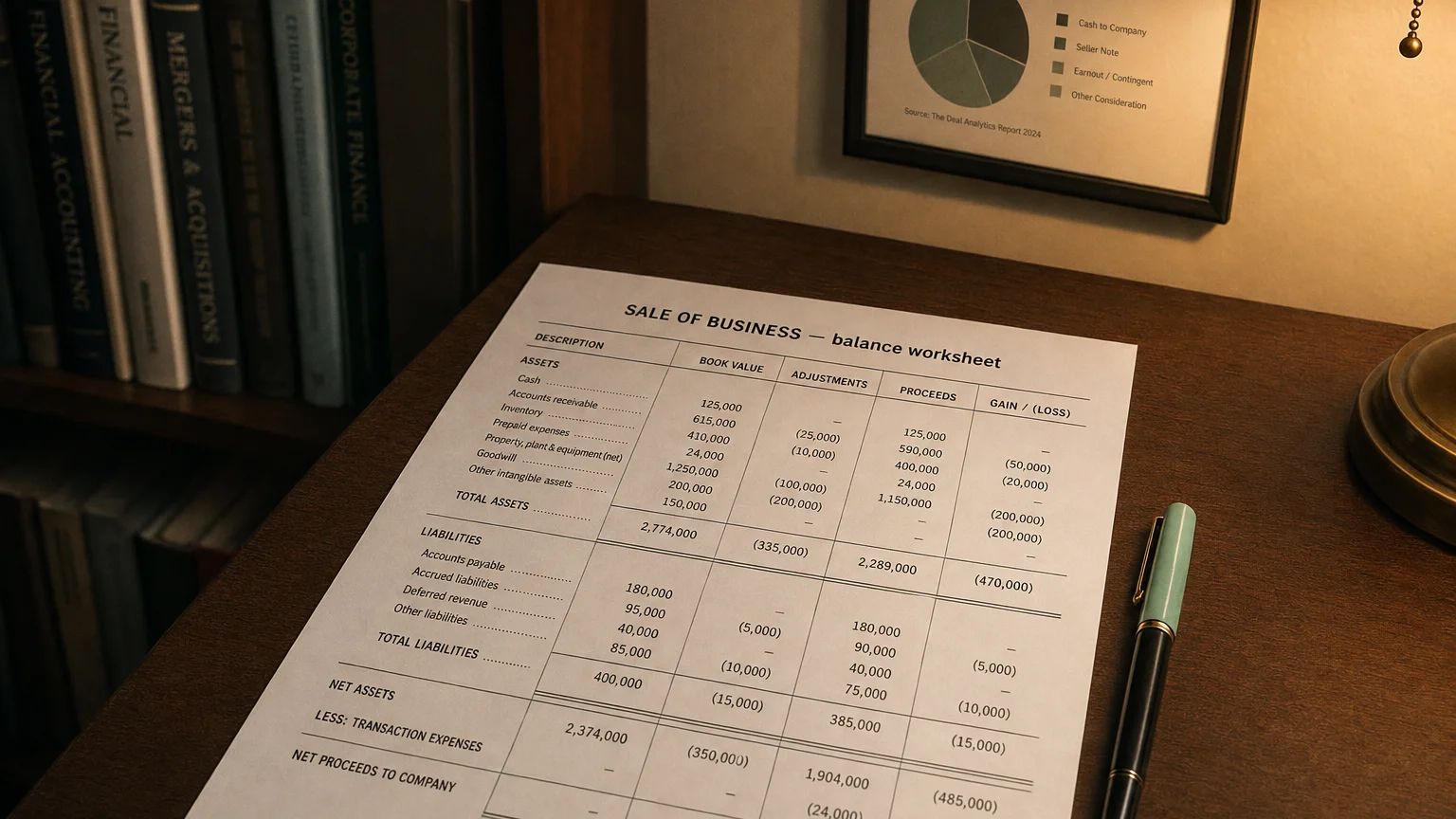
The accounting gain/loss (proceeds minus book value of net assets sold) hits the income statement separately.
If meets discontinued operations criteria, cash flows may be grouped separately.
“When a management with a reputation for brilliance tackles a business with a reputation for poor fundamental economics, it is the reputation of the business that remains intact.”
— Warren Buffett, Chairman & CEO, Berkshire Hathaway Berkshire Hathaway Chairman’s Letter 1985 (1985)
A Real-World Example
Conglomerate decides its consumer electronics division no longer fits strategy.
- Sells division for $800M cash
- Pays $20M advisor/legal fees
- Sale of Business: +800M gross)
- Division net assets book value 300M pre-tax gain in P&L
Massive investing cash boost—often used for debt paydown, buybacks, or new acquisitions.
Common Reasons for Sales
- Refocus on core competencies
- Raise cash to reduce leverage
- Unlock hidden value (‘sum of parts’ higher)
- Exit low-margin or troubled units
- Regulatory/antitrust requirements
- Respond to activist investors
Accounting and Presentation
- Cash inflow in investing activities
- Labeled ‘Sale of Business’ or ‘Proceeds from Disposal of Subsidiary’
- Gross proceeds common; net if costs significant
- Gain/loss in income statement (often ‘Other gains’ or discontinued ops)
- Discontinued ops treatment if material and strategic shift
Working capital true-up or earn-outs may adjust cash later.
Impact on Financials
- Large investing cash inflow
- Removes sold unit’s assets/liabilities
- Future revenue/profit reduced
- Potential margin improvement (if low-margin unit)
- One-time gain boosts earnings
What to Watch For
- Proceeds vs. book value (gain size)
- Use of cash (productive or just balance sheet repair?)
- Revenue/earnings lost from sold unit
- One-time nature (not sustainable)
- Strategic rationale and execution timing
Repeated sales may indicate lack of focus or ongoing issues.
Q · 01 What is Sale Of Business? +