
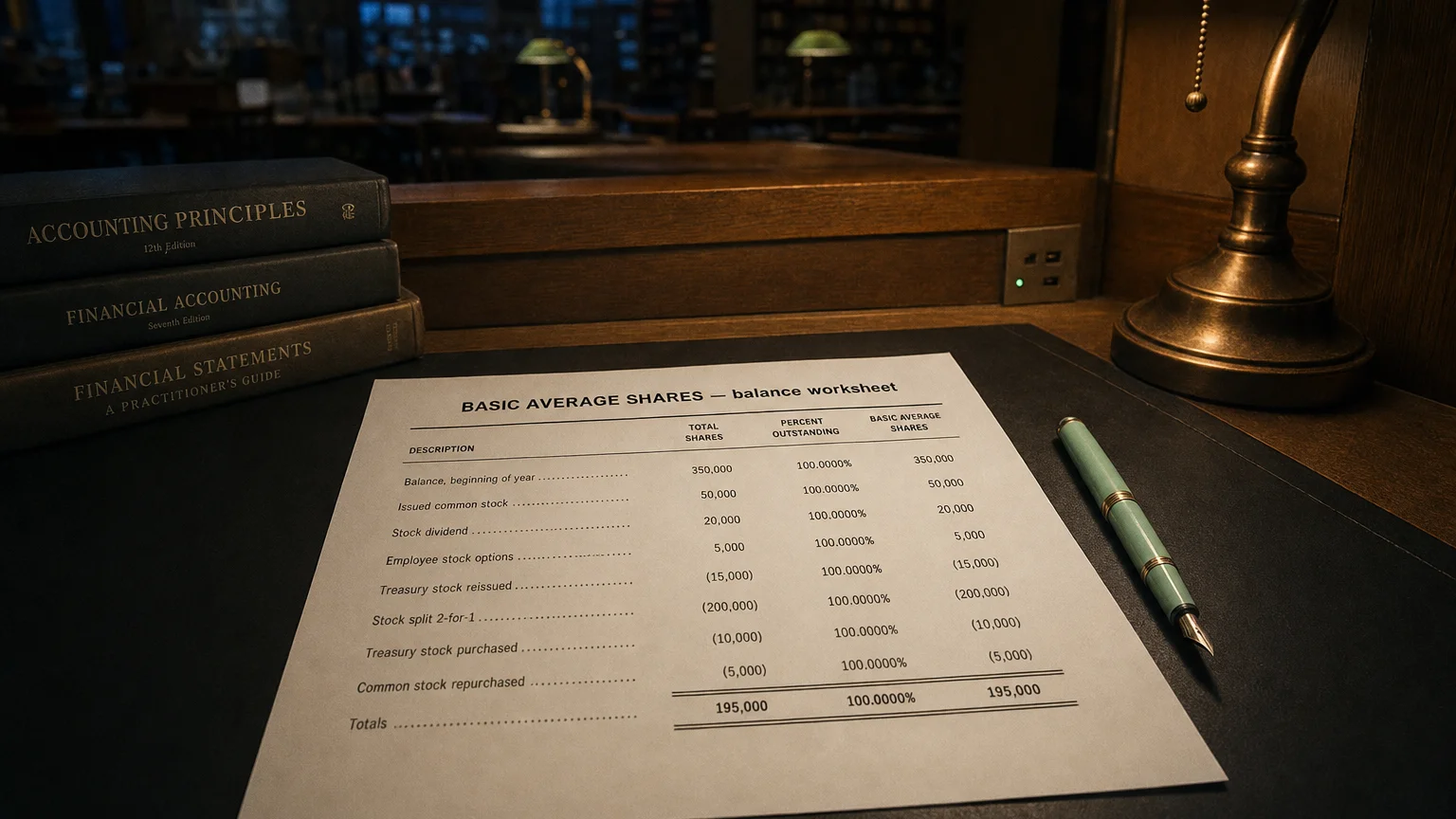
Basic Average Shares—formally basic weighted average shares outstanding—is the time-weighted common share count over a reporting period. It serves as the denominator in basic EPS and excludes potential shares from options, warrants, or convertible securities.
In investing, you get what you don't pay for. Costs matter enormously.

Basic Average Shares (also referred to as basic weighted average shares outstanding) is a figure that represents the average number of common shares a company had outstanding over the reporting period, adjusted for any changes in share count during that time. In simple terms, it’s an average of how many shares were in the hands of shareholders throughout the period, rather than just a snapshot of shares at period-end. “Basic” indicates that this share count is non-dilutive—it excludes any potential extra shares from convertible instruments (like stock options or convertible bonds) that could increase the total shares outstanding.
What Do Basic Average Shares Represent?
Basic average shares represent the weighted average number of a company’s common shares outstanding during an accounting period. Companies often issue or buy back shares, causing the number of shares to fluctuate. Instead of simply using the ending share count, the weighted average accounts for the timing of these changes. For example, if a company repurchases a chunk of its stock on the last day of the year, using the lower year-end share count alone would make EPS look higher than it really was. By weighting shares for the portion of the period they were outstanding, basic average shares ensure the EPS calculation isn’t distorted by such timing effects.
Why Are Basic Average Shares Important?
Basic average shares are important because they are integral to calculating Earnings Per Share (EPS), which is one of the most widely watched indicators of a company’s performance. Using the average number of shares is crucial because it aligns the earnings with the right number of shares that were actually in circulation while those earnings were generated. This prevents companies from “polishing” their EPS by timing share buybacks or issuances. In short, basic average shares ensure that per-share earnings metrics like EPS are calculated on a consistent and fair basis. On an income statement, you’ll typically see the net income, the reported basic EPS, and often the number of basic weighted-average shares used in the calculation, which provides transparency.
“In investing, you get what you don’t pay for. Costs matter enormously.”
— John C. Bogle, Founder, The Vanguard Group Common Sense on Mutual Funds (1999)
How Basic Average Shares Relate to EPS
Basic average shares are directly used to compute Basic EPS. The formula is:
Formula: Basic EPS = Net Income available to common shareholders / Basic Average Shares Outstanding
If a company earned 2.00 per share ($100m / 50m).
Basic vs. Diluted Shares
Basic average shares do not include any potential new shares from things like employee stock options, warrants, or convertible bonds. Those potential shares are considered in a separate calculation called diluted average shares, which is used to calculate Diluted EPS. Diluted average shares will always be equal to or higher than basic average shares.
Q · 01 What are Basic Average Shares? +
Q · 02 Why use a weighted average instead of period-end share count? +
Q · 03 How does Basic Average Shares differ from Diluted Average Shares? +
Q · 04 Where do investors find Basic Average Shares in financial statements? +