Capital Expenditure Reported is the actual cash a company pays to acquire, build, or significantly upgrade long-term physical assets—factories, machinery, equipment. It appears as a cash outflow in the investing section of the cash flow statement.
If you aren't willing to own a stock for ten years, don't even think about owning it for ten minutes.

Capital Expenditure Reported (often abbreviated as CapEx) is the actual cash outflow a company incurs to acquire, build, or significantly improve long-term tangible assets—property, plant, equipment, or sometimes intangibles—that will generate benefits over multiple years. This line appears in the investing section of the cash flow statement and reflects the company’s investment in maintaining or expanding its productive capacity.
What Capital Expenditure Really Means
CapEx is the money a company spends to buy or upgrade the physical tools it needs to run and grow the business—factories, machines, vehicles, IT hardware, buildings.
It’s not about day-to-day costs like salaries or utilities (those are operating expenses). CapEx is betting on the future: ‘This new factory line will produce more widgets for years.’
The ‘reported’ part emphasizes it’s the actual cash spent, not just the accounting accrual.
“If you aren’t willing to own a stock for ten years, don’t even think about owning it for ten minutes.”
— Warren Buffett, Chairman & CEO, Berkshire Hathaway Berkshire Hathaway Chairman’s Letter 1996 (1996)
A Clear Example
An automaker decides to build a new electric vehicle plant.
- Spends $800M on land, construction, robotic assembly lines
- Pays $200M to suppliers over the year
- Cash flow statement: -$1B Capital Expenditure Reported
- Once complete → new capacity producing EVs for decades
That $1B outflow today creates tomorrow’s revenue stream.
Two Main Types of CapEx
Maintenance CapEx
- Replace worn equipment
- Repair facilities
- Keep current operations running
- Required to sustain existing revenue
Growth CapEx
- New factories or stores
- Capacity expansion
- Major technology upgrades
- Drives future revenue growth
Analysts love splitting them—maintenance is ‘must have’, growth is ‘nice to have’.
Where It Shows Up
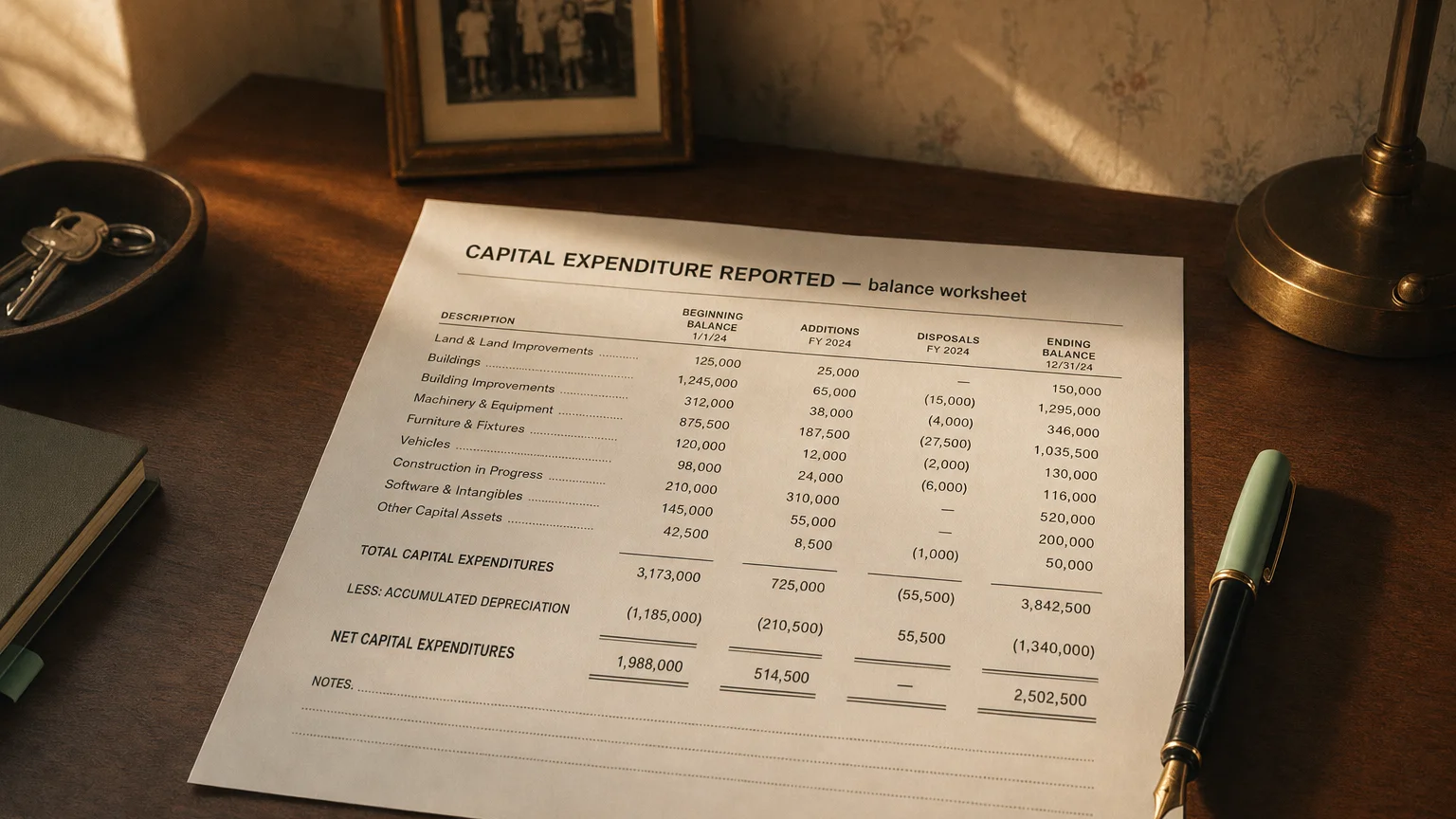
Cash flow statement investing section:
- ‘Capital Expenditure Reported’
- ‘Purchases of Property, Plant and Equipment’
- ‘Additions to Fixed Assets’
- Sometimes netted with asset sales
Footnotes often detail major projects.
Why Companies Spend on CapEx
- Expand production capacity
- Improve efficiency (newer tech = lower costs)
- Enter new markets or products
- Replace obsolete assets
- Meet regulatory or safety standards
- Stay competitive
What to Watch For
- Trend vs. depreciation (above = growing asset base)
- CapEx / Sales ratio (investment intensity)
- Growth vs. maintenance split
- Free Cash Flow impact (CapEx eats cash)
- Industry comparison (capital-intensive higher)
- Sudden drop (cutting investment?)
High CapEx without revenue growth can signal overinvestment or delays.
Q · 01 Where does Capital Expenditure appear on financial statements? +
Q · 02 What is the difference between CapEx and operating expenses? +
Q · 03 How does CapEx affect free cash flow? +
Q · 04 What is the difference between maintenance and growth CapEx? +