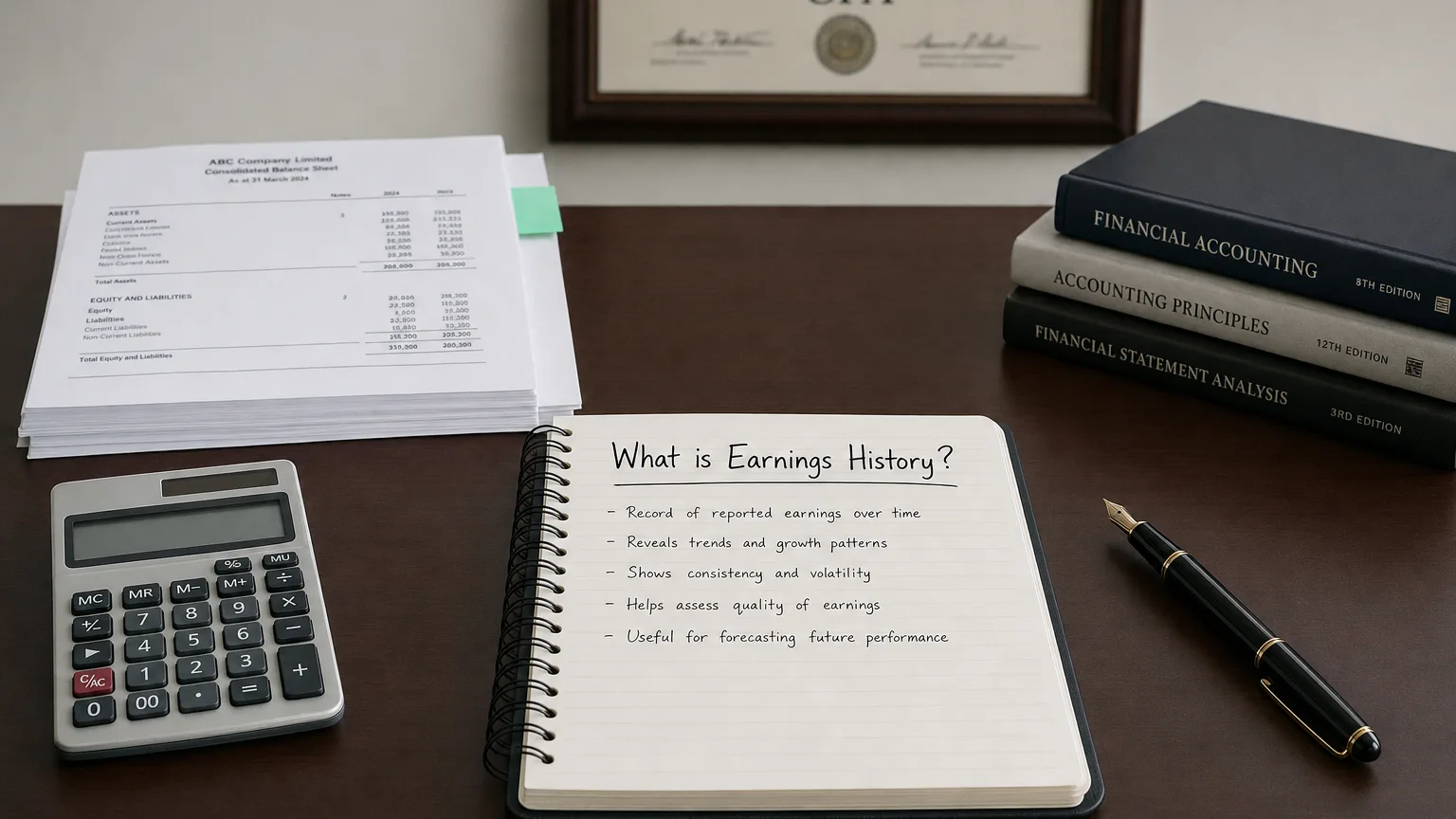
Earnings History is a financial concept covered in this article. How Past Performance Provides Clues About Future Success
If you aren't willing to own a stock for ten years, don't even think about owning it for ten minutes.

A company’s Earnings History is a chronological record of its past profitability, typically presented as a quarter-by-quarter or year-by-year list of its Earnings Per Share (EPS). Think of it as a student’s official academic transcript. A single grade (one earnings report) is interesting, but the entire transcript (the earnings history) tells you the real story. It reveals patterns of consistency, growth, and resilience. By analyzing this history, investors can look beyond the short-term noise of a single quarter and gain a much deeper understanding of a company’s operational discipline and its ability to perform against Wall Street’s expectations over time.
Deconstructing the Earnings History: More Than Just Numbers
When you look up a stock’s earnings history on a financial platform, you’ll typically see a chart or a table that shows four key pieces of data for each of the last several quarters.
 A typical earnings history chart comparing estimated vs. reported EPS.
The Four Key Data Columns
- Period: The fiscal quarter being reported (e.g., Q2 2025).
- EPS Estimate: The consensus earnings per share that Wall Street analysts were forecasting for that quarter.
- Reported EPS: The actual earnings per share that the company officially reported.
- Surprise (%): The percentage by which the reported EPS beat or missed the estimate. A positive percentage is a ‘beat’; a negative percentage is a ‘miss’.
What’s an ‘Earnings Surprise’?
An earnings surprise is the difference between the analyst consensus estimate and the actual reported earnings. A large, positive surprise (e.g., +15%) indicates the company performed significantly better than Wall Street expected, which is a very bullish signal.
The Importance of Consistency: What to Look For
“If you aren’t willing to own a stock for ten years, don’t even think about owning it for ten minutes.”
— Warren Buffett, Chairman & CEO, Berkshire Hathaway Berkshire Hathaway Annual Report (1996)
Analyzing the earnings history isn’t about any single number; it’s about identifying meaningful patterns. A company’s track record reveals a lot about the quality of its management and the predictability of its business.
Key Patterns to Identify
- A History of ‘Beats’: Does the company have a long track record of consistently reporting earnings that are higher than analyst estimates? This is the hallmark of a well-managed company that knows how to set realistic expectations and then over-deliver. It builds immense credibility with investors.
- The Magnitude of Surprises: Are the beats small and consistent (e.g., 1-2% every quarter) or are they large and erratic? While large beats are great, a pattern of consistent, predictable beats can be a sign of a very stable business.
- How the Stock Reacts: Look at what the stock price did on the day after each earnings report. Did the stock rally on beats and fall on misses? Or was the reaction sometimes counter-intuitive (e.g., the stock fell despite a beat)? This can give you clues about the market’s underlying sentiment and what it truly cares about (like revenue growth or future guidance).
- Seasonality: Does the company consistently have a stronger Q4 (holiday season for retailers) or a weaker Q1? Understanding the natural seasonal rhythm of a business can help you contextualize a single quarter’s performance.
How to Use Earnings History in Your Analysis
The earnings history is a powerful tool for due diligence. It helps you verify if a company’s ‘story’ is backed up by a history of actual performance.
Comparing Two Fictional Companies
Company A (Consistent Performer): Has beaten earnings estimates for 15 of the last 16 quarters. The stock tends to grind higher steadily. This suggests a predictable, high-quality business.
Company B (The Gambler): Has a history of huge earnings beats and huge misses. Its stock chart is extremely volatile. This suggests a less predictable, higher-risk business. While you might hit a home run, you could also strike out badly.
Past Performance is Not a Guarantee
The most important rule in investing also applies here. A long history of beating earnings is a fantastic sign, but it does not guarantee the company will beat estimates next quarter. Always combine historical analysis with a forward-looking view of the business, its industry, and the overall economy.