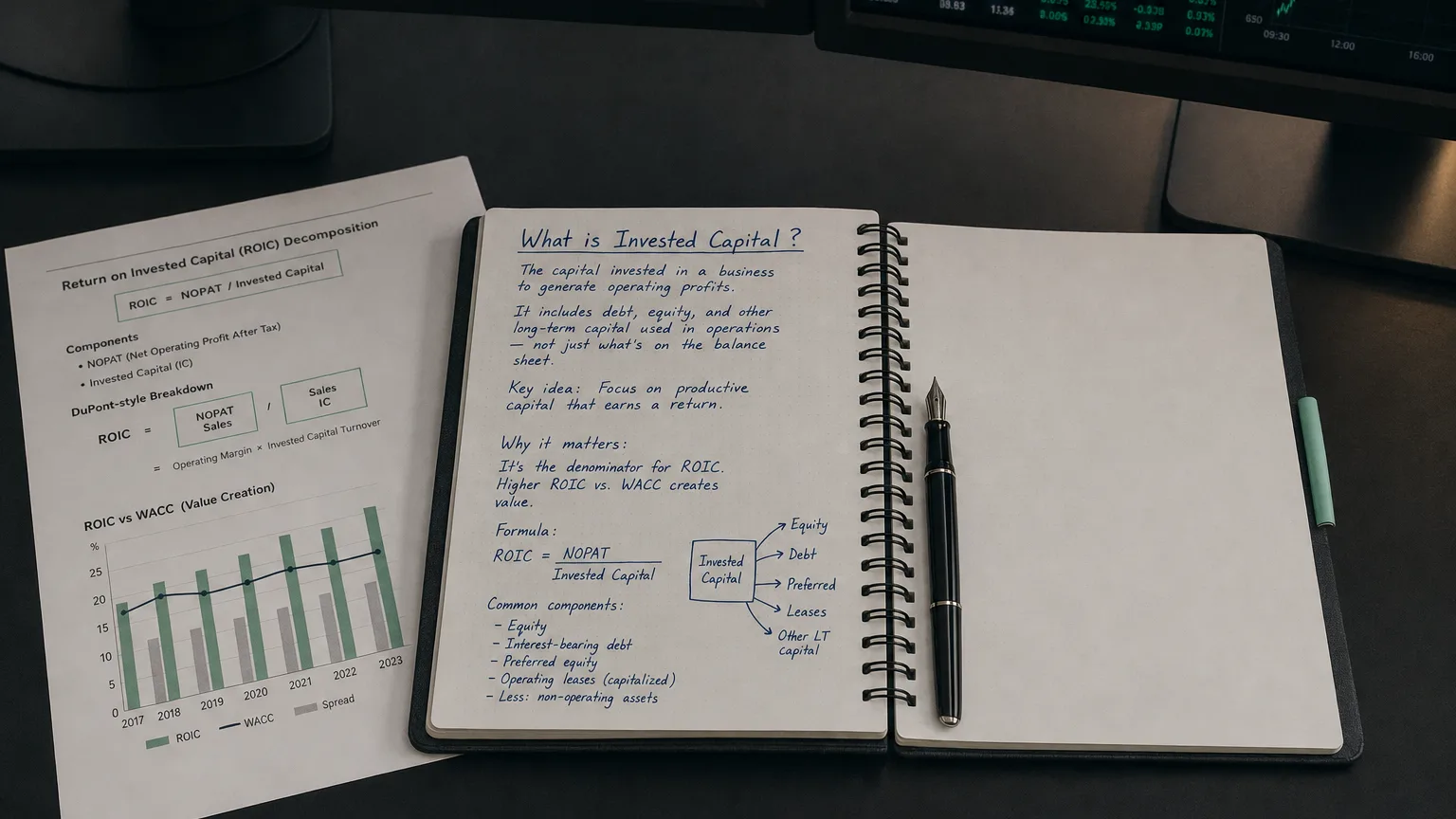
A guide to the total capital provided by a company's investors, how it's calculated, and its role in measuring financial efficiency and value creation.
Should you find yourself in a chronically-leaking boat, energy devoted to changing vessels is likely to be more productive than energy devoted to patching leaks.

Invested Capital is a fundamental concept in corporate finance that represents the total funds investors have committed to a company. In simple terms, it is the money provided by shareholders and debtholders that the business uses to fund its operations and growth. This combined value of equity and interest-bearing debt (including instruments like bonds and capital lease obligations) constitutes the company’s invested capital. Importantly, invested capital is not literally labeled as a single line item on a balance sheet – instead, it’s derived from various balance sheet accounts (debt, equity, etc.). In this guide, we will break down what invested capital represents, why it matters, its typical components, how to calculate it using two common approaches, and how it compares to related metrics like capital employed and total assets.
What Does Invested Capital Represent?
In financial terms, invested capital represents the cumulative investments made in a company by its owners and lenders. It is essentially the portion of the company’s asset base financed by long-term sources of capital (shareholders’ equity and debt). You can think of it in two equivalent ways:
-
Operating perspective (Assets side): The net assets a company needs to run its business – i.e. the assets actively employed in operations (like factories, equipment, and working capital).
-
Financing perspective (Liabilities/Equity side): The total financing provided by investors (creditors and shareholders) to fund those net assets. In other words, it’s the sum of funds raised from equity and debt that are invested into the company’s operations.
Because of double-entry accounting, these two views meet in the middle: the dollars invested by investors are tied up in the assets the company uses. Thus, invested capital is essentially the bridge between the company’s sources of funds and its uses of funds.
Purpose of Invested Capital in a Business
For a company, invested capital serves as the lifeblood for growth and operations. Companies raise this capital to purchase long-term assets (for example, buying land, buildings, machinery) and to fund day-to-day operating needs (such as inventory purchases or covering operating expenses). In essence, it’s the pool of money that enables the business to expand and pursue opportunities. Unlike a short-term bank loan that must be quickly repaid, invested capital (especially equity) can fund projects without immediate cash outflows – for instance, a firm might prefer issuing stock or bonds over bank borrowing to avoid hefty interest or near-term repayments.
From an investor’s perspective, invested capital is crucial because it sets the base on which returns are generated. Analysts and investors look at how effectively a company uses its invested capital by evaluating metrics like Return on Invested Capital (ROIC). A higher ROIC indicates the company is a “value creator” – it’s using the funds from investors efficiently to produce profits. In fact, metrics such as ROIC, Return on Capital Employed (ROCE), and Economic Value Added (EVA) all revolve around how well a firm leverages its invested capital to generate earnings. If a company’s ROIC consistently exceeds its cost of capital (the blended cost of equity and debt), it’s creating shareholder value; if not, it may be destroying value despite having capital available. In summary, invested capital is not just a static figure – it’s closely watched as an indicator of operational efficiency and a company’s ability to turn funding into profits.
Components of Invested Capital
Invested capital typically comprises several key components taken from the balance sheet. Broadly, it includes all long-term funds supplied by investors to the company, adjusted for any assets not used in operations. The main components are:
-
Shareholders’ Equity: This is the owners’ stake in the company. It includes common equity (share capital), preferred equity (if any), and retained earnings (profits reinvested back into the company). In other words, all money that shareholders have put in (through stock purchases or reinvested profits) counts toward invested capital. For example, when a company raises cash by issuing shares, that cash contributes to invested capital as part of equity financing.
-
Debt Capital: These are interest-bearing debt obligations that the company has incurred to finance its operations. It includes short-term borrowings (like short-term loans or notes payable) and long-term debt (such as bonds or long-term loans), as well as capital lease obligations (since leases are essentially a form of financing). Both short- and long-term portions of debt are counted because they represent money lenders have contributed to the business. In practice, analysts often sum all interest-bearing debt – current and non-current – to get “total debt” for invested capital calculations.
-
Other Long-Term Liabilities (Financing equivalents): In some definitions, certain non-debt liabilities that effectively finance operations are also included. A common example is deferred tax liabilities – these arise from accounting timing differences and can be viewed as an interest-free loan from the government, thus part of the capital funding the business. Another example might be minority interests (if the company has consolidated subsidiaries financed partly by outside investors). These items are not always applicable, but when present, they represent additional funds in use and may be added to invested capital for completeness.
-
Non-Operating Assets (to subtract): A critical adjustment in calculating invested capital is to exclude assets not actively used in operations. Chief among these is excess cash. Companies often hold cash or marketable securities beyond what’s needed for routine operations; such idle cash is not “invested” in the business’s core activities. Invested capital is usually calculated net of excess cash – effectively subtracting surplus cash and non-operating investments. This is because including a large cash hoard would overstate the capital actually employed in the business’s operations and understate the efficiency (ROIC). As one analyst put it, “it’s not an ‘operating’ asset, so it should be mostly excluded from invested capital”. Similarly, other non-operating assets like investments in other companies, idle land, or assets held for sale are typically left out of invested capital, since they are not part of the core operational asset base.
In summary, invested capital = Equity + Debt + (other long-term funding) – Non-operating assets. For instance, one simplified formula often used is:
Invested Capital = Total Debt + Total Equity – Excess Cash.
This formula captures the idea that we take all interest-bearing capital from investors and subtract any portion that’s sitting unused as cash. The result is the net capital actively deployed in the business.
Calculating Invested Capital: Operating vs. Financing Approaches
There are two common approaches to calculate invested capital, both yielding the same result if done correctly. One starts from the asset side (operating approach) and the other from the financing side (financing approach) of the balance sheet. Both methods are simply mirror images – one focuses on the uses of capital, and the other on the sources of capital – and they should equate because of the balance sheet equation (Assets = Liabilities + Equity). We’ll outline each approach:
Operating Approach (Net Assets Method)
The operating approach calculates invested capital by summing up the net assets used in operations. It begins with the company’s assets and subtracts certain liabilities that do not represent investor financing. The steps typically are:
-
Net Working Capital (NWC): Start with current operating assets and subtract non-interest-bearing current liabilities. Current operating assets include items like accounts receivable, inventory, and other short-term assets that are used in the business’s operations (often excluding cash or cash equivalents beyond a necessary minimum). Non-interest-bearing current liabilities usually refer to operational liabilities like accounts payable and accrued expenses – these are sources of financing from suppliers and others that cost no interest. The difference is net working capital, which represents the portion of short-term assets that truly requires financing because it isn’t covered by free short-term liabilities. In formula form: NWC = Current Assets (excluding excess cash) – Non-interest-bearing Current Liabilities.
-
Long-Term Operating Assets: Add the net long-term assets that are used in the business. The major component here is Property, Plant & Equipment (PP&E) – the net book value of factories, equipment, and other fixed assets. To this we also add intangible assets that arise from operations or acquisitions, such as goodwill, patents, trademarks, or software. Goodwill and acquired intangibles appear on the balance sheet typically due to acquisitions (they reflect past invested capital used to buy other businesses) and are considered part of the capital employed in the business. We also include any other operating assets not captured above (for example, long-term prepaid expenses or operational long-term investments specific to the business).
-
Sum up Invested Capital: Finally, sum Net Working Capital + Net PP&E + Goodwill/Intangibles + other operating assets. The result is Invested Capital under the operating approach. This total represents all assets that require investor funding to operate the company, after removing assets financed by “free” liabilities. In equation form:
Invested Capital = Net Working Capital + Net Fixed Assets + Goodwill & Intangibles (+ any other operational long-term assets).
For example, if a company’s balance sheet shows $100 of inventory and receivables, $40 of accounts payable, $300 of net fixed assets, and $50 of goodwill from an acquisition (and minimal cash), its invested capital would be calculated as $(100 – 40) + 300 + 50 = $410. This means $410 of investor-supplied funds are tied up in the operations of the business.
Financing Approach (Sources of Capital Method)
The financing approach starts from the liabilities & equity side of the balance sheet. It tallies up all the investor-provided funds (debt and equity) and adjusts for any funding that isn’t deployed in operations. The typical steps are:
-
Total Debt: Sum all interest-bearing debt. This includes short-term debt (such as bank credit lines or current portion of long-term debt) plus long-term debt (bonds, loans, etc.). If the company has lease obligations, their present value can be included here as well (together these form “total debt & leases”). The sum of short- and long-term interest-bearing liabilities gives Total Debt.
-
Total Equity: Determine shareholders’ equity. This will include common stock, additional paid-in capital, retained earnings, and possibly preferred stock or other equity components. In essence, add up all forms of equity capital the company has received and kept (common equity + preferred equity + accumulated profits). If we denote common shareholders’ equity plus any preferred stock as Total Equity, this represents the equity portion of invested capital.
-
Other Long-Term Funding: Add any other long-term liabilities that function as capital. As noted earlier, deferred tax liabilities or certain provisions can be considered here, as they represent funds the company is effectively using (money that will be paid in the far future, if at all). These are added to align with the asset-side approach which included the assets financed by these items. For simplicity, many analyses focus on just debt and equity, but it’s good to be aware of these additional sources.
-
Subtract Non-Operating Cash/Investments: If the company has significant excess cash or non-operational investments, subtract these out. They represent capital raised that is not actually deployed in the operating business. By subtracting this, we ensure the financing approach targets only capital in use. (This step is equivalent to what we did in the operating approach by excluding excess cash from current assets.) For example, if a company’s total debt + equity is $500, but $90 of that is sitting in short-term investments not needed for operations, the invested capital in use would be $410 (the same $410 we’d get from the asset side).
-
Sum up Invested Capital: Now add the components from steps 1–3 (and subtract step 4). In formula form, Invested Capital = Total Debt + Total Equity + Other long-term liabilities – Cash & non-operating investments. In many cases, this reduces to Debt + Equity – Excess Cash, as a practical approximation. Continuing the earlier example, the company’s invested capital via financing side would be the sum of its debt and equity (say $300 debt + $200 equity = $500) minus the $90 excess cash, equaling $410 – matching the asset-side calculation.
Both approaches should arrive at the same invested capital figure as long as they’re applied consistently. It’s worth noting that while the financing approach might seem simpler (just grab total debt and equity from the balance sheet), it can mislead if you omit adjustments. For instance, simply adding debt and equity without subtracting large cash reserves would overstate invested capital in operations. Conversely, forgetting certain funding sources like preferred stock or long-term leases would understate it. That’s why many experts recommend carefully using the operating approach – it forces you to identify which specific assets are funded and ensures you exclude things that shouldn’t count. Ultimately, either method, when done rigorously, yields the invested capital: the total dollars actually supporting the company’s operational assets.
Invested Capital vs. Capital Employed vs. Total Assets
It’s common to compare invested capital with similar balance sheet-based metrics like “capital employed” and “total assets”, as these terms can sound alike but have distinct meanings:
- Capital Employed: This term generally refers to the total capital in use by the business. In many contexts, capital employed is essentially synonymous with invested capital – and often the terms are used interchangeably. A classic definition of capital employed is total assets minus current liabilities. This formula yields the long-term capital investment in the business (since subtracting current liabilities removes the portion of assets financed by short-term, non-investor funding). In practice, that calculation should equal the sum of shareholders’ equity and net debt (debt minus cash), which is one way to describe invested capital. Indeed, one authoritative source notes: *“The sum of fixed assets and working capital is called capital employed. Capital employed is financed by capital invested – i.e. shareholders’ equity and net debt – and thus this sum is equal to capital employed.”*vernimmen.com. In other words, Capital Employed = Invested Capital in value, differing mostly in perspective (capital employed emphasizes the assets side, while invested capital emphasizes the sources of financing side).
This diagram compares the scope of Invested Capital (used in ROIC, left) and Capital Employed (used in ROCE, right). The blue circle represents the capital base for each metric. Invested capital (left) is typically a subset of total capital, focusing on the funds actively deployed in operations. Capital employed (right) covers a broader base – essentially all long-term capital in the business, which in most cases encompasses invested capital plus any non-operational holdings.
However, some nuances exist. As illustrated above, invested capital is effectively a subset of capital employed. Capital employed includes every aspect of long-term capital (all debt and equity financing, whether currently invested in operations or not). Meanwhile, invested capital often excludes “non-active” assets not being used in the business. For example, if a company has significant investments in other companies or excess cash, those would count as part of capital employed (since it’s part of total assets funded by capital) but would be excluded from the invested capital that’s circulating in the business itself. Another difference is in usage: ROCE (Return on Capital Employed) uses capital employed as the denominator, often calculated from a pre-tax operating profit, whereas ROIC uses invested capital (usually post-tax) as the denominator. Because capital employed can include a bit more (like cash or broader assets), ROCE can be seen as a slightly more holistic measure of overall capital utilization, while ROIC zeroes in on core invested funds for operations. In practice, well-defined capital employed and invested capital should converge to a very similar number; differences arise based on whether or not one adjusts for things like excess cash or intangible assets. The key takeaway is that both metrics aim to quantify the long-term capital base of a company – just be clear on the definition being used in any analysis.
- Total Assets: This is the sum of everything the company owns, as shown on the balance sheet. Total assets will naturally be greater than or equal to invested capital, because it includes assets financed by all sources, including short-term liabilities. For instance, accounts payable finance a portion of current assets but wouldn’t be counted in invested capital (since payables are not investor-supplied capital), yet those current assets still appear in total assets. Total assets also include any non-operating or excess assets. Thus, total assets = invested capital + current liabilities (like payables) + any non-operating assets excluded from invested capital. When comparing metrics, Return on Assets (ROA) uses total assets in the denominator, which gives a broader measure of efficiency including all assets regardless of financing. ROA tends to be lower than ROIC for a profitable company, since the asset base in ROA is larger (it counts assets financed by payables and other non-capital sources as well). Analysts sometimes prefer ROIC or ROCE over ROA because those focus on the capital at risk from investors. In summary, total assets is a raw number straight from the balance sheet, while invested capital (or capital employed) is a refined number that zeroes in on the assets that require long-term funding.
To highlight the differences: imagine a company with $100 in total assets, $20 in short-term payables, and $10 in surplus cash sitting idle. Its capital employed (or invested capital) might be roughly $80 (that is, $100 total assets – $20 payables = $80, and if we exclude the $10 excess cash, we get $70 of truly productive invested capital). Total assets would remain $100. An investor examining efficiency would see that using $70–$80 of invested capital the company generates profit, whereas $100 of total assets includes some assets not contributing to operations or financed “freely.” This illustrates why invested capital/ capital employed metrics are often favored for evaluating operational return and efficiency – they give a cleaner view of how the money from investors is put to work.
Key Takeaways
-
Invested Capital is the total investor-supplied capital in a company, combining shareholders’ equity and debt financing. It represents the funds used to purchase operating assets and run the business.
-
It is not a single line on the balance sheet but rather derived from balance sheet items. Invested capital can be calculated from the asset side (net operating assets) or the financing side (debt + equity minus non-operational assets), and both approaches should yield the same figure.
-
The purpose of invested capital is to fund the company’s operations and growth (buying equipment, funding working capital, etc.), and its significance lies in how efficiently it’s used. Metrics like ROIC evaluate how much profit is generated per dollar of invested capital, indicating whether a company is creating value with the money investors have put in.
-
Typical components of invested capital include shareholders’ equity (common/preferred stock and retained earnings) and interest-bearing debt (loans, bonds, leases) – essentially all long-term sources of funding. Analysts usually exclude excess cash or non-operating investments to focus on capital actually deployed in the business.
-
There are two calculation methods:
-
Operating Approach: Sum the company’s net operating assets – e.g. (Current operating assets – current operating liabilities) plus net fixed assets, goodwill, and other intangibles – to get invested capital. This focuses on the assets that need funding.
-
Financing Approach: Sum all interest-bearing debt + equity (and any equivalent funding sources like deferred tax liabilities or preferred stock), then subtract any non-operational cash/investments, to arrive at invested capital. This focuses on sources of funds from investors.
-
-
Capital Employed vs. Invested Capital: These are closely related terms. Capital employed typically means total assets minus current liabilities (or equivalently equity plus debt minus cash), which in practice equates to invested capital for a companyvernimmen.com. Some definitions consider invested capital as the portion of capital employed that is actively used in the business (excluding idle assets), making invested capital a more refined subset of capital employed.
-
Total Assets vs. Invested Capital: Total assets include all assets of the firm, regardless of how they’re financed. Invested capital is narrower, excluding portions of assets financed by short-term liabilities or not used in operations. Therefore, ROA (with total assets) gives a broader picture of efficiency (including all assets), while ROIC/ROCE (with invested capital/capital employed) hone in on the efficiency of the capital actually at stake from investors.
By understanding invested capital, one gains insight into how a company is funded and how that funding is deployed. It’s a key building block for analyzing corporate performance – allowing students and practitioners of corporate finance to assess whether a firm’s investments are paying off and how its financial structure supports its strategy. Armed with the concepts of invested capital and related metrics, you can better evaluate a company’s financial health and its capacity to generate value from the money entrusted to it.
Sources: The information and definitions above were synthesized from corporate finance educational resources and financial analysis references, including the Corporate Finance Institute, Investopedia, and expert insights by financial analysts, among others, to ensure technical accuracy and up-to-date context.

Q · 01 What is Invested Capital? +