
Cash and cash equivalents (CCE) are a company's most liquid assets, including physical currency, demand deposits, and short-term investments with original maturities of 90 days or less. CCE is the first line item under current assets and measures immediate liquidity.
Pennies don't fall from heaven, they have to be earned here on earth.
Cash and Cash Equivalents (CCE) are the most liquid assets on a company’s balance sheet. “Cash” includes currency (cash on hand, coins) and demand deposits (bank checking or savings accounts). “Cash equivalents” are very short‐term, highly liquid investments that can be quickly converted into a known amount of cash with negligible risk of loss. Accounting standards from both IFRS and US GAAP define cash equivalents as investments with original maturities of generally three months or less.
Key Characteristics of Cash Equivalents
To be classified as a cash equivalent, an investment must meet several strict criteria to ensure it is almost as good as cash itself.
- Short-Term Maturity (≈3 months or less): The investment must have an original maturity of 90 days or less. This ensures that changes in interest rates will have a negligible effect on its value.
- High Liquidity: The asset must be easily and quickly convertible into a known amount of cash. This requires an active market or immediate redemption features.
- Insignificant Risk of Value Change: Due to their short maturity, these assets carry minimal price risk. This generally excludes volatile instruments like stocks or long-term bonds.
- Readily Convertible to a Known Amount of Cash: The combination of short maturity and high liquidity ensures the company knows almost exactly how much cash it will receive upon conversion.
Equity securities are generally excluded from cash equivalents unless they are, in substance, equivalent to cash, such as preference shares acquired shortly before a specified redemption date.
“Pennies don’t fall from heaven, they have to be earned here on earth.”
— Margaret Thatcher, Prime Minister of the United Kingdom (1979-1990) Speech at Lord Mayor’s Banquet, London (1979)
Common Examples
Businesses typically group a variety of highly liquid items under the ‘Cash and Cash Equivalents’ line item.
What’s Included in CCE?
Presentation on the Balance Sheet
On the balance sheet (or statement of financial position), cash and cash equivalents appear under current assets. It is standard practice for companies to list “Cash and Cash Equivalents” as a single, combined line item at the very top, reflecting its status as the most liquid asset.
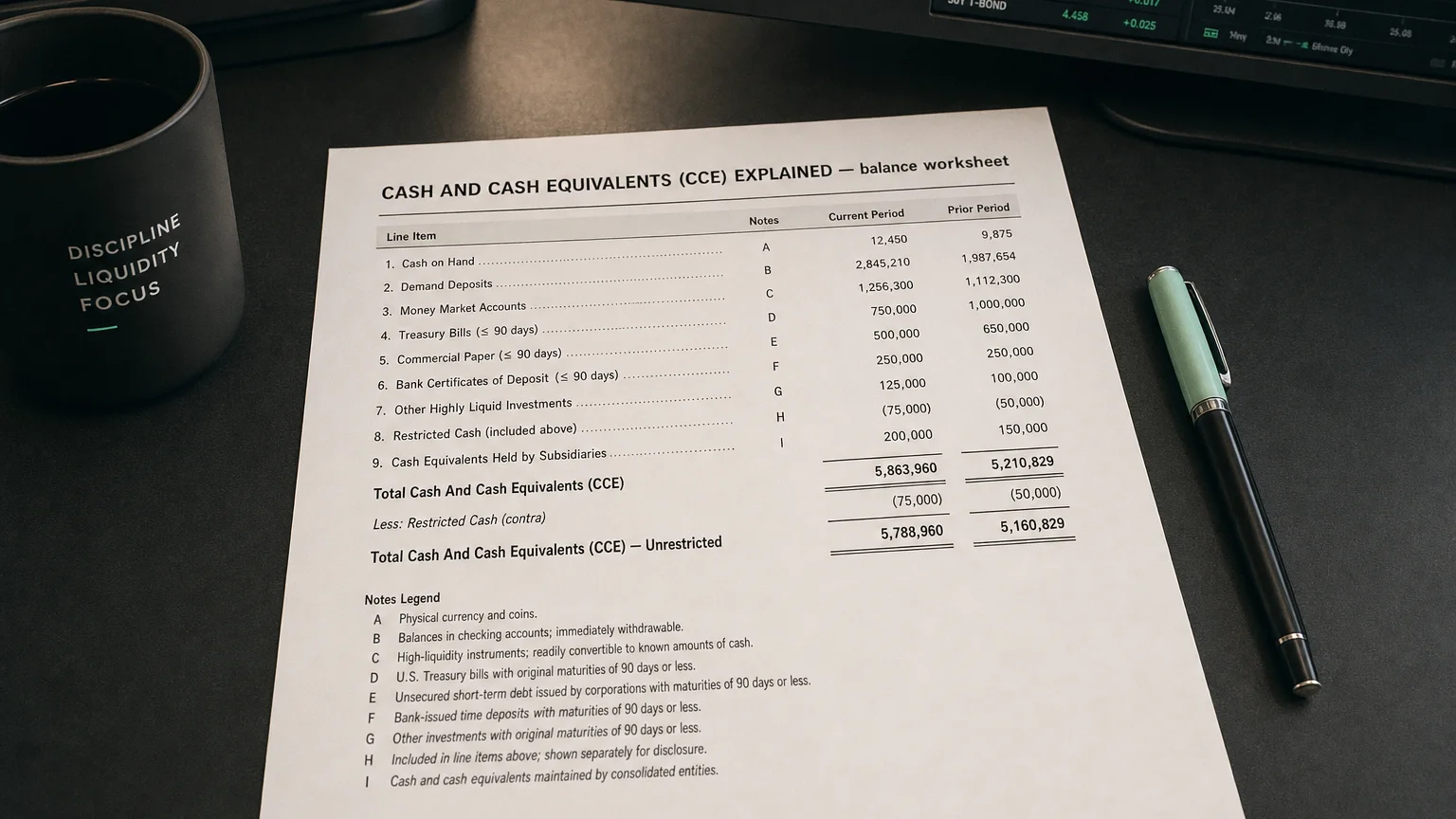
Sample Balance Sheet Snippet
It is important to note that any restricted cash—funds that are not readily available for general use—must be disclosed separately from CCE, even if they are included in the total cash figure on the balance sheet.
Importance for Financial Health
Cash and cash equivalents are a key indicator of a company’s liquidity—its ability to meet short‐term obligations. These assets can be used immediately to pay bills, payroll, and other expenses, serving as a critical safety buffer.
Cash is King
As many investors say, “cash is king.” A company can be profitable on paper but still fail if it lacks sufficient cash to pay its bills. CCE represents the money a company has immediately available to ensure smooth operations.
Analysts, lenders, and investors watch CCE levels closely. A healthy balance suggests strong short-term solvency, while a low balance can raise red flags about funding needs. CCE is a fundamental component of key liquidity ratios, such as the current ratio and quick ratio, which help stakeholders assess whether a company can pay its debts in the near term.
Q · 01 What qualifies as a cash equivalent? +
Q · 02 Where does CCE appear on the balance sheet? +
Q · 03 Why do analysts monitor cash and cash equivalents? +