
Purchase of Investment Properties is a financial concept covered in this article. Cash Outflows for Acquiring Investment Real Estate
No asset is so good that it can't become a bad investment if bought at too high a price. And there are few assets so bad that they can't be a good investment when bought cheap enough.
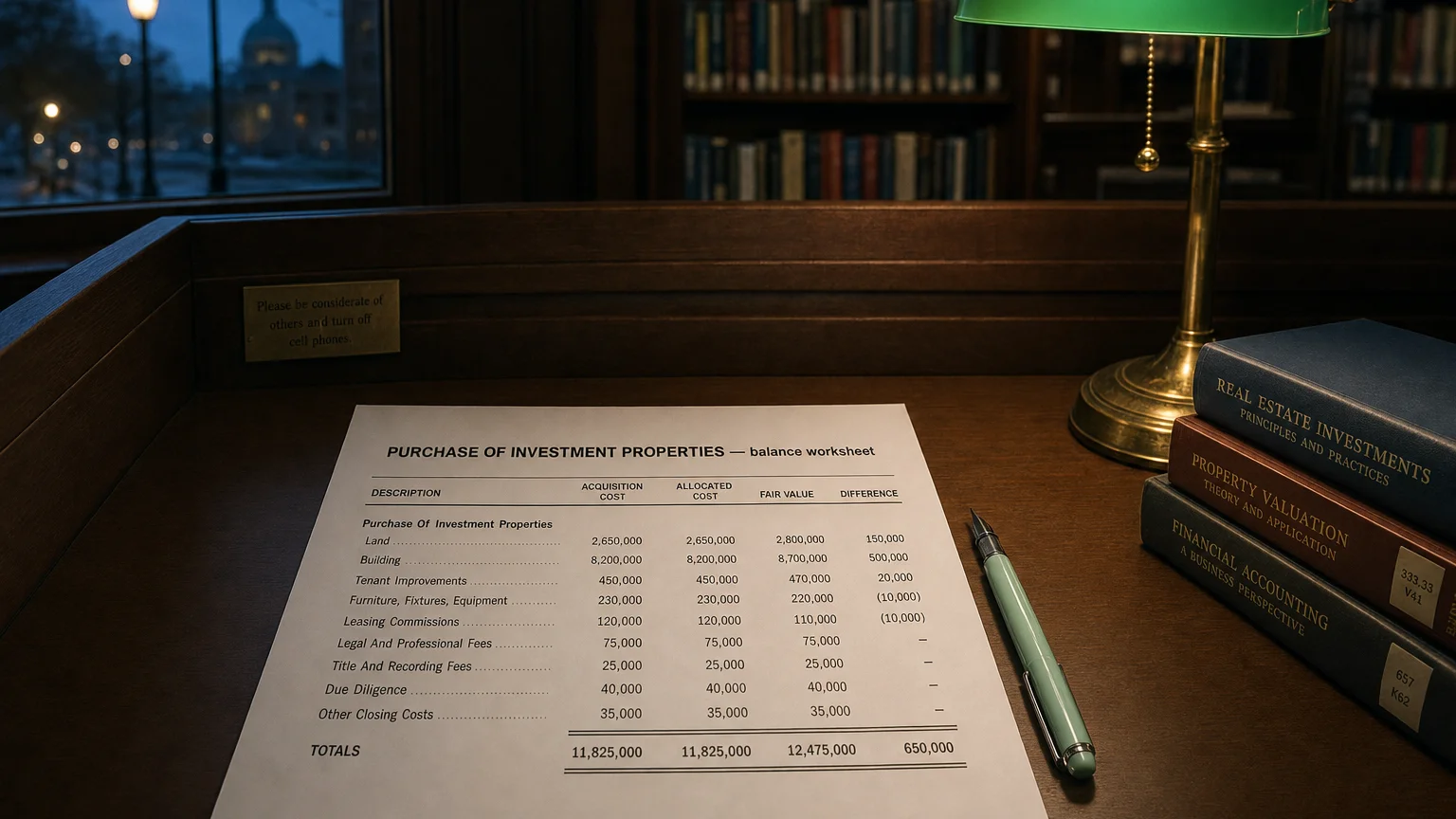
Purchase of Investment Properties is the cash spent to acquire new real estate assets classified as investment properties—land or buildings held primarily for rental income or capital appreciation (or both), not for operational use. This outflow appears in the investing section of the cash flow statement and reflects expansion or repositioning of the company’s investment property portfolio.
What It Represents
Purchase of Investment Properties is the cash paid to buy or develop new properties intended for investment purposes.
- Acquisition of existing buildings or land
- Development costs for new investment properties
- Direct transaction costs (legal, due diligence, transfer taxes)
- Capitalized interest during construction (if qualifying)
It’s the outflow counterpart to sales of investment properties.
Only under IFRS IAS 40—US GAAP treats all real estate purchases as PP&E.
“No asset is so good that it can’t become a bad investment if bought at too high a price. And there are few assets so bad that they can’t be a good investment when bought cheap enough.”
— Howard Marks, Co-Chairman, Oaktree Capital Management Oaktree Memo: ‘The Most Important Thing’ (2003)
A Practical Example
A property company wants to expand its retail portfolio.
- Buys a shopping center for $250M cash
- Pays $8M in legal and transfer fees
- Purchase of Investment Properties: -$258M outflow
- Investment Properties asset increases by $258M
Cash leaves, but long-term rental income potential rises.
Common Reasons for Purchases
- Portfolio expansion in growing markets
- Acquire higher-yielding or better-located assets
- Diversify property type or geography
- Replace sold properties (recycling capital)
- Take advantage of low prices or interest rates
- Development of new investment-grade properties
Accounting and Presentation
- Cash outflow in investing activities
- Labeled ‘Purchase of Investment Properties’ or ‘Acquisitions of Investment Property’
- Includes direct costs (not financing fees)
- Often netted with sales for ‘Net Investment Properties’ line
- Capitalized to Investment Properties asset
Fair value model: Subsequent revaluation changes to P&L.
Impact on Financials
- Significant investing cash outflow
- Increases Investment Properties asset balance
- Future rental income and depreciation (cost model)
- Potential fair value gains (fair value model)
- May require debt financing
What to Watch For
- Size relative to cash flow (sustainable growth?)
- Trend (accelerating acquisitions?)
- Relation to sales (net buyer or balanced?)
- Yield on acquired properties
- Financing source (debt vs. sales proceeds)
Heavy purchases without offsetting sales can pressure liquidity.
Q · 01 What is Purchase Of Investment Properties? +