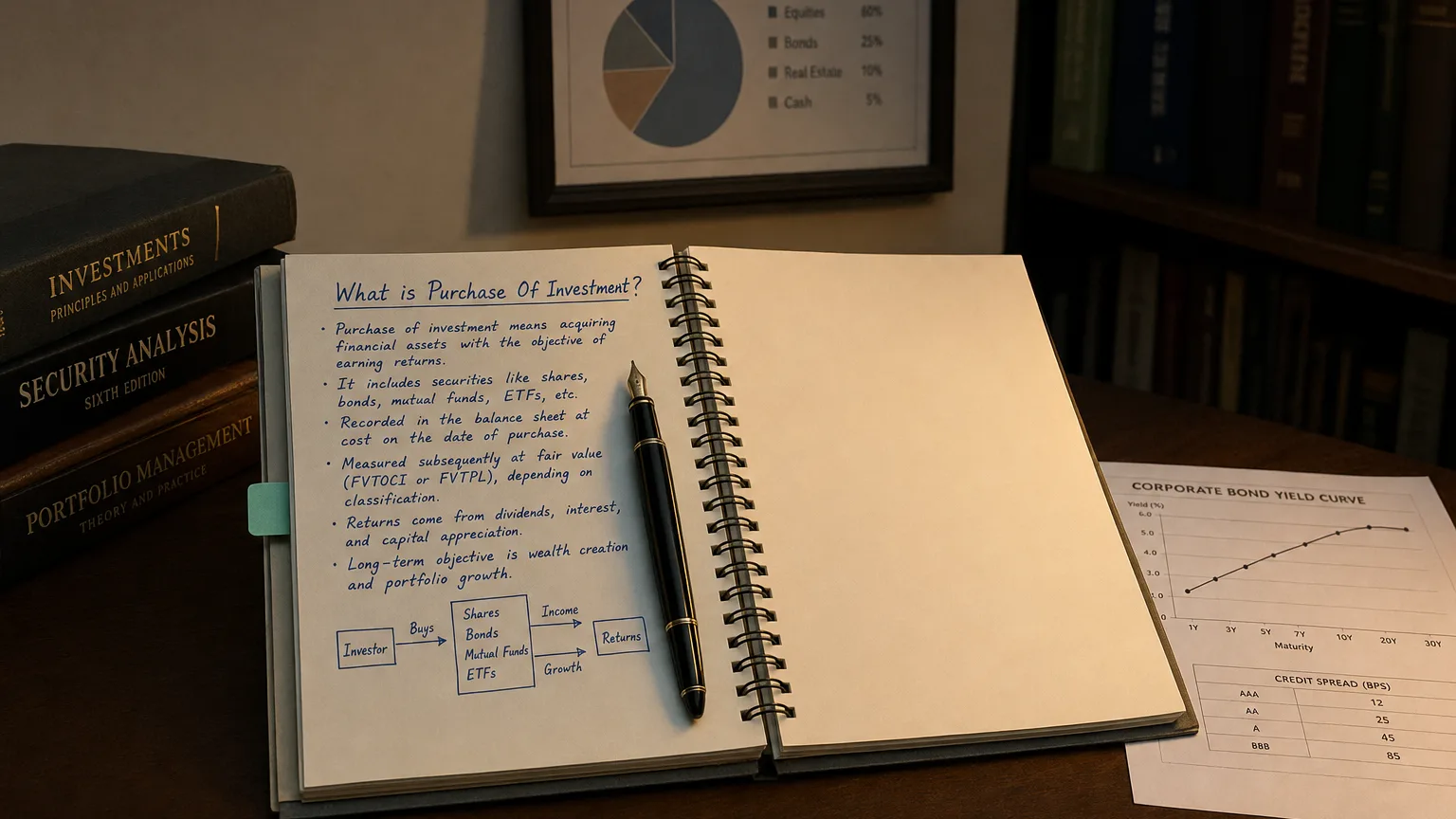
A key investing activity representing the cash a company spends to acquire financial assets like stocks and bonds, or physical assets like property and equipmen
If you aren't willing to own a stock for ten years, don't even think about owning it for ten minutes.

On a cash flow statement, “Purchase of Investments” refers to cash spent by a company to acquire investment assets. In simple terms, it means the business is using its cash to buy investments - for example, purchasing stocks, bonds, or other financial securities, as well as physical assets like property and equipment. This is recorded as part of the company’s investing activities. Whenever a company buys an investment with cash, it reduces the company’s cash on hand because money is flowing out to make the purchase.
Reporting and Types of Investments
The purchase of an investment is always recorded as a cash outflow in the Investing Activities section of the cash flow statement, typically shown as a negative number or in parentheses. This section tracks all cash used for or generated from a company’s long-term assets and investments.
Types of Investments Included
- Equity Securities: Purchasing stocks or ownership stakes in other companies.
- Debt Securities: Buying financial instruments like corporate bonds or government Treasury bills.
- Long-Term Assets (Capital Expenditures): Although often itemized separately as ‘Purchase of PP&E,’ this is a form of investment in the business’s own productive capacity.
- Acquisitions of Businesses: Using cash to buy another company or a controlling stake in one.
- Intangible Assets: Acquiring assets like patents, trademarks, or software licenses.
“If you aren’t willing to own a stock for ten years, don’t even think about owning it for ten minutes.”
— Warren Buffett, Chairman & CEO, Berkshire Hathaway Berkshire Hathaway Chairman’s Letter 1996 (1996)
Strategic Reasons for Purchasing Investments
Companies purchase investments for several strategic and financial reasons, all aimed at increasing value over the long term.
- To Generate a Return on Excess Cash: A primary motive is to put idle cash to work. Investing surplus funds in marketable securities allows a company to earn interest, dividends, or capital gains.
- For Growth and Long-Term Gains: Investing in new assets (CapEx) or acquiring other companies is fundamental to expanding operations, increasing revenue, and driving future profits.
- For Strategic Asset Allocation: Companies invest to manage their resources, diversify holdings, and balance risk. A cash-rich tech company, for example, might hold a large portfolio of short-term securities to maintain liquidity while still earning a return.
How to Interpret Significant Investment Purchases
A large cash outflow for ‘Purchase of Investments’ provides important clues about a company’s strategy and financial health.
A Sign of Reinvestment, Not a Loss
It is crucial to understand that a large negative figure here is not a business loss. It represents a deliberate choice to deploy cash into assets that are expected to generate future value. A healthy, growing company is expected to have significant cash outflows for investments.
Potential Interpretations
- Indication of Growth Initiatives: A large outflow often signals that the company is in growth mode—building new facilities, upgrading technology, or acquiring competitors.
- Efficient Use of Excess Cash: For a cash-rich company, a large purchase of marketable securities indicates that management is proactively managing its balance sheet to earn a return on otherwise idle cash.
- Context is Key: To properly interpret the outflow, analysts consider it alongside operating cash flow. If a company is generating strong cash from its operations, using it for investments is a healthy sign. If it’s borrowing heavily to fund investments, the expected return on those investments becomes more critical.
Example on a Cash Flow Statement
A company’s cash flow from investing activities might show:
- Purchase of property, plant and equipment: ($150,000)
- Purchase of investments: ($50,000)
- Proceeds from sale of investments: $30,000
Here, the (150,000) spent on its own operational assets (CapEx), but both are cash outflows in the investing section.