
Industry Analysis is a financial concept covered in this article. How a Company's Industry Defines Its Opportunities and Challenges
You can't take the same actions as everyone else and expect to outperform.
An Industry is a group of companies that are engaged in the same primary business activity. Think of the entire economy as a giant library. The Sectors are the main sections (like ‘Technology,’ ‘Healthcare,’ ‘Finance’), and the Industries are the specific shelves within those sections (like ‘Software,’ ‘Pharmaceuticals,’ ‘Banking’). Understanding a company’s industry is absolutely critical because a company’s success is heavily influenced by the ‘neighborhood’ it lives in. A brilliant company in a dying industry faces a constant uphill battle, while even an average company in a booming industry can thrive. Industry analysis provides the context necessary to properly evaluate a stock’s potential.
The GICS Framework: How Industries Are Classified
To bring order to the chaos of the market, financial data providers use a standardized hierarchy to classify companies. The most widely used system is the Global Industry Classification Standard (GICS), developed by MSCI and S&P Dow Jones Indices. It’s a four-tiered system that gets progressively more specific.
The GICS Hierarchy
- 1. Sector: The broadest category. There are 11 official GICS sectors (e.g., Information Technology, Health Care).
- 2. Industry Group: A more specific grouping within a sector (e.g., within Technology, you have ‘Software & Services’).
- 3. Industry: This is the level we’re focused on. It’s a specific business activity (e.g., within ‘Software & Services,’ you have the ‘Software’ industry).
- 4. Sub-Industry: The most granular level (e.g., within ‘Software,’ you have ‘Application Software’ and ‘Systems Software’).
Example: Classifying Microsoft (MSFT)
Sector: Information Technology
Industry Group: Software & Services Industry: Software Sub-Industry: Application Software
“You can’t take the same actions as everyone else and expect to outperform.”
— Howard Marks, Co-Chairman, Oaktree Capital Management Oaktree Memo: ‘Dare to Be Great’ (2006)
Why Industry Analysis is a Crucial First Step
A famous saying from legendary investor Warren Buffett is to look for ‘great businesses with a durable moat.’ That ‘moat’—or competitive advantage—is often defined by the structure of the industry itself. A company’s industry determines the fundamental rules of the game it has to play.
A Rising Tide Lifts All Boats
The overall health and growth prospects of an industry can often be more important than the performance of any single company within it. Investing in the fifth-best software company in a booming industry might be more profitable than investing in the absolute best railroad company in a stagnant one. The industry’s ‘tailwind’ provides a powerful boost.
Q: What frameworks are used for industry analysis?
The most famous academic framework is Porter’s Five Forces. It’s a model for analyzing an industry’s competitive intensity and, therefore, its attractiveness. The five forces are: 1) Threat of new entrants, 2) Bargaining power of buyers, 3) Bargaining power of suppliers, 4) Threat of substitute products, and 5) Rivalry among existing competitors.
How to Use Industry Data in Your Analysis
Smart investors use industry analysis to contextualize a company’s performance and identify both opportunities and hidden risks.
A Practical Investor’s Workflow
- Identify the Industry and Its Growth Rate: When you first look at a stock, immediately identify its specific industry. What is the consensus forecast for the industry’s growth over the next 5 years? This sets your baseline.
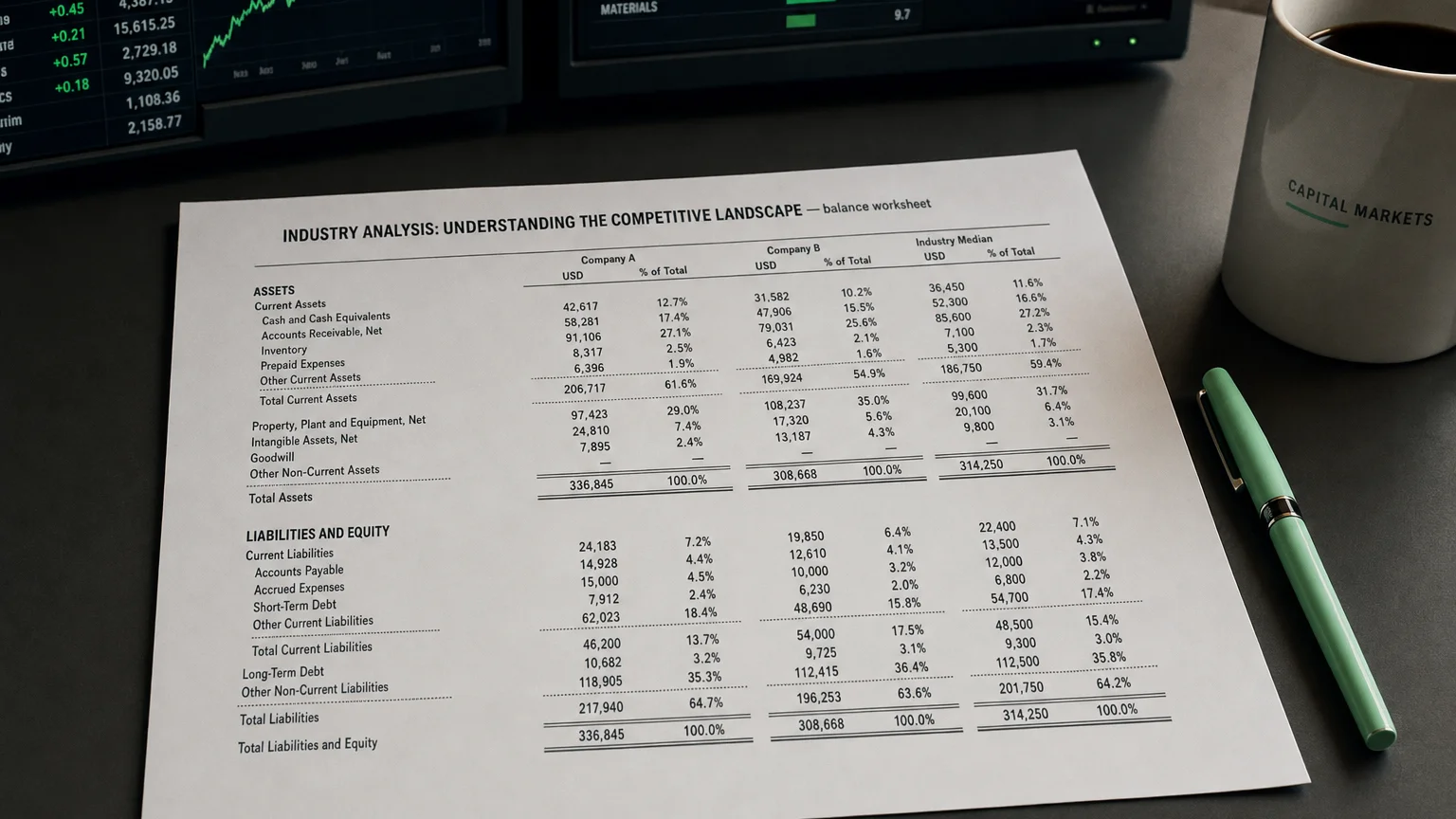
- Compare the Company to its Peers: This is the most important step. How does your company’s performance (e.g., revenue growth, profit margins) stack up against its direct competitors in the same industry? A company with a 30% profit margin might look amazing on its own, but if the industry average is 40%, it’s actually an underperformer.
- Identify Industry Leaders and Laggards: Within every industry, there are leaders and laggards. By comparing key metrics, you can determine if the company you’re analyzing is a dominant player or one that is struggling to keep up.
- Understand Industry-Specific Risks: Every industry has unique risks. For pharmaceutical companies, it’s the risk of a clinical trial failing. For airlines, it’s the price of jet fuel. For software companies, it’s the threat of a disruptive new technology. You must understand these risks before investing.
Q · 01 What is Industry Analysis? +