What Is a Balance Sheet? Assets, Liabilities & Equity
Understand the balance sheet — the snapshot of a company's financial position. Learn how assets, liabilities, and shareholders' equity are structured and what
Overview
Understand the balance sheet — the snapshot of a company's financial position. Learn how assets, liabilities, and shareholders' equity are structured and what
Introduction
A balance sheet answers a simple but powerful question: what does this company own and what does it owe — right now? As one of the three primary financial statements (alongside the income statement and cash flow statement), the balance sheet provides a point-in-time snapshot of financial health.
Every balance sheet is governed by the fundamental accounting equation:
Assets = Liabilities + Shareholders' Equity
This equation must always balance. Every dollar of assets is financed either by borrowed money (liabilities) or by owner investment and retained earnings (equity).
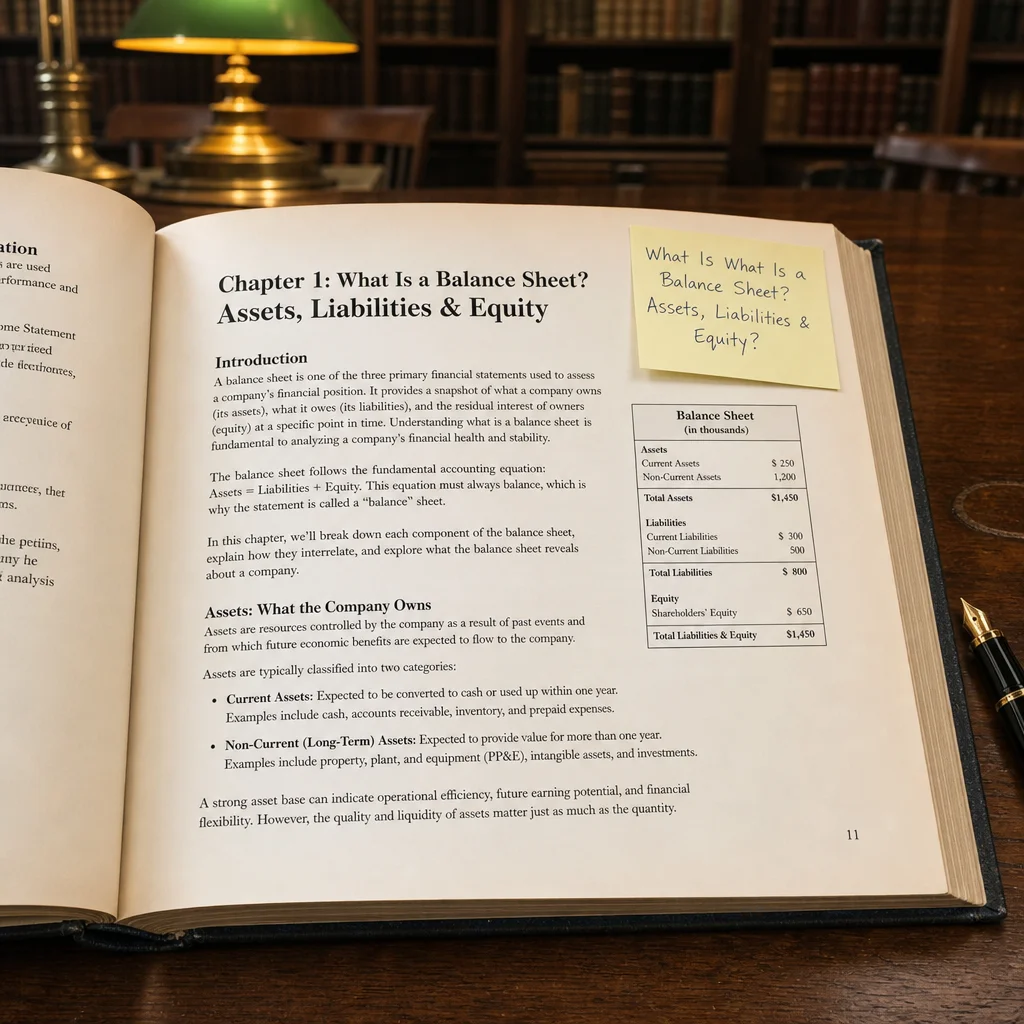
Assets: What the Company Owns
Assets are classified by how quickly they can be converted to cash.
Current Assets (within 12 months):
- Cash and cash equivalents
- Accounts receivable (money owed by customers)
- Inventory
- Prepaid expenses
Non-Current Assets (long-term):
- Property, plant, and equipment (PP&E)
- Intangible assets (patents, trademarks, goodwill)
- Long-term investments
The ratio of current to non-current assets reveals much about the operating model — capital-intensive businesses (manufacturing, utilities) carry large PP&E; asset-light software businesses hold mostly cash and receivables.
"In the short run, the market is a voting machine. In the long run, it is a weighing machine."
— Benjamin Graham, Author, The Intelligent Investor Security Analysis (1934)
<!-- quote-id: graham-002 verified -->
Liabilities: What the Company Owes
Liabilities are split along the same time horizon.
Current Liabilities (due within 12 months):
- Accounts payable (owed to suppliers)
- Short-term debt and current portion of long-term debt
- Accrued expenses
Long-Term Liabilities:
- Long-term debt (bonds, term loans)
- Deferred tax liabilities
- Operating lease obligations
High short-term liabilities relative to current assets can signal a liquidity risk. The current ratio (Current Assets ÷ Current Liabilities) is the standard quick-look measure: a ratio above 1.0 indicates the company can cover near-term obligations.
Shareholders' Equity: The Owner's Stake
Equity represents the net worth attributable to shareholders:
- Common stock and additional paid-in capital
- Retained earnings — accumulated profits not paid as dividends
- Treasury stock — shares repurchased by the company (reduces equity)
When cumulative losses exceed paid-in capital, equity turns negative — a red flag in most industries, though some capital-allocation models intentionally run negative book equity (e.g., share-buyback-heavy companies like some consumer staples).
Key Ratios Derived from the Balance Sheet
| Ratio | Formula | What It Measures |
|---|---|---|
| Current Ratio | Current Assets ÷ Current Liabilities | Short-term liquidity |
| Debt-to-Equity | Total Debt ÷ Total Equity | Financial leverage |
| Book Value per Share | Total Equity ÷ Shares Outstanding | Intrinsic value floor |
| Asset Turnover | Revenue ÷ Total Assets | Operational efficiency |
Frequently Asked Questions
What is a balance sheet?
A balance sheet is a financial statement that shows a company's assets, liabilities, and shareholders' equity at a specific point in time. It follows the fundamental equation: Assets = Liabilities + Equity.
What are the three main sections of a balance sheet?
The three sections are: (1) Assets — what the company owns, divided into current and non-current; (2) Liabilities — what the company owes, also split into current and long-term; (3) Shareholders' Equity — the residual interest representing owners' claim on assets after liabilities are settled.
What is the difference between current and non-current assets?
Current assets are expected to be converted to cash within one year (e.g., cash, accounts receivable, inventory). Non-current assets are long-term holdings like property, equipment, and intangible assets that provide value over multiple years.
How do investors use the balance sheet?
Investors use the balance sheet to assess liquidity (current ratio, quick ratio), leverage (debt-to-equity ratio), and book value per share. A strong balance sheet — with manageable debt and ample liquid assets — signals financial stability.