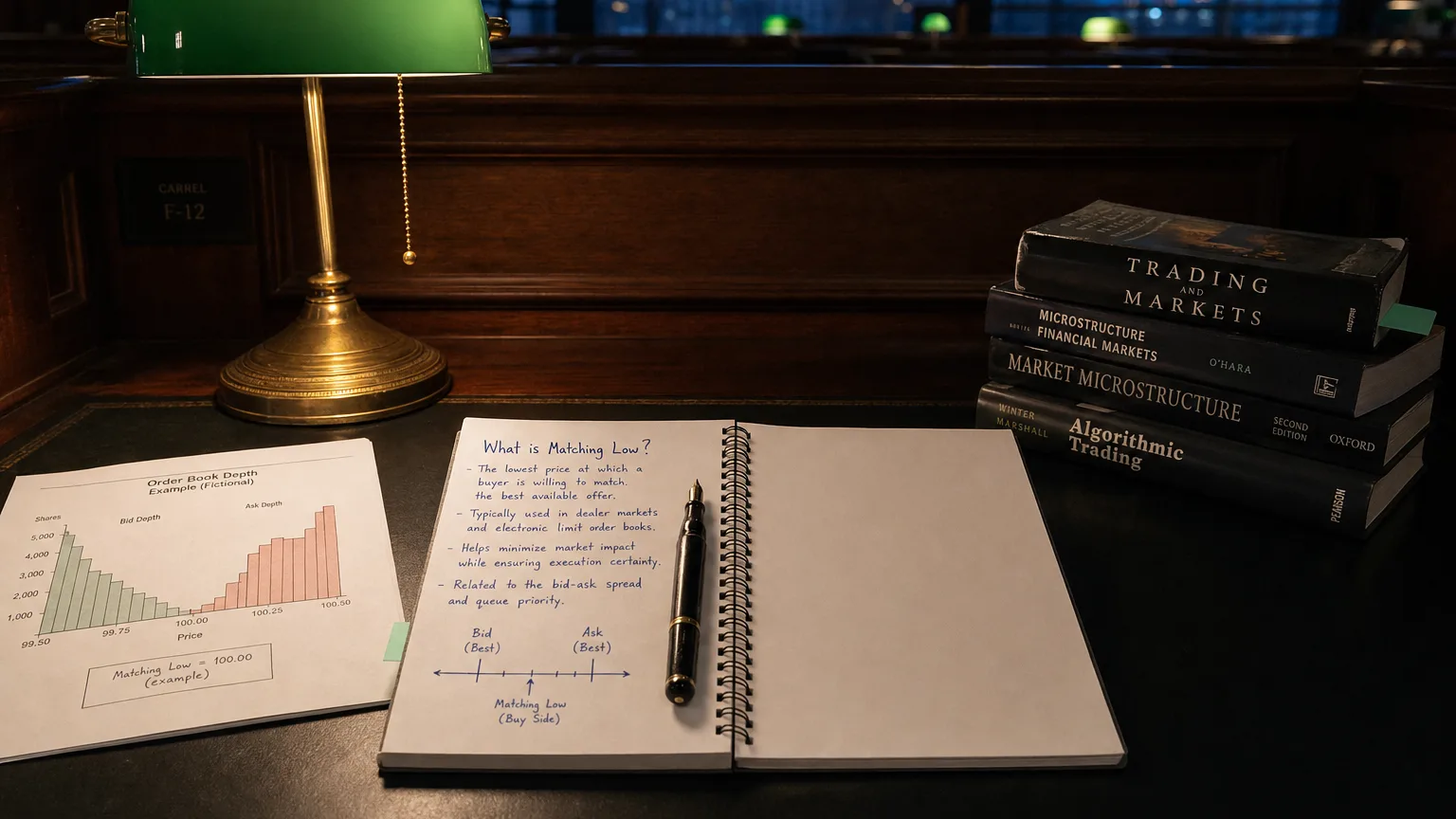
Matching Low is a financial concept covered in this article. A Subtle Bullish Reversal Pattern in Candlestick Analysis
The goal of a successful trader is to make the best trades. Money is secondary.

The Matching Low is a two-candle formation that appears after a down-trend and is classed (in theory) as a bullish-reversal signal. Both candles are bearish—closing lower than they open—but the second candle’s close matches (or sits within a tick of) the first candle’s close. The equal closes suggest price has found temporary support; in practice, statistical studies show it actually behaves as a bearish-continuation ≈ 60 % of the time.
Identification checklist
| Rule | Detail | Why it matters |
|---|---|---|
| Prevailing trend | Clear, steady decline | Pattern aims to mark exhaustion/support |
| Candle #1 | Long black/red body | Bears firmly in control |
| Candle #2 | Black/red body that closes = Candle #1 close (lows may differ) | Shows sellers couldn’t push the settle lower |
| Shadows | Allowed; bodies are the key | Focus is the matching closes |
| Confirmation (prudent) | Close above Candle #2 high within 1-3 bars | Filters out frequent bear-continuation prints |
Because the closes must match exactly in many definitions, the pattern is rare and most common in thin-liquidity symbols.
Market psychology
-
Candle #1: continuation of the sell-off; shorts stay confident.
-
Candle #2: sellers try again, but close no lower—hint of buying at that price level.
-
Fork in the road: if price lifts above Candle #2, trapped shorts cover and a relief rally can start; if it breaks the shared close, bears regain the steering wheel and drive lower.
Trading blueprint
| Element | Aggressive tactic | Conservative tactic |
|---|---|---|
| Entry | Buy on Candle #2 close if volume spikes & RSI < 30 | Buy only after a close above Candle #2 high |
| Stop-loss | Just below the two-candle low or ATR(14)×1 | Same |
| Targets | 1.5–3 R or nearest resistance / EMA | Same; trail stop at +1 R |
| Bearish play | Short a decisive break below the matching closes if the broader down-trend is intact |
Time filter: if price hasn’t moved ≥ 0.5 R within 3–4 bars, consider scaling out—the pattern’s edge decays quickly.
Statistical tendencies (Bulkowski, US stocks 1991-2023)
| Metric | Result |
|---|---|
| Acts as bearish continuation | 61 % |
| 10-day performance rank | 8 / 103 (strong when breakout occurs) |
| Frequency rank | 58 / 103 (mid-pack rarity) |
Edge improves when the pattern forms within the lower third of the yearly range or as a pullback inside a larger up-trend.
Strengths
-
Objective two-bar rules—scanner-friendly.
-
Equal closes give a clean support line for stop placement.
-
When confirmation triggers, rallies can be swift (top-10 move size in Bulkowski data).
Limitations & pitfalls
-
Raw reversal edge is weak—without confirmation it continues lower more often than it reverses.
-
Rare on liquid instruments; more frequent in thin or gapping markets.
-
Traders sometimes mistake equal lows for equal closes—ensure the closes line up.
Quick visual cheat-sheet
⬇️ Down-trend
🟥 Long black body (close = C₁)
🟥 2nd black body closes *exactly* at C₁
⌛ Bulls need a close above Candle #2 high → long
⚠️ Break back below the shared close → continuation short
Summary
The Matching Low hints that bears may be exhausting, but history shows they still win six times out of ten. Treat the pattern as a pause with potential—demand a bullish follow-through before going long, keep stops tight at the shared close, and stay open to shorting if price punches through that level instead. Rock the confirmation, guard the risk, and let the market tell you which side truly owns the match.