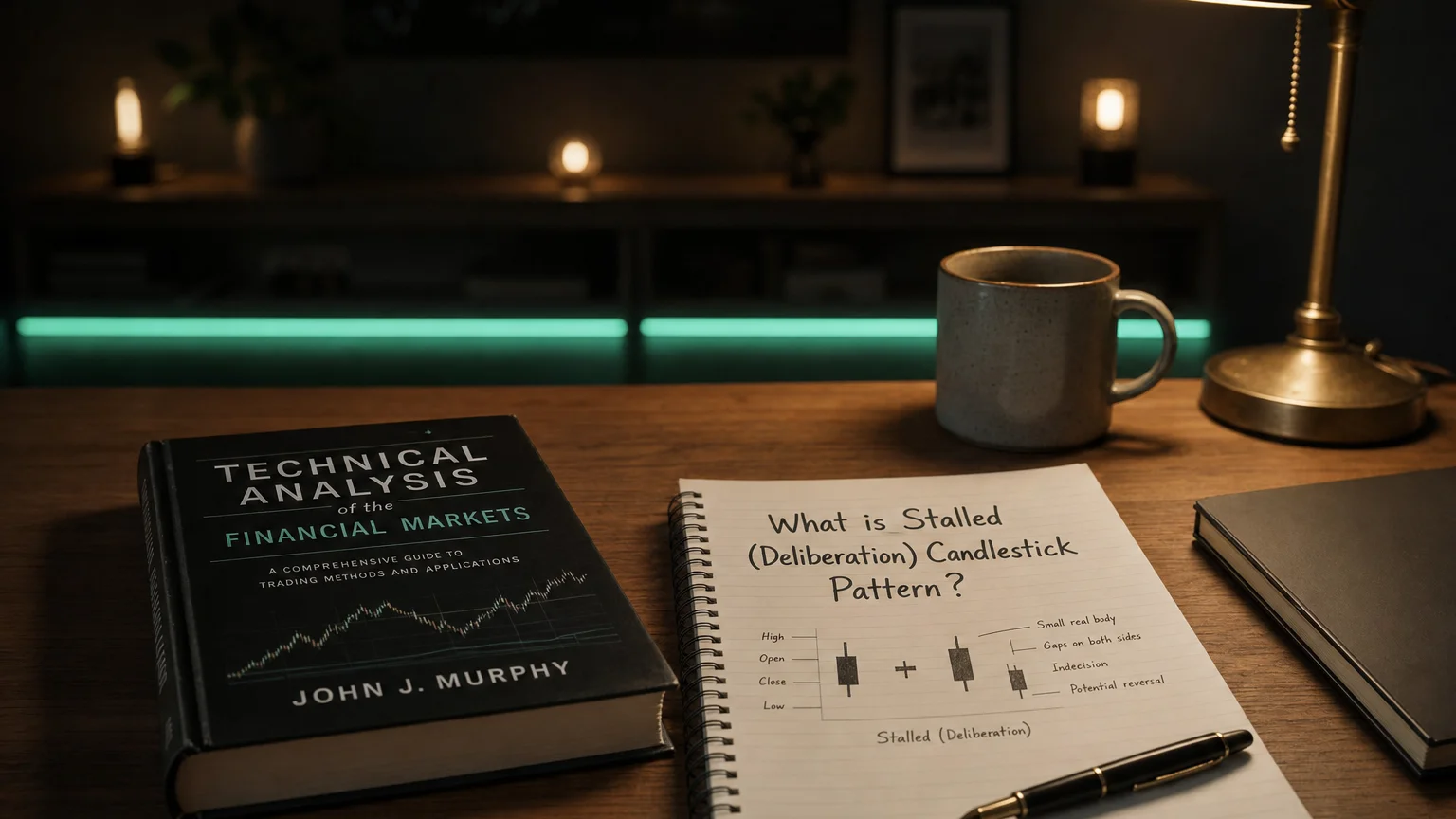
is a financial concept covered in this article. The Bullish Rally's Yellow Flag Warning
The most important rule of trading is to play great defense, not great offense.
The Stalled Pattern—also called the Deliberation Pattern—is a three-candle bearish-reversal formation that crops up after an extended uptrend. Think of it as a clear signal of momentum fatigue. It’s like watching a sprinter lead a race with two powerful strides, only to stumble and lose all momentum on the third step. This pattern, which looks like a Three White Soldiers pattern that suddenly runs out of gas, serves as a strong warning that the prevailing optimism is fading and a reversal could be just around the corner.
Identification Checklist: Spotting the Stall
The Stalled Pattern is a visual story of a powerful advance hitting a sudden wall. To identify it correctly, you need to see a clear progression from strength to weakness across three candles.
 Two strong green candles are followed by a small, weak third candle, indicating a stall in momentum.
The Three-Candle Rule Set
- Trend: The pattern must appear after a clear, persistent advance (an uptrend). It’s a signal that flips the prevailing optimism on its head.
- Candle 1: A long bullish (white/green) body that closes near its high. This shows the bulls are firmly in charge.
- Candle 2: Another long bullish body that opens above the close of the first candle and pushes to a new high. The bullish momentum still appears strong.
- Candle 3: The ‘stall’. This candle opens with an up-gap but then fails to follow through. It prints a small real body and often has a long upper shadow (wick), showing that the fresh highs were aggressively sold into. It closes inside the body of the second candle.
The Importance of the Third Candle
The entire story hinges on the third candle. Its failure to make a meaningful advance after gapping up is the first concrete sign of buyer fatigue. The long upper shadow is particularly telling, as it represents a failed rally and a successful counter-attack by sellers within the same session.
“The most important rule of trading is to play great defense, not great offense.”
— Paul Tudor Jones, Founder of Tudor Investment Corporation, hedge fund manager Market Wizards: Interviews with Top Traders, Jack D. Schwager (New York Institute of Finance, 1989), chapter “Paul Tudor Jones — The Art of Aggressive Trading” (1989)
Market Psychology: The Story Behind the Stall
This pattern provides a clear window into the shifting psychology at a market top, capturing the moment when euphoria gives way to doubt.
The Three-Day Narrative
- Two-Bar Surge: The first two candles show the bulls are confidently marching higher. The strong closes and new highs invite FOMO (Fear Of Missing Out) buying from retail traders.
- Gap Euphoria: The third day gaps even higher at the open. This is often peak euphoria, trapping the last of the short-sellers and convincing the final batch of buyers to jump in at the top.
- The Stall & Sell-Off: Suddenly, at these new highs, supply overwhelms demand. Smart money, which may have been riding the trend, begins to sell aggressively into the strength provided by the late buyers. This intense selling pressure pushes the price down, leaving a stubby body and a long upper shadow.
- The Expectation: The trap is now set. If the next bar breaks below the low of the third candle, the recently trapped bulls will be forced to bail out of their positions, often sparking a sharp pullback or a full-scale reversal.
The Trading Blueprint & Statistical Tendencies
Trading the Stalled Pattern requires discipline. It’s a warning signal that sets up a potential trade, but acting on the warning without confirmation is a common pitfall.
A Typical Bearish Tactic
- Entry: The conservative and recommended entry is to go short on a close below the low of the third candle. An aggressive trader might enter short near the close of the third candle, but only if there is a massive volume spike and/or clear bearish divergence on the RSI.
- Initial Stop-Loss: A logical stop-loss is placed just above the high of the third candle. This creates a tight, well-defined risk profile.
- Profit Targets: Common targets are a risk-multiple of 1.5R to 3R, the nearest significant demand zone (support), or a touch of a major moving average like the 20-period EMA.
- Edge Boosters: The signal is much more reliable when it occurs in an overbought condition (RSI > 70), shows MACD bearish divergence, or forms at a known major resistance level or Fibonacci extension.
A Note on Statistics
Academic-grade statistics on the Stalled Pattern are scarce because its strict definition makes it very rare on liquid symbols. It is widely accepted qualitatively as a warning of fading momentum. Traders report that when confirmed, it often leads to pullbacks of 1 to 3 times the third candle’s body size within the next 5-10 bars.
Strengths, Limitations & Pitfalls
Strengths
- Visually Obvious: The three-step ‘strong, strong, weak’ structure is easy to spot or code into a scanner.
- Juicy R:R Ratio: The tight invalidation point (a stop just over the third candle’s high) allows for a very favorable reward-to-risk profile.
- Early Warning System: It highlights momentum exhaustion before many other indicators or traders have spotted it.
Limitations & Pitfalls
- Ultra-Rare: You may only see this pattern a few times per year on any given market. Patience is key.
- Weak Without Confirmation: The raw, unconfirmed pattern’s edge is weak. About half of these patterns will simply consolidate before drifting higher. Waiting for the break below the third candle’s low is critical.
- Can Morph into Consolidation: If bulls regroup and defend the low of the third candle, the pattern can simply turn into a harmless consolidation box. The breakdown is your proof that the bears have won.