Hedging Assets Current is a financial concept covered in this article. Fair Value of Derivative Instruments Designated as Hedges (Asset Position)
In the short run, the market is a voting machine. In the long run, it is a weighing machine.
Hedging Assets Current represent the positive fair value of derivative financial instruments (such as swaps, forwards, options) that are designated as hedging instruments and are expected to settle or affect earnings within the next 12 months. These assets arise when the derivative is ‘in the money’ from the company’s perspective under a qualifying hedge relationship, providing an economic offset to hedged risks.
What Hedging Assets Represent
Hedging Assets Current show the current mark-to-market value of derivatives used specifically to hedge risks (interest rate, FX, commodity, etc.) when the hedge is favorable to the company.
They are the counterpart to hedging liabilities—together reflecting the net fair value of the hedge portfolio.
Only derivatives in formal hedge accounting relationships are labeled ‘hedging’—trading derivatives are separate.
Common Hedging Instruments
- Interest rate swaps (receive-fixed when rates fall)
- FX forwards/contracts (currency strengthens vs. exposure)
- Commodity futures/swaps (price drops for buyer hedge)
- Options designated as hedges
- Cross-currency swaps
Used by companies with exposure to rates, currencies, or commodities.
“In the short run, the market is a voting machine. In the long run, it is a weighing machine.”
— Benjamin Graham, Author, The Intelligent Investor Security Analysis (1934)
A Practical Example
Company with variable-rate debt enters pay-fixed/receive-variable interest rate swap to hedge rising rates.
- Rates fall → swap has positive value (you receive more than pay)
- Fair value 5M
- Offset: lower interest expense on debt
- If rates rise → swap negative → hedging liability
The asset shows the hedge is working—economic gain offsetting higher debt cost.
Accounting Treatment
- Fair value each period
- Cash flow hedges: Effective portion to OCI, ineffective to P&L
- Fair value hedges: Changes to P&L (offset hedged item)
- Net investment hedges: OCI (FX translation)
- Current classification if settlement/effect within 12 months
Hedge accounting reduces volatility by matching timing/location of gains/losses.
Balance Sheet Presentation
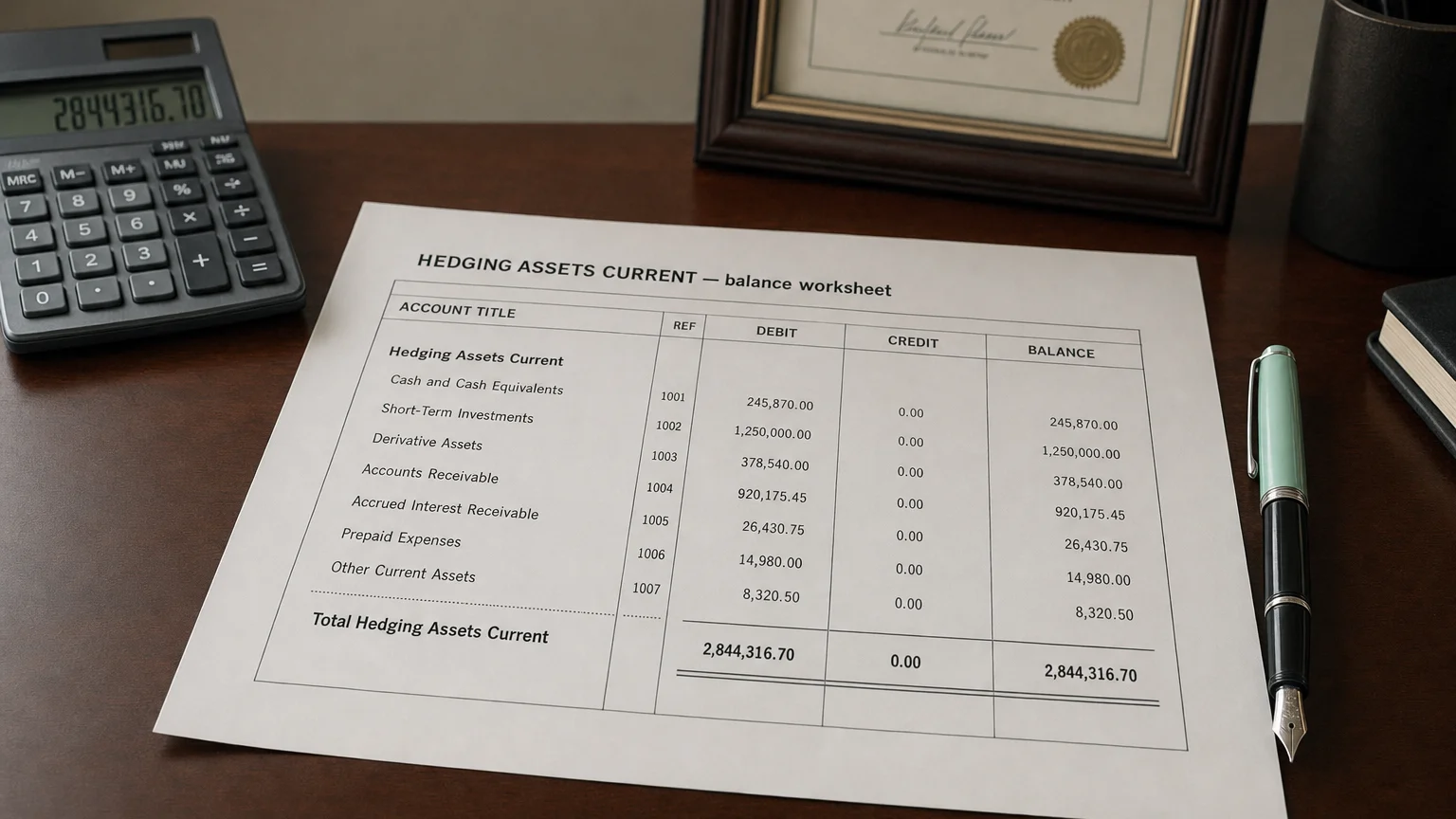
Under current assets as:
- ‘Hedging Assets Current’
- ‘Derivative Assets - Hedging’
- ‘Current Derivative Hedging Assets’
- Often netted with hedging liabilities if right of offset
Extensive footnotes: notional, fair value, hedge type, effectiveness.
Analytical Implications
- Active risk management program
- Exposure to underlying risks (rates, FX, commodities)
- Potential OCI buildup (cash flow hedges)
- Earnings protection quality (effective hedges)
- Balance sheet volatility if ineffective
Large net hedging assets/liabilities signal significant risk exposures.
Q · 01 What is Hedging Assets Current? +