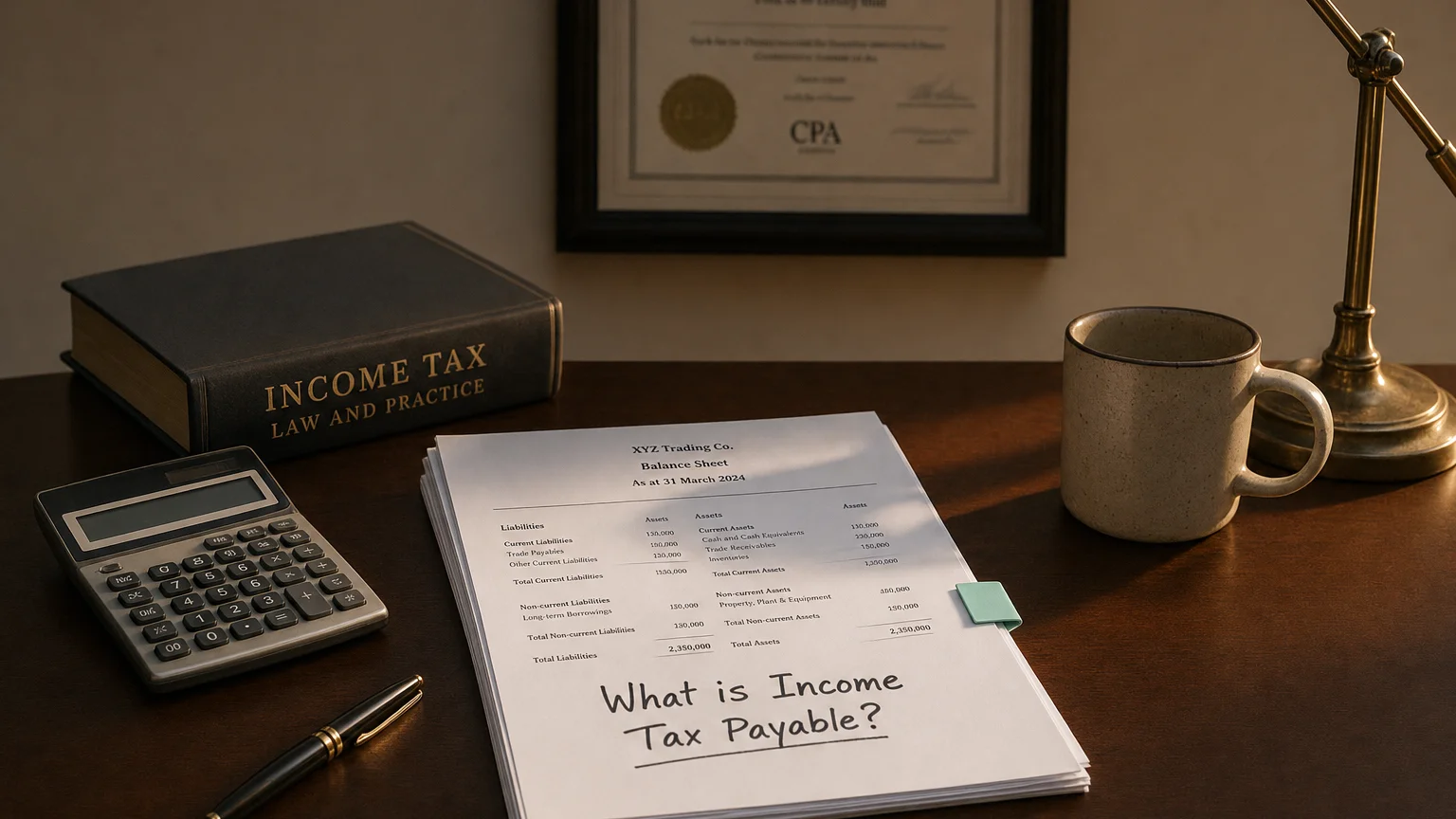
A breakdown of the current liability on the balance sheet representing the income taxes a company owes to the government.
Know what you own, and know why you own it.

Income Tax Payable refers to the amount of income taxes a company owes to the government (federal, state, or local) based on its taxable profits, which it has incurred but not yet paid. In other words, it is a tax liability arising from the company’s earnings for a given period. This liability exists from the time the tax is accrued (recorded as an expense) until the company actually remits the tax to the tax authorities. Once the tax is paid, the income tax payable is eliminated (reduced to zero) on the books.
Where It Appears on the Balance Sheet
On the balance sheet, income tax payable is typically listed in the current liabilities section. It is considered a short-term (current) liability because it represents a debt the company expects to settle within the next 12 months (by the next tax due date). In most cases, corporate income taxes are due within a year of being accrued, so they fall under current liabilities alongside items like accounts payable and short-term loans. (If, in rare cases, a portion of income taxes is not due for over a year, that portion could be classified as a long-term liability, but normally all income tax payable is current.) On some balance sheets, income tax payable may appear as a specific line item (e.g. “Income Taxes Payable” or “Taxes Payable”), or it might be included with other accrued expenses and payables, but it always resides in the liabilities section of the balance sheet as an obligation the company owes.
How Income Tax Payable is Calculated or Derived
Income tax payable is calculated based on the company’s taxable income for the period and the relevant tax rates, adjusted for any applicable deductions or credits. The process typically works as follows:
-
Determine Taxable Income: Start with the company’s pretax accounting profit (often called earnings before tax, or EBT) and adjust it according to tax laws to arrive at taxable income. Tax laws may require adding or removing certain items (for example, some expenses aren’t deductible for tax, and some revenues might be tax-exempt). These adjustments mean taxable income can differ from the accounting profit reported on the income statement. For instance, governments might allow accelerated depreciation for tax purposes, which lowers taxable income compared to accounting income. The taxable income is the portion of profit that the government will tax.
-
Apply the Tax Rate: Multiply the taxable income by the appropriate tax rate(s) to compute the gross tax liability. A company may be subject to multiple tax jurisdictions (federal, state, local) with different rates. Often an effective tax rate is used, which is basically the combined rate applicable. For example, if a company’s taxable income is $100,000 and the corporate tax rate is 20%, the gross tax would be $20,000. This calculated amount represents the income tax the company owes for that period (before considering any credits or prepayments). It is also the amount that will be recorded as income tax expense on the income statement for the period.
-
Subtract Credits and Prepayments: If the company has any tax credits (government incentives that directly reduce taxes owed) or if it has made estimated tax payments throughout the year, these will reduce the remaining tax payable. For example, if the company in the above example owes $20,000 for the year but had already paid $5,000 in quarterly estimated taxes, it would have $15,000 left as income tax payable at year-end. Tax credits (for things like R&D, renewable energy investments, etc.) similarly reduce the actual tax bill dollar-for-dollar. After applying payments and credits, the remainder is the net income tax payable that appears on the balance sheet.
-
Record the Liability: Under accrual accounting, the company records an income tax expense in its income statement for the period and simultaneously records the corresponding income tax payable on the balance sheet. The typical journal entry is a debit to Income Tax Expense and a credit to Income Tax Payable for the amount of tax owed for the period. This ensures the expense is recognized in the correct period, even if the cash will not be paid out until a later date.
In formula form, Income Tax Payable for the period can be thought of (in a simplified way) as:
Taxable Income×Tax Rate − Tax Credits − Tax Prepayments=Income Tax Payable.\text{Taxable Income} \times \text{Tax Rate} \ - \ \text{Tax Credits} \ - \ \text{Tax Prepayments} = \text{Income Tax Payable}.Taxable Income×Tax Rate−Tax Credits−Tax Prepayments=Income Tax Payable.
The exact calculation can be complex in practice due to varying tax rules, but the core idea is that it represents the actual tax bill for the period as determined under tax law. Notably, this tax payable amount often matches the current tax portion of the income tax expense on the income statement, unless there are timing differences between accounting rules and tax rules – which leads to deferred tax assets or liabilities (more on that below).
Significance in Financial Analysis and Reporting
Income tax payable is an important figure for both financial reporting and analysis, for several reasons:
-
Accurate Profit Measurement: Recording income tax payable (along with the corresponding tax expense) ensures that the company’s net income is properly stated for the period. By accruing taxes owed, the company matches the tax expense to the same period in which the profit was earned (even if the cash will be paid later). This upholds the accounting matching principle and gives a more accurate picture of after-tax profits for stakeholders.
-
Current Obligations and Liquidity: As a current liability, income tax payable reflects a near-term cash outflow the company must make. Analysts look at it as part of the company’s short-term obligations. In assessing liquidity or working capital, income tax payable is included with other current liabilities to evaluate if the company can meet its obligations coming due within a year. A relatively large income tax payable will factor into ratios like the current ratio and working capital. For example, an increase in income tax payable from one period to the next (without payment yet) effectively means the company’s cash was conserved (boosting operating cash flow), but it also means a larger cash payment will be due soon. Financial analysts might monitor this because a significant unpaid tax bill could impact the company’s cash flow when it comes due.
-
Indicator of Profitability and Tax Management: The size of the income tax payable is directly tied to the company’s profitability and tax planning strategies. A higher income tax payable generally signals higher taxable profits for the period (assuming a stable tax rate). Analysts might compare the income tax expense (on the income statement) with the income tax payable to understand if the company is deferring taxes. A difference between the two often arises from deferred tax items. For instance, if a company’s reported tax expense is lower than the tax payable calculated per the tax return, the excess portion of tax payable might be recorded as a deferred tax asset (indicating the company paid more cash taxes than its accounting expense, possibly to be benefited in the future). Conversely, if the tax expense is higher than the current tax payable, the difference might be recorded as a deferred tax liability, meaning some taxes are being pushed to future periods. In summary, income tax payable, together with deferred tax accounts, helps provide a complete picture of a company’s tax situation.
-
Compliance and Timing: From a reporting standpoint, the income tax payable account signals compliance with tax obligations. It shows that the company acknowledges its tax debt. Financial statement users know this amount will have to be paid by the deadline (e.g. by the next tax filing date). A company that consistently shows a very high income tax payable relative to its size might be delaying tax payments (or simply had an unusually profitable period). Auditors and analysts may pay attention to this, as failure to pay taxes on time could result in penalties. However, it’s normal for companies to accrue taxes throughout the year and then pay them when due. The presence of income tax payable on the balance sheet is expected in accrual accounting and doesn’t imply any problem – it’s simply part of the period-end process.
-
Distinction from Income Tax Expense: It’s important in analysis to distinguish income tax payable (balance sheet) from income tax expense (income statement). The two are related but not identical. Income tax expense is the total tax cost reported for the period’s profit (an expense reducing profit), whereas income tax payable is the portion of that tax expense that is currently due to be paid (the liability). Any difference between the two would be explained by deferred taxes or installments paid. In most straightforward cases, for the current year’s taxes, the expense and the payable will match in amount. Income tax payable stays on the balance sheet until the company pays it off, at which point cash decreases and the payable is removed. Recognizing this distinction is significant for analysis: it helps one verify that the company’s tax expense is properly supported by either cash payments or an increase in payable (or deferred taxes) in the same period.
In summary, income tax payable is significant as a measure of taxes owed in the short term, affecting the company’s liquidity and working capital, and as a component of accurate financial reporting of taxes. It provides insight into a company’s tax obligations and timing of tax cash flows, which are important for both compliance and analysis of the company’s financial health.
Example of Income Tax Payable in Practice
To illustrate, consider a simple example. Suppose ABC Corporation has $100,000 of profit before taxes for the year. The corporate income tax rate (combined federal/state) applicable to ABC is 20%. This would result in an income tax of $20,000 for the year (20% of $100,000). ABC would record an income tax expense of $20,000 on its income statement, and simultaneously record $20,000 as income tax payable on its balance sheet (this is done via a journal entry debiting Income Tax Expense and crediting Income Tax Payable). The $20,000 in income tax payable represents the liability for taxes ABC owes and must pay to the government.
Now, assume ABC will pay this tax three months later, before the tax deadline. When ABC remits the $20,000 to the tax authority, it will record the payment by decreasing the income tax payable and decreasing cash by $20,000 (crediting cash and debiting the income tax payable account). After the payment, the income tax payable on the balance sheet returns to zero (until next period’s taxes accrue). The sequence of events is:
-
Year-End Accrual: ABC incurs $20,000 of tax on the year’s profit. Financial statements show a $20,000 tax expense on the income statement, and a corresponding $20,000 income tax payable on the balance sheet (current liability).
-
Subsequent Payment: ABC pays $20,000 to the government. This reduces ABC’s cash and eliminates the payable. The balance sheet liability for income tax payable goes down by the amount paid, and ABC has fulfilled its tax obligation for that period.
For a more complex example, imagine a company that operates in multiple states or countries. It might owe income taxes to the federal government and several states. Each of those obligations collectively make up the total income tax payable. If the company’s profit was, say, $200,000 and it faces a 21% federal tax and an 8.84% state tax (as in California), its combined effective tax rate would be about 29.84%. That would produce a tax expense of about $59,680 for the year. Until paid, that $59,680 is recorded as income tax payable (current liability). When the company pays the federal and state authorities, the payable will be reduced accordingly. This example shows how income tax payable is calculated and recorded in a real-world scenario with multiple tax jurisdictions.
Overall, income tax payable is a straightforward but essential concept: it represents taxes accrued and owed in the short term. It appears on the balance sheet as a liability, is computed from taxable income and tax rates (with adjustments for any credits/payments), and serves as an indicator of a company’s obligations to the government. Its proper accounting ensures that financial statements accurately reflect the company’s obligations and that stakeholders understand the upcoming cash outflows for taxes. By examining income tax payable, along with related figures like income tax expense and deferred taxes, one can gain insight into a company’s tax position and compliance in the context of its overall financial health.
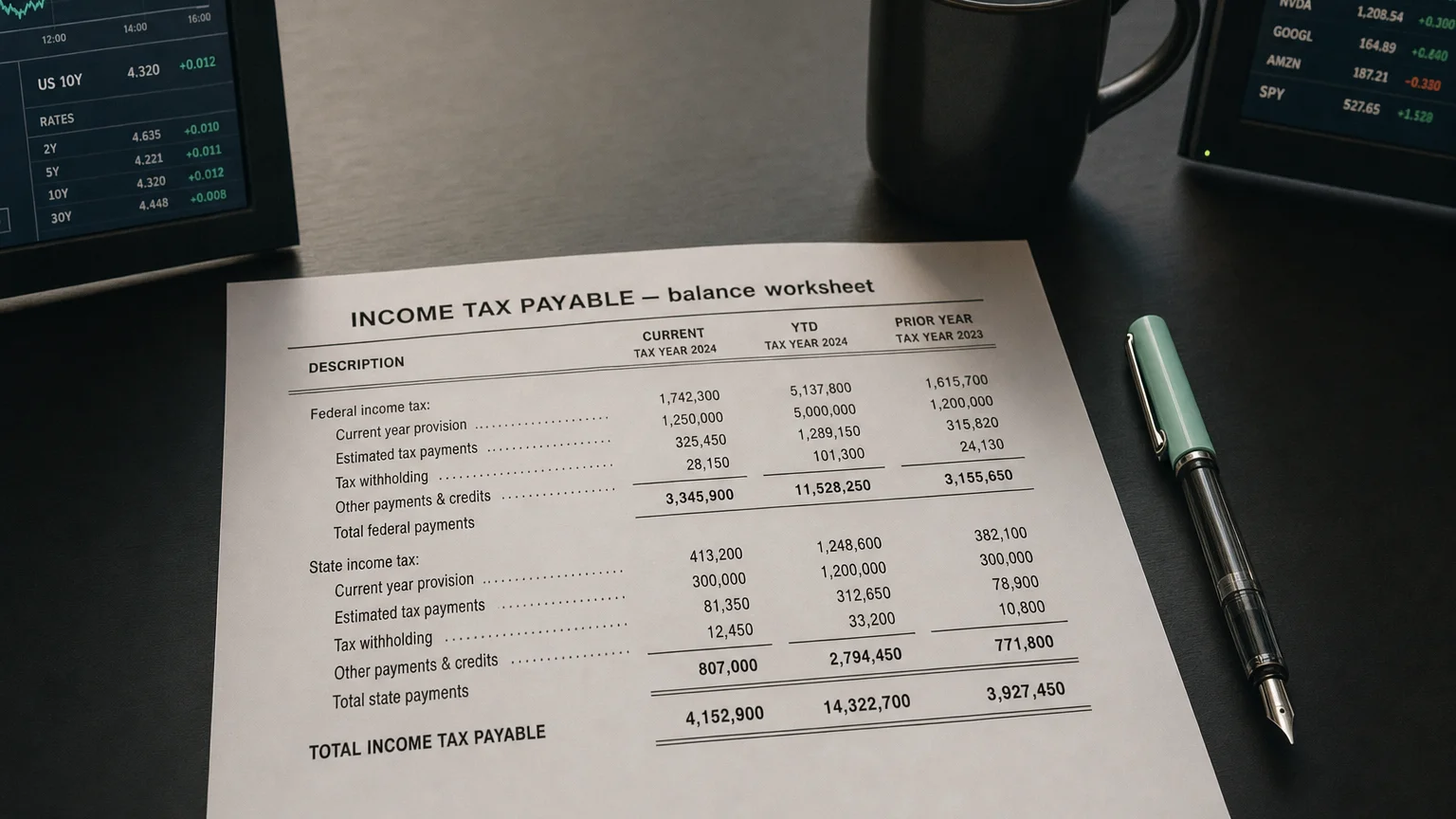
Q · 01 What is Income Tax Payable? +