Line of Credit is a financial concept covered in this article. Revolving Borrowing Facility with Flexible Drawdown and Repayment
You only have to be able to evaluate companies within your circle of competence. The size of that circle is not very important; knowing its boundaries, however, is vital.

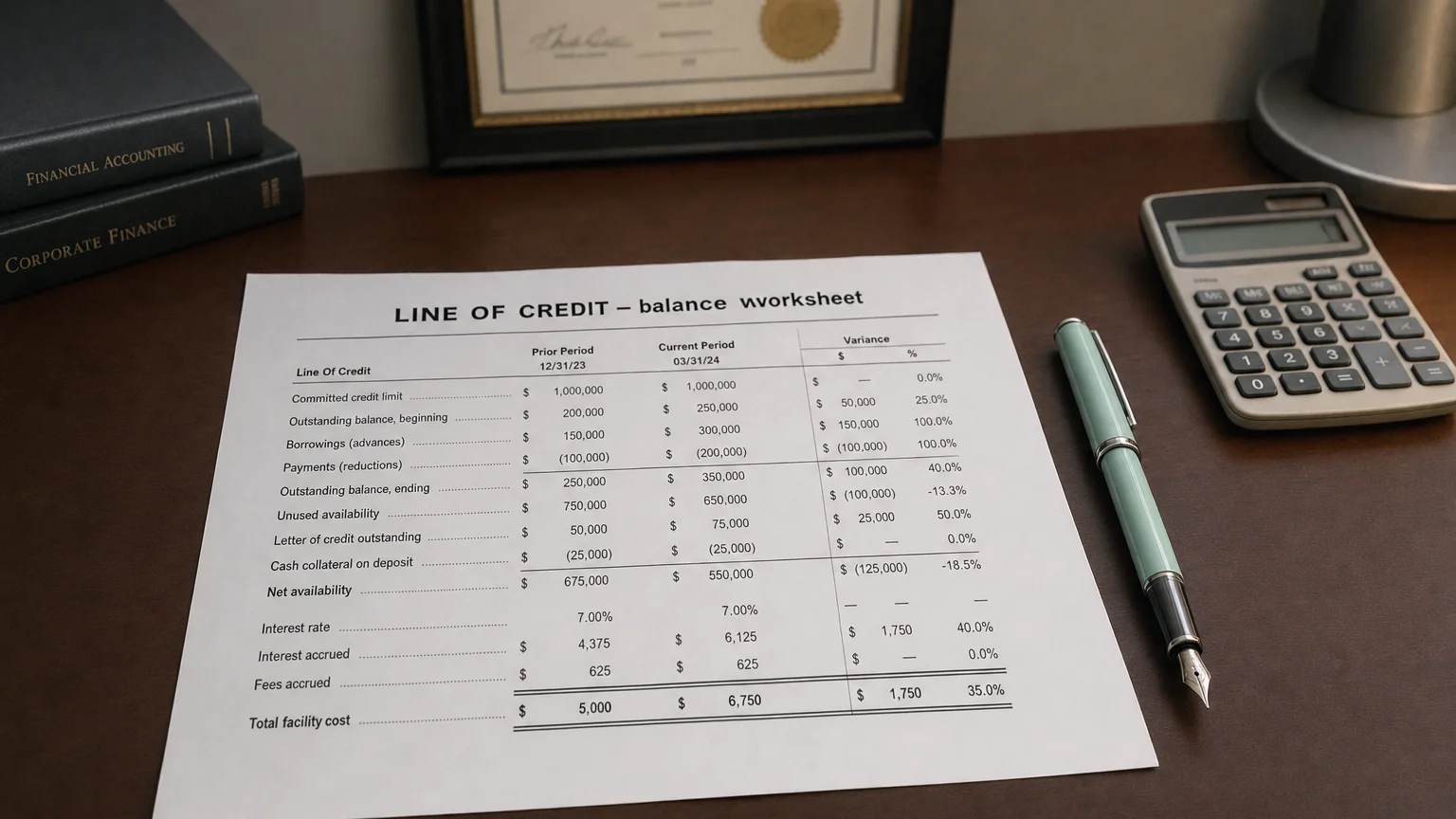
Line of Credit (LOC) is a flexible borrowing arrangement between a lender (typically a bank) and a borrower that establishes a maximum loan balance the borrower can draw upon as needed. Unlike a term loan with a fixed disbursement, a line of credit allows repeated drawdowns and repayments up to the approved limit, often with interest charged only on the outstanding amount.
What Is a Line of Credit?
A Line of Credit provides pre-approved access to funds up to a set limit. The borrower can draw any amount at any time (subject to availability), repay, and redraw as needed during the term.
It functions like a credit card for businesses or individuals—flexible working capital financing without fixed installments.
Revolving nature distinguishes it from term loans (single disbursement, fixed schedule).
Common Types of Lines of Credit
“You only have to be able to evaluate companies within your circle of competence. The size of that circle is not very important; knowing its boundaries, however, is vital.”
— Warren Buffett, Chairman & CEO, Berkshire Hathaway Berkshire Hathaway Chairman’s Letter 1996 (1996)
- Secured LOC: Backed by collateral (inventory, receivables, real estate)
- Unsecured LOC: Based on creditworthiness (higher interest)
- Committed LOC: Lender obligated to provide funds (commitment fee)
- Uncommitted LOC: Lender discretion (lower cost, less reliable)
- Revolving Credit Facility (RCF): Large corporate version, often syndicated
- Personal/Home Equity Line of Credit (HELOC): Consumer versions
Business LOCs often used for short-term needs; larger RCFs may have longer terms.
Key Features and Terms
- Credit limit: Maximum drawable amount
- Drawdown: Borrowing against the line
- Interest: Variable rate (prime + margin) on outstanding balance only
- Commitment fee: Percentage on undrawn amount
- Covenants: Financial ratios, restrictions
- Maturity: Typically 1-5 years, renewable
Balance Sheet Presentation
On the balance sheet:
- Drawn amount: Recorded as liability (usually current)
- ‘Line of Credit’ or ‘Bank Overdraft/Revolver’ line
- Often under ‘Current Debt’ or ‘Other Current Borrowings’
- Undrawn commitment disclosed in footnotes (off-balance-sheet)
- Long-term revolvers may split current/non-current
Interest accrued separately if material.
Advantages and Uses
- Flexibility for seasonal or unpredictable cash needs
- Cost-effective (pay interest only on used funds)
- Working capital management
- Bridge financing
- Backup liquidity (committed lines)
Analytical Considerations
Lines of credit impact analysis by:
- Providing liquidity cushion (undrawn capacity)
- Increasing short-term debt burden when drawn
- Potential covenant breaches triggering acceleration
- Commitment fees as ongoing cost
- Comparison of drawn vs. total facility for utilization
Heavy reliance on short-term LOCs can signal liquidity risk or rollover concerns.
Q · 01 What is Line Of Credit? +