A guide to the miscellaneous catch-all category for short-term assets on the balance sheet that are too minor to be reported individually.
An investment operation is one which, upon thorough analysis, promises safety of principal and an adequate return. Operations not meeting these requirements are speculative.

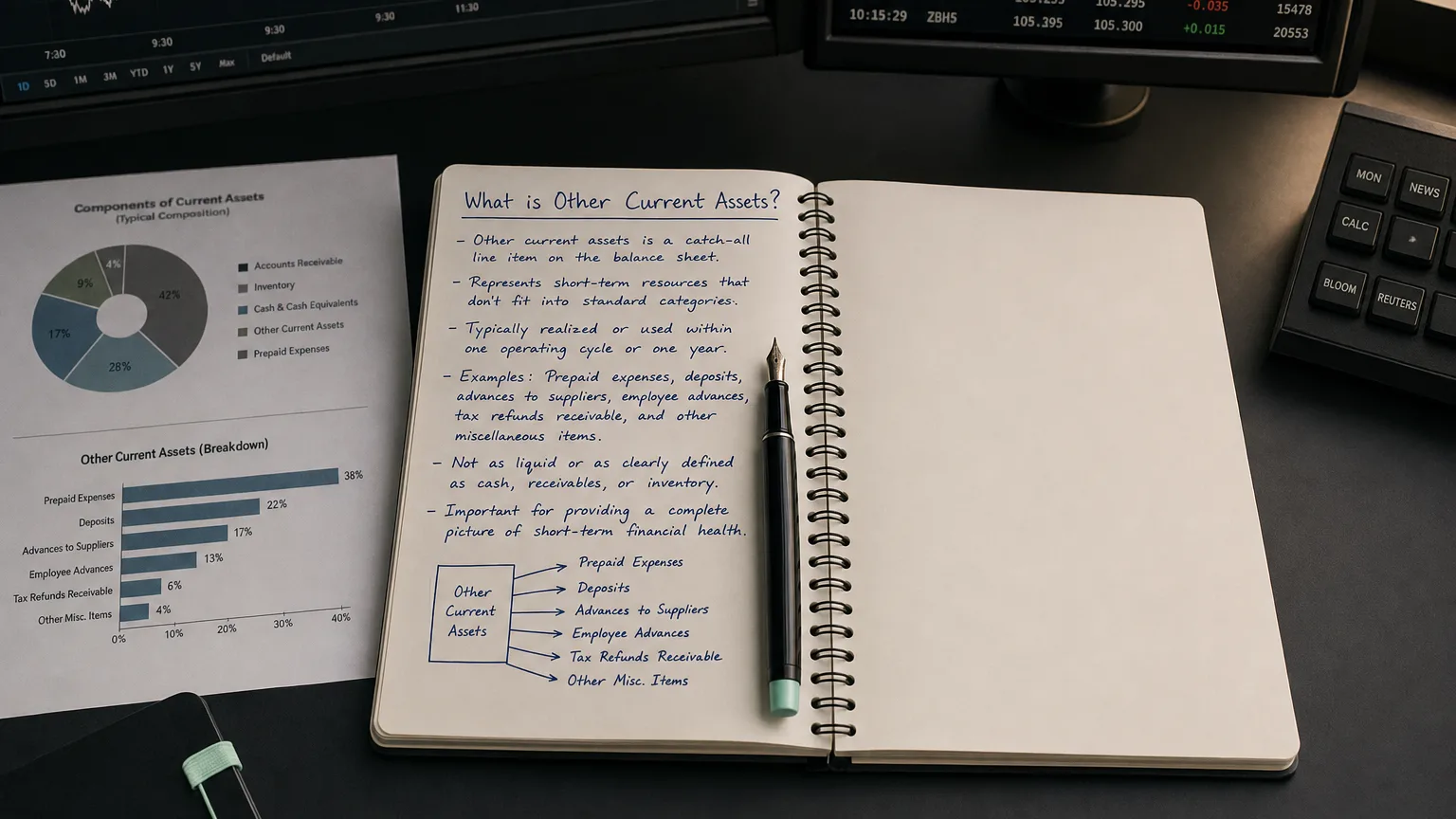
Other current assets (often abbreviated OCA) are a catch-all category of short-term assets on a company’s balance sheet. Like all current assets, items in this category are expected to be converted into cash or used up within one business cycle (usually within a year). They are labeled “other” because they do not fall into the standard current asset categories—such as cash, marketable securities, accounts receivable, or inventory—which are typically listed separately due to their significance. In other words, OCA includes miscellaneous or uncommon current assets that are too minor to warrant their own line item.
What’s Included in Other Current Assets?
Companies may classify a variety of items as “other current assets” if they are short-term and not significant enough to stand alone. Common examples include:
- Advances or deposits: Short-term loans or advance payments made to suppliers or employees.
- Assets held for sale: A piece of property or equipment that is actively being marketed and expected to be sold within a year.
- Restricted cash: Cash set aside for a specific purpose that will become available for general use within one year.
- Prepaid expenses: Sometimes, smaller prepaid costs are grouped here instead of being listed on a separate line.
- Current deferred tax assets: Short-term tax benefits that are not large enough to be reported separately.
“An investment operation is one which, upon thorough analysis, promises safety of principal and an adequate return. Operations not meeting these requirements are speculative.”
— Benjamin Graham, British-born American economist, professor and investor; founder of value investing Security Analysis (Graham & Dodd, 1st edition 1934); restated in The Intelligent Investor (4th rev. ed., 1973), Chapter 1, p. 18 (1934)
How OCA Differs from Major Current Assets
The main current asset accounts—cash, accounts receivable, and inventory—are listed individually because they are common to most businesses and material in amount. Other Current Assets serves as the “miscellaneous drawer” for everything else.
- Nature: Cash, AR, and inventory are directly tied to a company’s core operations. OCA items are often ancillary or arise from one-off transactions.
- Materiality: The balances for major current assets are usually significant. OCA items are, by definition, insignificant or immaterial on their own.
- Frequency: Core current assets are present in nearly every reporting period. OCA items may appear infrequently or irregularly.
Importance and Accounting Standards
Even though it’s typically a small line item, the Other Current Assets category serves an important role in financial reporting and is governed by key accounting principles.
The Materiality Rule
Accounting standards (U.S. GAAP and IFRS) require that if any single item within ‘other current assets’ becomes material (i.e., large enough to influence a user’s decision), it must be disclosed separately. For example, SEC rules require separate disclosure for any item that exceeds 5% of total current assets. This ensures companies cannot hide significant assets in this catch-all category.
For analysts, this category ensures the completeness of the balance sheet. While the assets are included in liquidity calculations like the current ratio, a large or fast-growing OCA balance is a signal to check the footnotes to understand its composition and assess the quality of those assets.