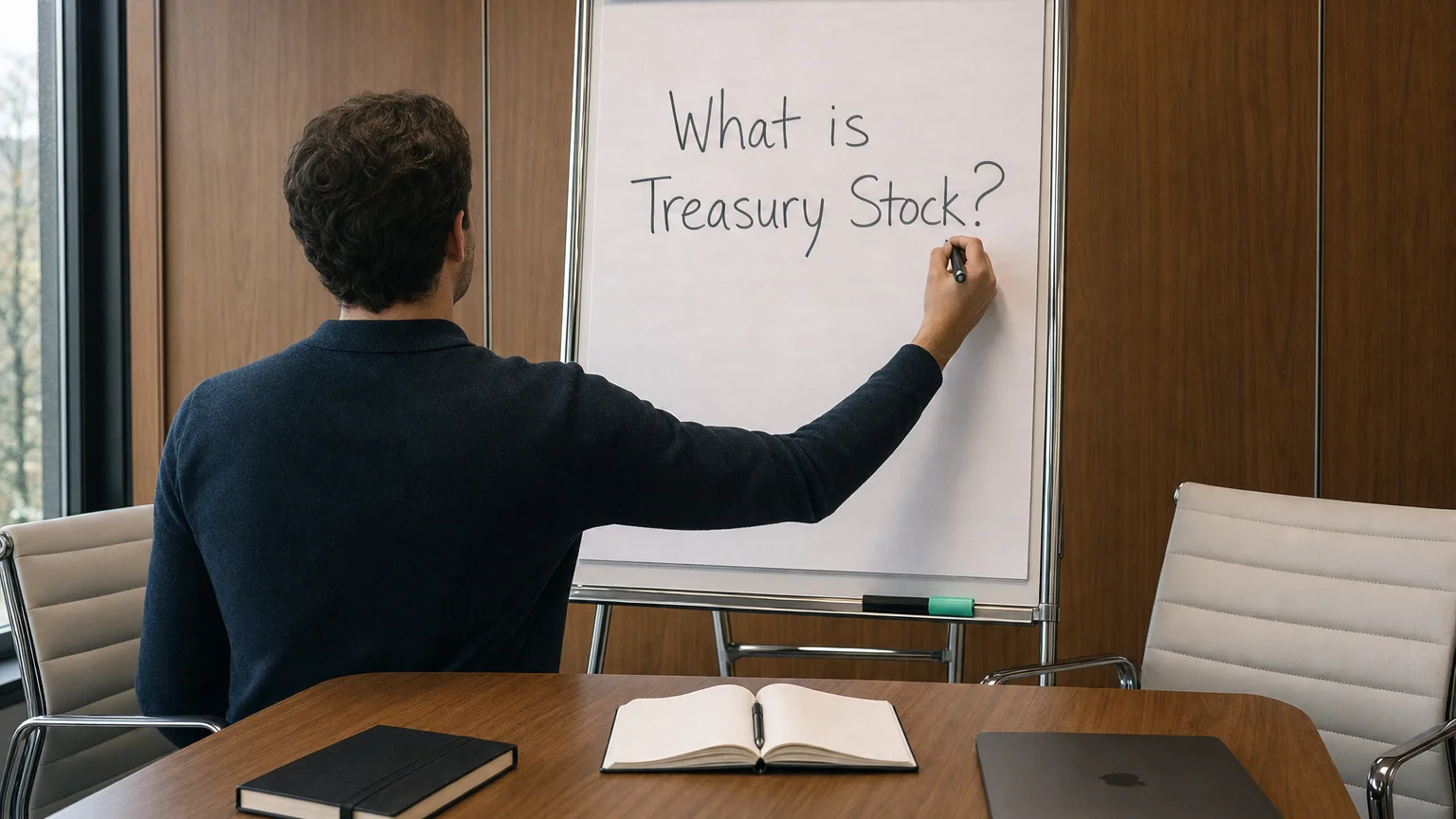
is a financial concept covered in this article. Company's Own Shares Repurchased and Held in Treasury
You only have to be able to evaluate companies within your circle of competence. The size of that circle is not very important; knowing its boundaries, however, is vital.

Treasury Stock represents shares of a company’s own stock that have been issued, subsequently repurchased (bought back) from the market, and are held by the company rather than retired or reissued. It is presented as a contra-equity account, reducing total shareholders’ equity on the balance sheet.
What Is Treasury Stock?
Treasury Stock arises when a company buys back its own shares from shareholders. These repurchased shares are not canceled (retired) but held in the company’s treasury for potential future use.
Unlike retired shares (which reduce issued shares), treasury shares remain issued but are no longer outstanding. They carry no voting rights, dividend rights, or preemptive rights while held.
Treasury stock reduces the number of shares outstanding, often boosting earnings per share (EPS) and return metrics.
Reasons Companies Create Treasury Stock
- Share repurchase programs to return capital to shareholders
- Increase EPS and other per-share metrics
- Signal management believes stock is undervalued
- Provide shares for employee stock options/RSUs or benefit plans
- Defend against hostile takeovers (reduce floating shares)
- Use as currency for acquisitions
Buybacks are common when companies generate excess cash and see their shares as attractive investments.
“You only have to be able to evaluate companies within your circle of competence. The size of that circle is not very important; knowing its boundaries, however, is vital.”
— Warren Buffett, Chairman & CEO, Berkshire Hathaway Berkshire Hathaway Chairman’s Letter 1996 (1996)
Accounting Treatment
Two main methods (cost method predominant under US GAAP/IFRS):
Cost Method (Most Common)
- Repurchase debits Treasury Stock at total cost
- Shown as negative amount in equity
- Resale above cost credits APIC; below cost debits APIC then Retained Earnings
Par Value Method (Less Common)
- Credits Common Stock at par, APIC for original premium
- Difference to cost handled via APIC/Retained Earnings
Treasury stock is always a contra-equity—never an asset.
Balance Sheet Presentation
Appears in shareholders’ equity as:
- Separate line: ‘Treasury Stock’ with negative value (parentheses)
- Deducted from total equity
- Disclosure: number of shares and cost basis in notes or parenthetically
Example: ‘Treasury stock, 5 million shares at cost ($500 million)’.
Impact on Key Metrics
- Reduces shares outstanding → higher EPS, ROE, book value per share
- Lowers total equity → higher leverage ratios
- No effect on shares issued (only outstanding)
- Cash outflow on repurchase affects liquidity
Analysts often add back treasury stock for ‘invested capital’ calculations.
Analytical Considerations
Treasury stock signals:
- Management confidence in value (buybacks at low prices positive)
- Capital allocation discipline (vs. dividends or growth investment)
- Potential EPS manipulation if timed poorly
- Future flexibility (shares available for compensation/acquisitions)
Heavy buybacks funded by debt increase financial risk; monitor sustainability.