Cash, Cash Equivalents, and Short-Term Investments
The three-tier asset group—cash, sub-90-day instruments, and near-maturity securities—anchoring the current assets section and measuring available liquidity.
Cash, Cash Equivalents, and Short-Term Investments groups currency and demand deposits, sub-90-day instruments (T-bills, commercial paper), and 3–12-month marketable securities at the top of the current assets section—the balance sheet's primary liquidity measure.
“
If we avoid the losers, the winners will take care of themselves.
HM
Howard Marks
Co-Chairman, Oaktree Capital Management · Oaktree Memo: 'The Most Important Thing' · 2003
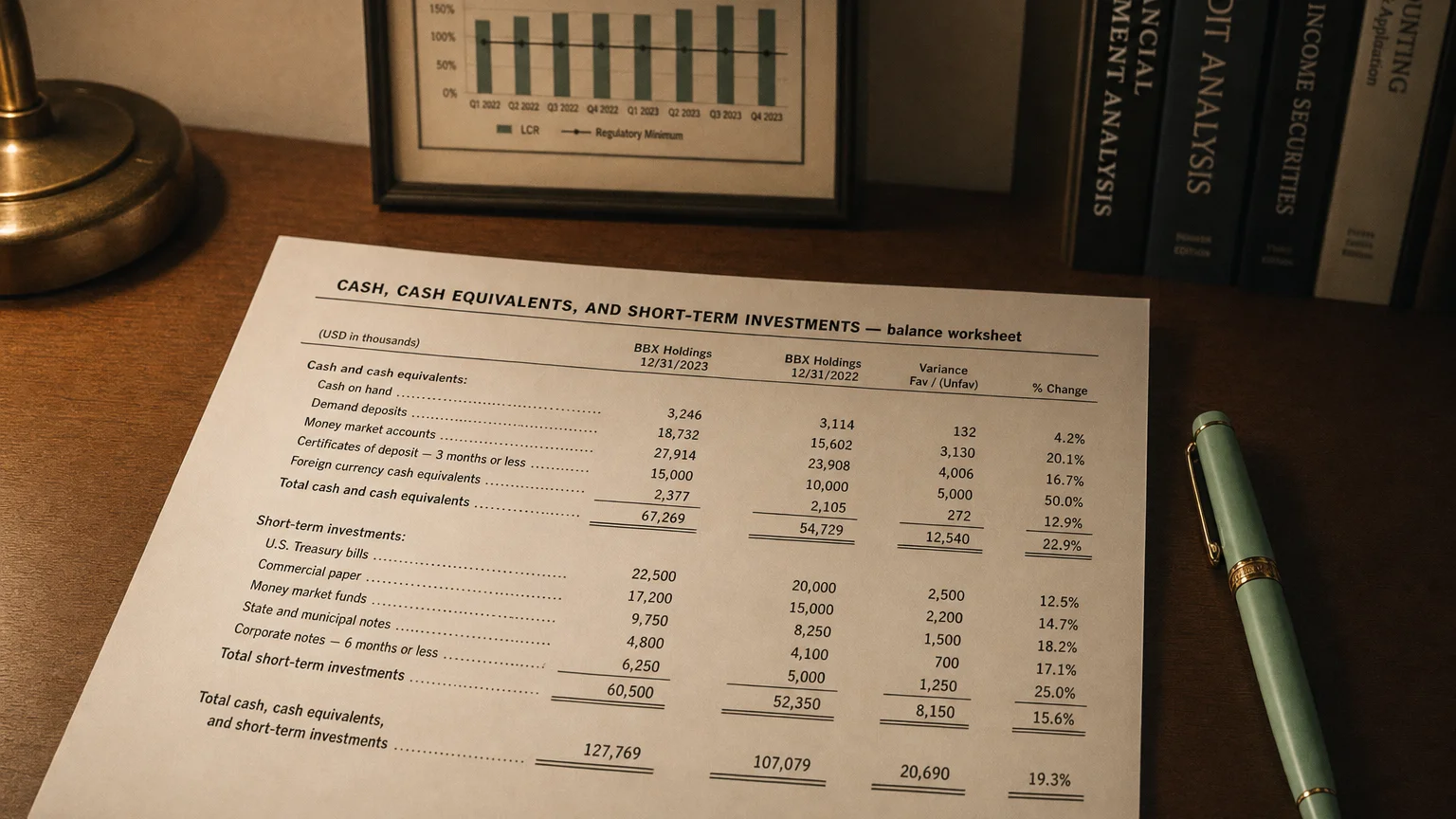
Cash, Cash Equivalents, and Short-Term Investments represent the most liquid assets on the balance sheet. They include physical cash, demand deposits, highly liquid investments with original maturities of three months or less (cash equivalents), and other short-term, low-risk investments readily convertible to known amounts of cash with minimal price fluctuation risk.
Breakdown of the Category
This line aggregates three closely related items:
Cash
Currency on hand
Demand deposits (checking accounts)
Petty cash
Cash Equivalents
Treasury bills (≤3 months)
Commercial paper (≤3 months)
Money market funds
Certificates of deposit (≤3 months)
Short-Term Investments
Government securities (3-12 months)
Corporate bonds (high quality, short maturity)
Marketable securities intended to be sold soon
Key test for cash equivalents: readily convertible to cash with insignificant risk of value change.
“If we avoid the losers, the winners will take care of themselves.”
— Howard Marks, Co-Chairman, Oaktree Capital Management
Oaktree Memo: ‘The Most Important Thing’ (2003)
A Practical Example
A company ends the year with:
$20M in checking accounts → Cash
$50M in 60-day Treasury bills → Cash Equivalents
$30M in 6-month corporate bonds (AAA-rated) → Short-Term Investments
Total line: $100M. All can be turned into cash quickly if needed for payroll, suppliers, or opportunities.
Accounting Treatment
Cash: At face value
Cash equivalents & short-term investments: Usually at fair value (changes often immaterial)
Interest income recognized as earned
Restricted cash (e.g., escrow, collateral) shown separately or disclosed
Foreign currency cash translated at spot rate
Bank overdrafts sometimes offset against cash if right of offset exists.
Balance Sheet Presentation
Top of current assets as:
‘Cash, Cash Equivalents, and Short-Term Investments’
‘Cash and Cash Equivalents’ + separate ‘Short-Term Investments’
Often the first or second line after total current assets summary
Footnotes detail restrictions, concentrations, and major components.
Why Companies Hold These Assets
Meet daily operating needs (payroll, suppliers)
Safety buffer for unexpected expenses
Earn modest return on idle cash
Maintain liquidity ratios for covenants
Park funds temporarily before investments/acquisitions
What to Watch For
Absolute level and trend (growing = strong cash generation)
Days cash on hand (cash / daily operating expenses)
Restricted cash reducing true liquidity
Concentration in one bank or instrument (risk)
Comparison to short-term obligations (current ratio coverage)
Very high balances may signal lack of investment opportunities or conservative management.
Q · 01
What distinguishes cash equivalents from short-term investments?
A · TL;DR
Cash equivalents have original maturities of 90 days or less with insignificant price risk—60-day T-bills, money market funds. Short-term investments cover 3–12-month instruments or marketable securities held for near-term sale, accepting marginally more price risk.
Q · 02
Why are these three categories often reported as one balance sheet line?
A · TL;DR
Companies group them because all three serve the same strategic purpose: available liquidity. Combining them simplifies comparisons of total near-cash resources across companies and periods, while footnotes detail the individual components for deeper analysis.
Q · 03
What is restricted cash and why does it matter here?
A · TL;DR
Restricted cash is cash legally or contractually unavailable for general use—held in escrow, pledged as collateral, or reserved for specific obligations. It is excluded from this line and disclosed separately, so analysts subtract it when measuring true available liquidity.
Q · 04
How does this line inform the current ratio calculation?
A · TL;DR
Cash, cash equivalents, and short-term investments are the most liquid portion of current assets. A high balance relative to current liabilities signals the company can cover near-term obligations without relying on receivables or inventory conversion.
Q · 05
What does a declining balance in this line typically signal?
A · TL;DR
A sustained decline may indicate weakening operating cash flows, heavy capital reinvestment, shareholder returns via dividends or buybacks, or reserve drawdowns to fund operations. The full cash flow statement—operating, investing, financing—identifies which driver applies.
Q · 01What distinguishes cash equivalents from short-term investments?+
Cash equivalents have original maturities of 90 days or less with insignificant price risk—60-day T-bills, money market funds. Short-term investments cover 3–12-month instruments or marketable securities held for near-term sale, accepting marginally more price risk.
Q · 02Why are these three categories often reported as one balance sheet line?+
Companies group them because all three serve the same strategic purpose: available liquidity. Combining them simplifies comparisons of total near-cash resources across companies and periods, while footnotes detail the individual components for deeper analysis.
Q · 03What is restricted cash and why does it matter here?+
Restricted cash is cash legally or contractually unavailable for general use—held in escrow, pledged as collateral, or reserved for specific obligations. It is excluded from this line and disclosed separately, so analysts subtract it when measuring true available liquidity.
Q · 04How does this line inform the current ratio calculation?+
Cash, cash equivalents, and short-term investments are the most liquid portion of current assets. A high balance relative to current liabilities signals the company can cover near-term obligations without relying on receivables or inventory conversion.
Q · 05What does a declining balance in this line typically signal?+
A sustained decline may indicate weakening operating cash flows, heavy capital reinvestment, shareholder returns via dividends or buybacks, or reserve drawdowns to fund operations. The full cash flow statement—operating, investing, financing—identifies which driver applies.
We use Google Analytics to understand how visitors use our site.
No data is collected without your consent.
Learn more.