
Hilbert Transform Dominant Cycle Phase (HT DCPHASE) is a financial concept covered in this article. The Market Metronome That Times Your Entries to the Current Beat
There is nothing new on Wall Street or in stock speculation. What has happened in the past will happen again and again.

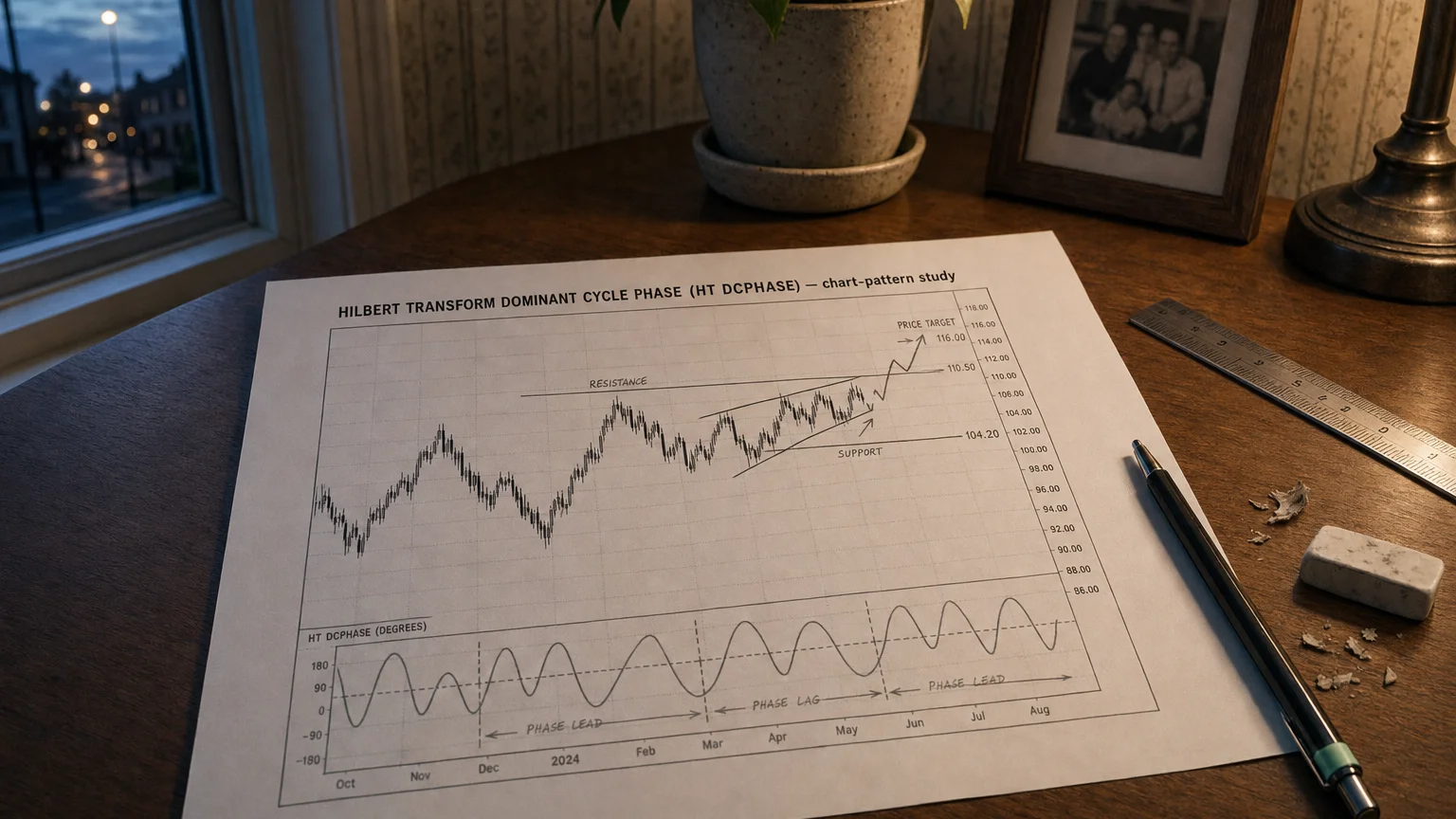
After the Dominant Cycle Period (DCPERIOD) gauges how long the market’s current rhythm is, the Dominant Cycle Phase pinpoints where in that rhythm price is right now (crest, trough, upswing, downswing).
John Ehlers introduced DCPHASE in the early-2000s to let traders time entries and exits at consistent points of an ever-changing cycle instead of relying on fixed-length oscillators.
How it’s computed – signal-flow sketch
-
Detrend price (median or close) with a high-pass or EMA filter to remove slow drift.
-
Apply a discrete Hilbert Transform to produce two components each bar:
-
In-Phase (I) → real part
-
Quadrature (Q) → 90°-shifted imaginary part
-
-
Instantaneous phase (raw angle):
(Formula — visualization pending)
Output in degrees or radians; unwrap so phase is continuous over time.
-
Normalize to dominant cycle:
If DCPERIODₜ ≠ previous period length, rescale phase so one full 360° sweep aligns with that dominant period. -
Smooth the phase with a short EMA (e.g., 0.33 α) to damp jitter.
Reading the dial — key phase landmarks
| Phase angle (deg) | Cycle position | Tactical implication |
|---|---|---|
| ** 0° / 360°** | Trough | Potential long seed area |
| ** 90°** | Upswing crest → mid-rise | Momentum strongest upward |
| 180° | Peak | Watch for topping signals / profit-take |
| 270° | Downswing trough → mid-fall | Momentum strongest downward |
Rule of thumb: Long setups when phase crosses 0°→30° rising; Short when phase falls through 180°→210° if confirmed by price/volume.
Example trading frameworks
| Module | Phase-driven rule |
|---|---|
| Adaptive Stochastic | %K look-back = ½ × DCPERIOD; trigger trades only when phase ∈ [350°, 30°] for longs, [170°, 210°] for shorts. |
| Cycle-synced stops | Exit long if phase > 150° and ADX turns down; exit short if phase < 330° and momentum turns up. |
| Composite Oscillator | MACD fast/slow lengths = 0.15 × DCPERIOD / 0.45 × DCPERIOD, then filter crosses with phase direction. |
Strengths
-
Phase tells timing, not just trend/no-trend: offers when as well as what.
-
Self-adapting – follows cycle length changes measured by DCPERIOD.
-
Pairs naturally with any adaptive MA, stochastic, or swing-projection logic.
Limitations & caveats
-
Requires clean data – gaps, thin volume, or spikes distort the Hilbert pair.
-
Whipsaw in non-cyclic regimes – during strong news moves or “random walks” the concept of a dominant cycle breaks down; use ADX or volatility filters.
-
Initialization lag – needs ≈ 50 bars to stabilise both the Hilbert filter and the period estimate.
Implementation checklist
-
Feed a smoothed median price ((H+L)/2) to cut noise.
-
Unwrap phase (avoid 360° jumps) before analysis.
-
Synchronise with DCPERIOD each bar so the 360° corresponds to the latest wavelength.
-
Confirm with a strength metric (ADX > 15 or VHF rising) before trading pure phase turns.
-
Risk (R) – place stops at opposite cycle extremes or ATR(14) away; phase alone is not a stop tool.
Summary
The Hilbert Transform — Dominant Cycle Phase is your market metronome: it pinpoints the real-time “beat” of price so you can strike near troughs, fade near peaks, or sync adaptive indicators to the rhythm in between. Use it as a timing overlay, always backed by confirmation of trend strength and volatility, and you’ll trade in step with the market’s current tune instead of dancing to yesterday’s beat. Rock on and manage that risk!
Q · 01 What is Hilbert Transform Dominant Cycle Phase Ht Dcphase? +