Kaufman Adaptive Moving Average (KAMA) is a financial concept covered in this article. The Smart MA That Speeds Up in Trends and Chills Out in Chop
The goal of a successful trader is to make the best trades. Money is secondary.

Developed by Perry J. Kaufman in 1995 (Smarter Trading), KAMA tries to “swing when the market swings and stay still when the market drifts.”
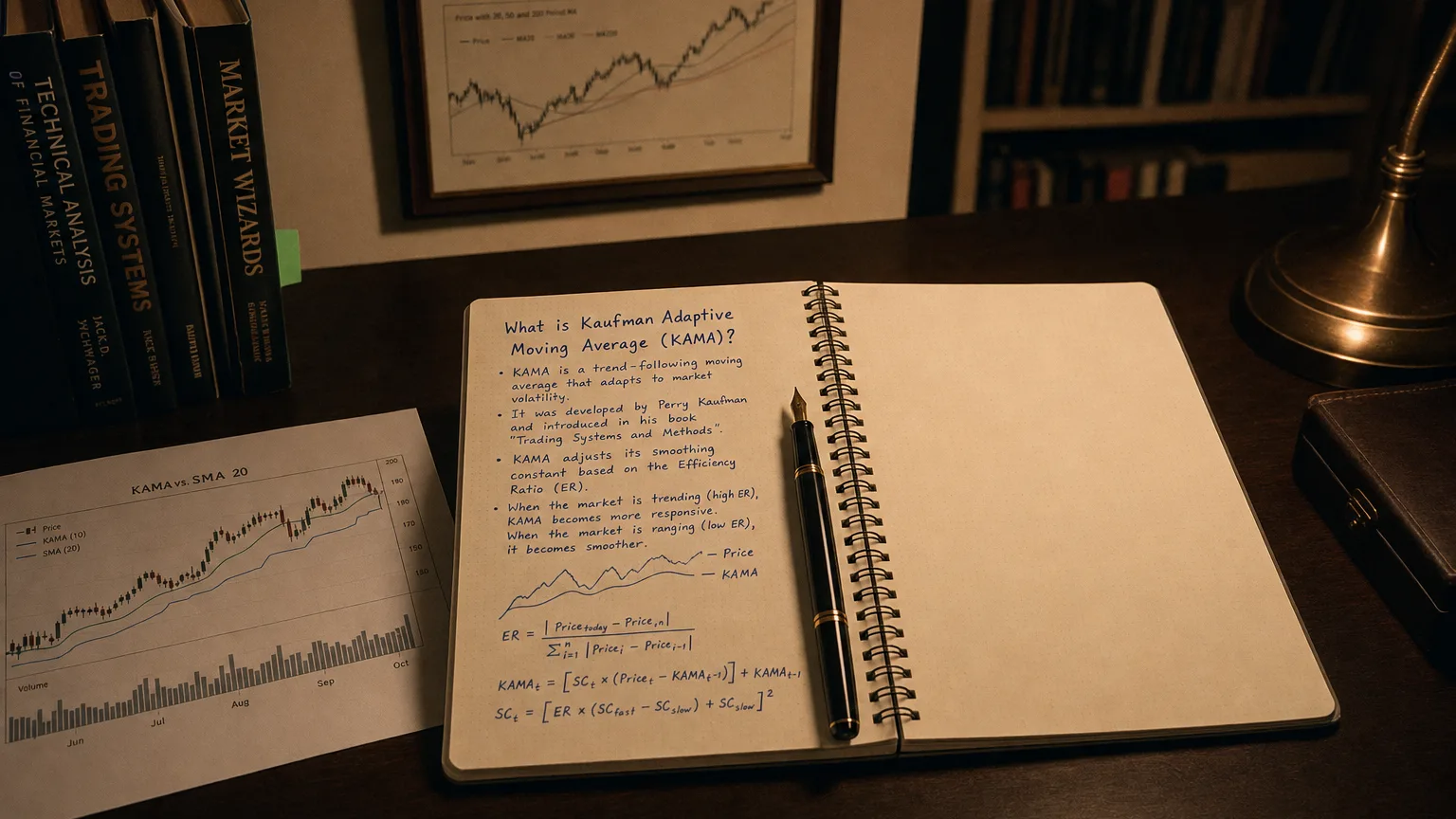
Problem solved: a classic moving average uses a fixed smoothing length, lagging badly in fast trends and whipsawing in low volatility. KAMA adapts its own speed every bar, based on the ratio of directional efficiency to noise.
Formula Walk-through
- Efficiency Ratio (ER) – 0 ≤ ER ≤ 1
(Formula — visualization pending)
If price moved in a straight line ER≈1; if it whipsawed back and forth ER≈0.
- Adaptive Smoothing Constant (SC)
Choose fast & slow EMA equivalents (e.g., 2-period and 30-period).
(Formula — visualization pending)
- KAMA update (EMA form)
(Formula — visualization pending)
seeded with an SMA of the first nnn prices.
Interpretation
| Behaviour | Reading |
|---|---|
| ER near 1 | Price direction clear ⇒ SC ≈ fast ⇒ KAMA tracks closely. |
| ER near 0 | Noise dominates ⇒ SC shrinks ⇒ KAMA flattens (acts like long MA). |
| Slope > 0 | Upswing; support/trend line. |
| Slope < 0 | Downswing; resistance/trend line. |
Trading Applications
-
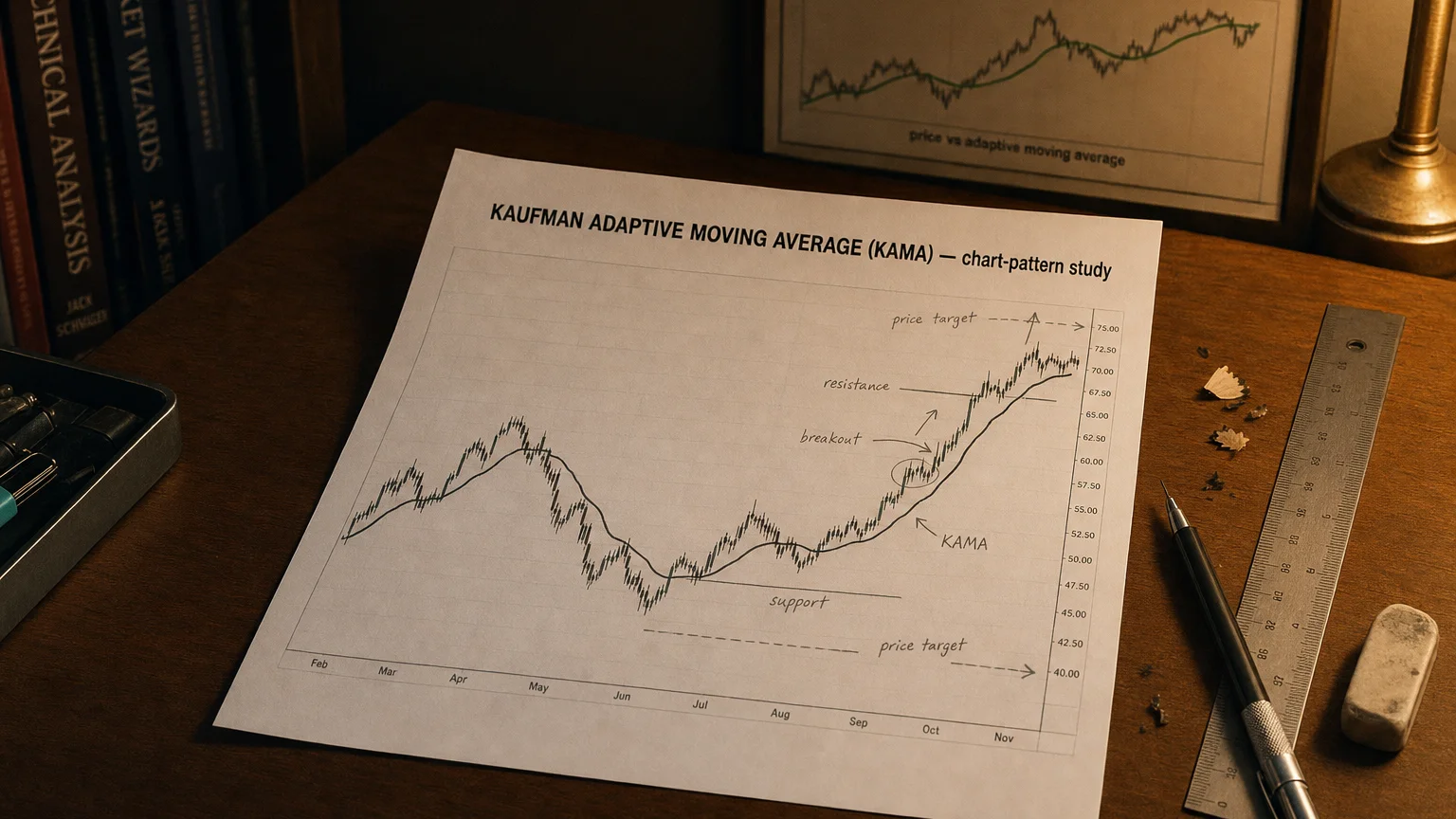
Trend filter – Stay long while price > KAMA and KAMA rising; short while below & falling.
-
Crossover system – Fast KAMA(2,30,10) vs slow SMA(50); trade the crosses.
-
Pull-back entry – In an up-trend, buy the first candle that tests & closes back above KAMA; stop 1 × ATR below.
-
Volatility throttle – Scale position size with ER: larger when ER > 0.6, smaller when ER < 0.3.
Strengths & Caveats
Pros
-
Self-tuning – speeds up in trends, slows in noise.
-
Reduced whipsaws in choppy zones compared with fixed EMAs.
-
Simple parameters (fast, slow, ER window) yet broadly robust.
Cons
-
Parameter trade-off – too-small slow length ≈ over-sensitive; too-large ≈ laggy.
-
Flat-line risk – during ultra-low volatility ER ≈ 0 ⇒ SC tiny ⇒ KAMA freezes; add a minimum SC floor if desired.
-
Not immune to gaps/news – big jumps still overshoot before KAMA catches up.
Take-away
The Kaufman Adaptive Moving Average replaces the one-size-fits-all smoothing constant with a bar-to-bar efficiency-weighted constant:
(Formula — visualization pending)
When markets trend, KAMA hugs price; when they meander, it parks itself, giving traders a dynamic support/resistance ribbon and a reliable trend filter that automatically adapts to changing volatility. Rock on and manage that risk!
Q · 01 What is Kaufman Adaptive Moving Average Kama? +