In-Neck Candlestick Pattern is a financial concept covered in this article. The Bearish Breather Before the Next Plunge
There is nothing new on Wall Street or in stock speculation. What has happened in the past will happen again and again.
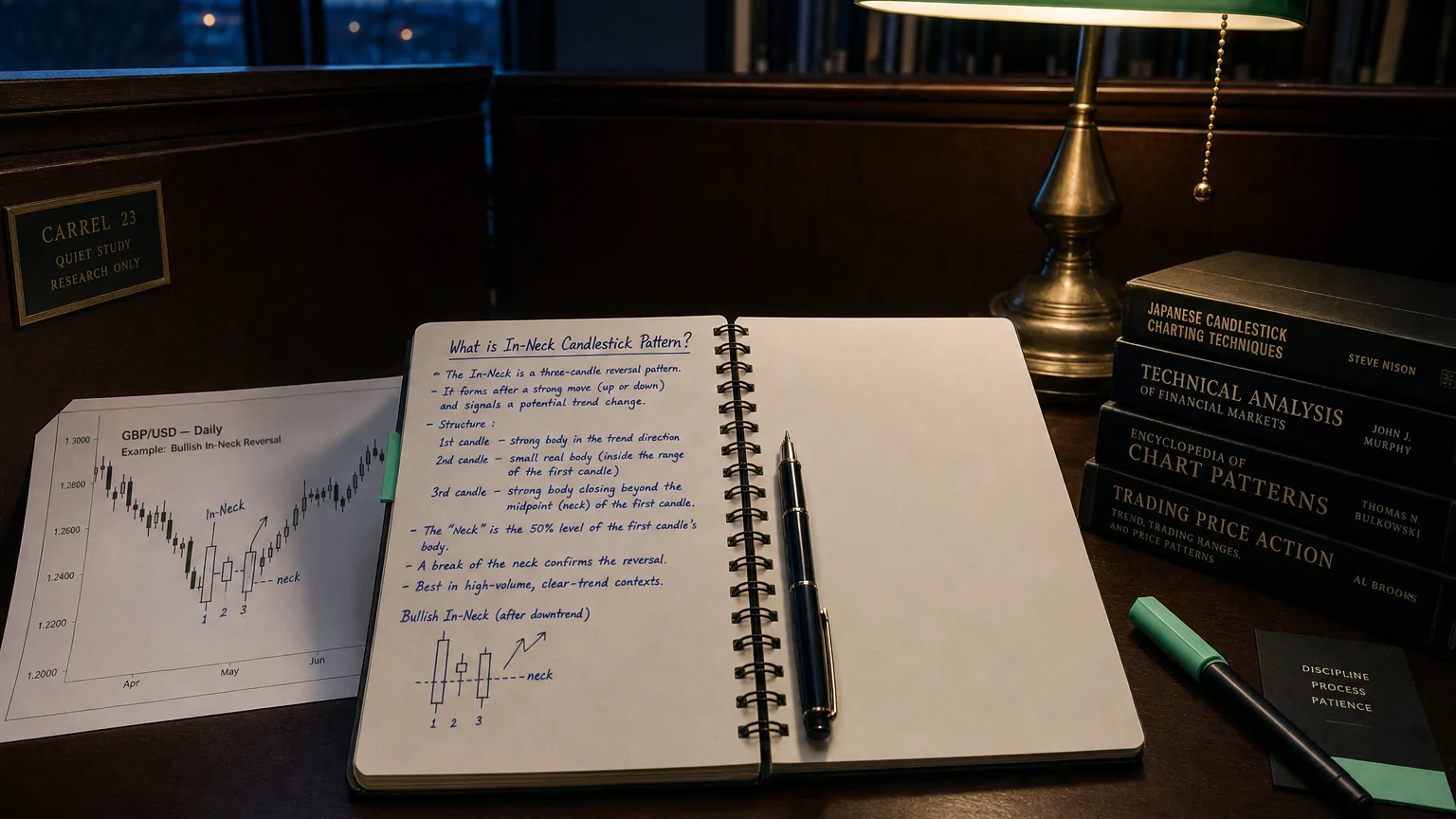
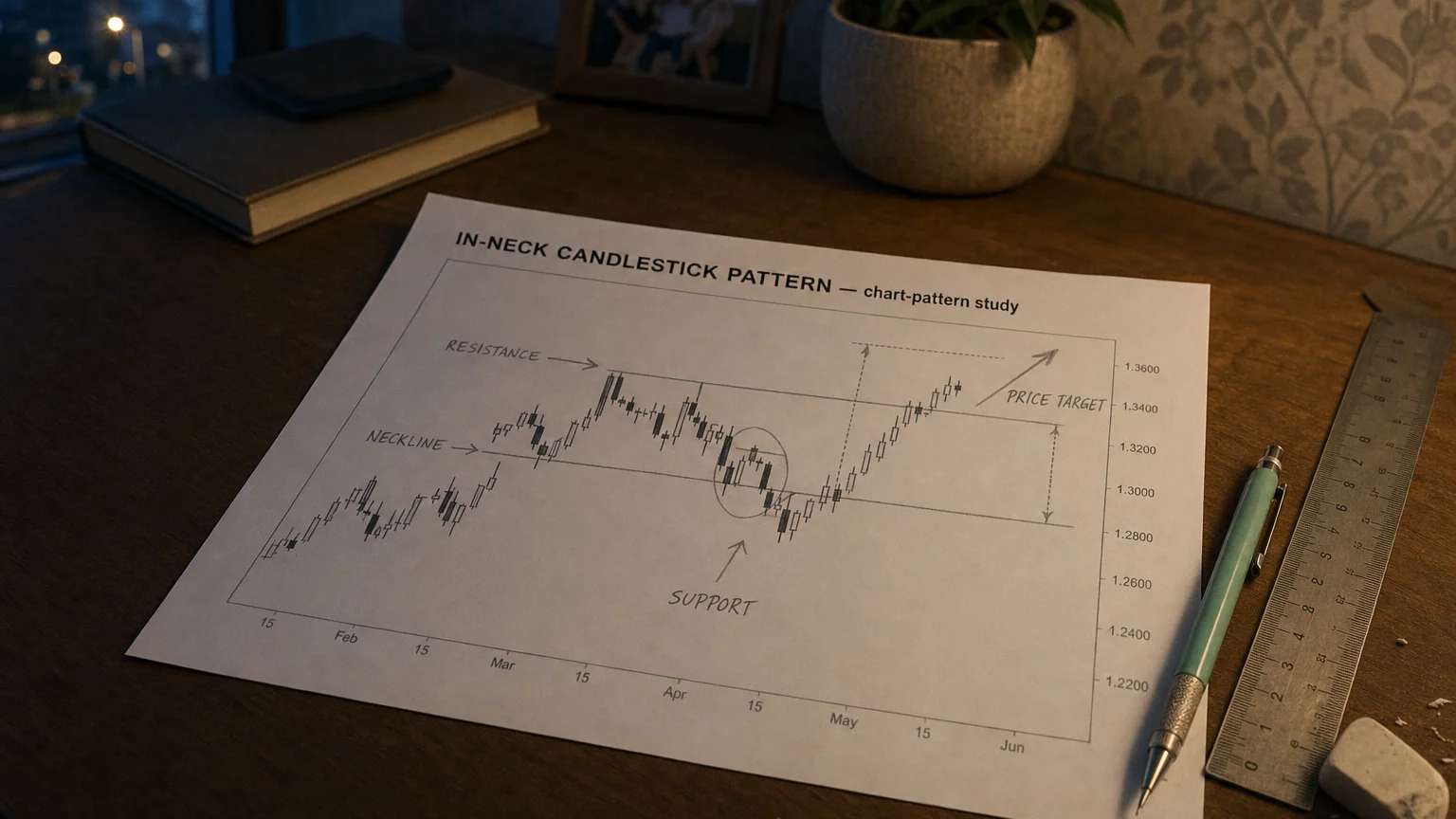
The In-Neck (also written In-Neck Line) is a two-candle bearish-continuation signal first catalogued in Japanese candlestick literature and later quantified by analysts such as Thomas Bulkowski. It appears within a prevailing down-trend and hints that bearish pressure is pausing—but not reversing—before the next leg lower.
How to recognise it – rule set
| Step | Bearish In-Neck requirements | Rationale |
|---|---|---|
| Background trend | Clear, established down-trend | Pattern is a continuation cue |
| Candle #1 | Long black/red body closing near its low | Bears firmly in control |
| Candle #2 | Opens below Candle #1’s low (gap-down) Closes slightly above Candle #1’s close but within the lower quarter of its body |
Bulls try a bounce, but can’t reclaim even half the prior drop |
| Upper/lower shadows | Ideally small on both candles | Emphasises directional conviction |
| Confirmation (optional) | Subsequent close below Candle #2 low | Filters out false prints |
Tip: If the second candle closes exactly at the prior close the pattern is an On-Neck; if it closes deeper inside the body (~30-50 %), it becomes a Thrusting pattern; beyond the midpoint it morphs into a Piercing Line (a bullish reversal).
Market psychology
-
Sell-off momentum (Candle #1) – bears drive price hard, fuelling fear.
-
Gap-down open (Candle #2) – sentiment remains bearish, but buyers sense short-term oversold conditions.
-
Feeble rebound – bulls manage only a marginal close above the prior close. Sellers have not been overrun; they’ve simply paused.
-
Continuation trigger – when price rolls back under Candle #2 the trapped dip-buyers bail, accelerating the down-move.
Trading blueprint
| Element | Typical tactic |
|---|---|
| Entry | Aggressive: short on the close of Candle #2. Conservative: wait for a break/close beneath Candle #2 low. |
| Initial stop | Above the high of Candle #1 (or ATR × 1). |
| Profit targets | 1.5–3 R, or next support / measured move equal to Candle #1’s range. |
| Filters that improve edge | • Rising volume on Candle #1 • Momentum indicators (RSI < 30) confirming weakness • Pattern occurs within lower third of yearly price range (Bulkowski finding). |
Statistical tendencies (Bulkowski, 5 M US candles 1991-2024)
| Metric | Result |
|---|---|
| Bearish continuation rate | 53 % – only slightly better than random |
| Frequency rank (of 103 patterns) | 62 (relatively rare) |
| Overall performance rank | 17 (top quintile) |
| Best 10-day move after breakout | 6.34 % (bear-mkt, up breakout) |
Key takeaway: while direction is only marginally bearish, when the breakout occurs the subsequent move is swift, making the pattern attractive for risk-focused traders.
Strengths
-
Clear, programmable rules – easy to scan.
-
Tight risk box – second candle’s narrow advance confines stop placement.
-
Works best near multi-month lows (per Bulkowski), where late bulls are most vulnerable.
Limitations & common pitfalls
-
Low occurrence rate on higher time-frames; patience required.
-
Only a near-random 53 % continuation rate—confirmation is critical.
-
Can be confused with On-Neck/Thrusting variants; mis-classification dilutes edge.
Quick visual checklist
⬇️ Down-trend in place
🟥 Long red candle closes near the low
↘️ Gap-down next session
🟩 Small green body closes just above prior close
📉 Breakdown below the green candle = short trigger
Bottom line
The In-Neck Pattern is a subtle “pause-then-plunge” formation: bulls muster a token counter-attack, but the effort stalls almost exactly where bears finished the prior day. That micro-failure often preludes renewed downside momentum. Trade the pattern only in strong down-trends, demand a breakdown confirmation, and you gain a compact, statistically vetted way to ride the next leg lower while keeping risk on a tight leash.
Q · 01 What is In-Neck Candlestick Pattern? +