
On Balance Volume (OBV) is a financial concept covered in this article. The Classic Volume Flow Indicator That Tracks Smart Money Pressure
A Tape Reader abhors information and follows a definite and thoroughly tested plan, which after months and years of practice becomes second nature to him.
Created by Joseph Granville in the 1960s, On Balance Volume (OBV) is one of the earliest and most enduring volume-based indicators. It keeps a running total of volume, adding the day’s volume on up closes and subtracting on down closes. The idea? Volume precedes price – rising OBV shows accumulation (buyers in control), falling OBV signals distribution (sellers dominating). Even without price on the chart, OBV often leads turns, making it a favorite for spotting divergences and confirming breakouts. Simple, powerful, and still crushing it after decades.
The Simple Calculation – Cumulative Volume Flow
Running total logic:
- If today’s close > yesterday’s close: OBV = Previous OBV + Today’s Volume
- If today’s close < yesterday’s close: OBV = Previous OBV − Today’s Volume
- If close unchanged: OBV = Previous OBV (no change)
Starts from zero (or arbitrary) – absolute level meaningless, direction and slope matter.
Some platforms let you add a moving average to OBV for signal crosses.
“A Tape Reader abhors information and follows a definite and thoroughly tested plan based on conditions as they appear moment by moment in the market.”
— Richard D. Wyckoff, Tape reader, founder of The Magazine of Wall Street, pioneer of technical analysis Studies in Tape Reading, Ticker Publishing Company, New York, 1910 (under pseudonym Rollo Tape), Chapter I (1910)
Reading OBV – What the Line Tells You
Key patterns:
- Rising OBV: Accumulation – buyers absorbing supply, bullish bias.
- Falling OBV: Distribution – sellers in control, bearish pressure.
- OBV new high with price: Confirmed uptrend – volume backing move.
- OBV divergence: Price higher high + flat/lower OBV → weakening bulls.
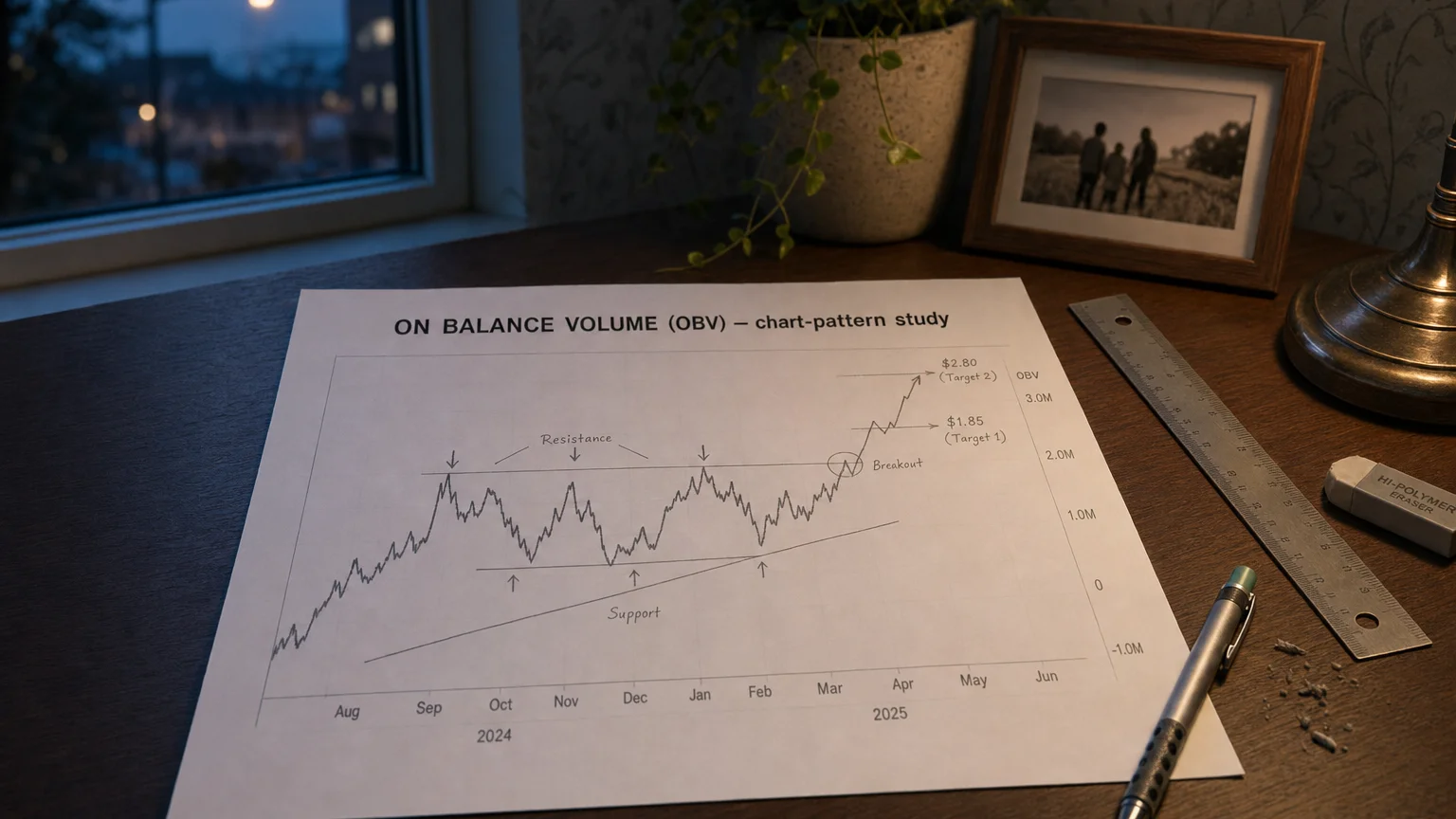
- OBV confirming breakout: Price breaks resistance + OBV surges → valid move.
OBV often leads price – watch for early warnings.
Pro Trading Setups
Battle-tested plays:
- Trend confirmation: Price rising + OBV rising stronger → stay long.
- Divergence reversal: Bearish divergence + price at resistance → short setup.
- Breakout validation: Price breakout + OBV breakout from its range → higher probability.
- Pullback entry: Uptrend + OBV dip then resume up → buy the dip with volume support.
Granville’s rule: Volume confirms price – trust moves where OBV agrees.
Enhancements and Variations
Common tweaks:
- OBV with MA: Add 20–50 period MA – crosses for signals.
- OBV trendline: Draw lines on OBV – breaks often precede price.
- On-Balance Volume Oscillator: OBV − MA(OBV) – centered momentum view.
Smart Combinations
Pair for power:
- Price action: Breakout + OBV surge = conviction.
- Momentum (RSI/MACD): Divergence confirmation.
- Trend tools (MA/ADX): OBV rising in uptrend = strong.
- Support/Resistance: OBV divergence at key level = reversal alert.
Strengths and Classic Limitations
The Wins
- Pure volume flow – leads price in divergences and confirmations.
- Simple, no parameters – easy to interpret.
- Excellent for spotting accumulation/distribution.
- Works across all volume-reporting assets.
The Gotchas
- Ignores intraday range – close-only focus.
- No volume on forex/crypto spot – needs tick volume proxy.
- Absolute level meaningless – focus on direction/slope.
- Can lag in very strong trends (volume confirms late).
Your OBV Launch Checklist
- Plot OBV below price chart.
- Draw trendlines on OBV for early breaks.
- Watch divergences religiously.
- Require OBV confirmation on breakouts.
- Add light MA for crossover signals if desired.
- Use for validation, not standalone entries.
Q · 01 What is On Balance Volume? +