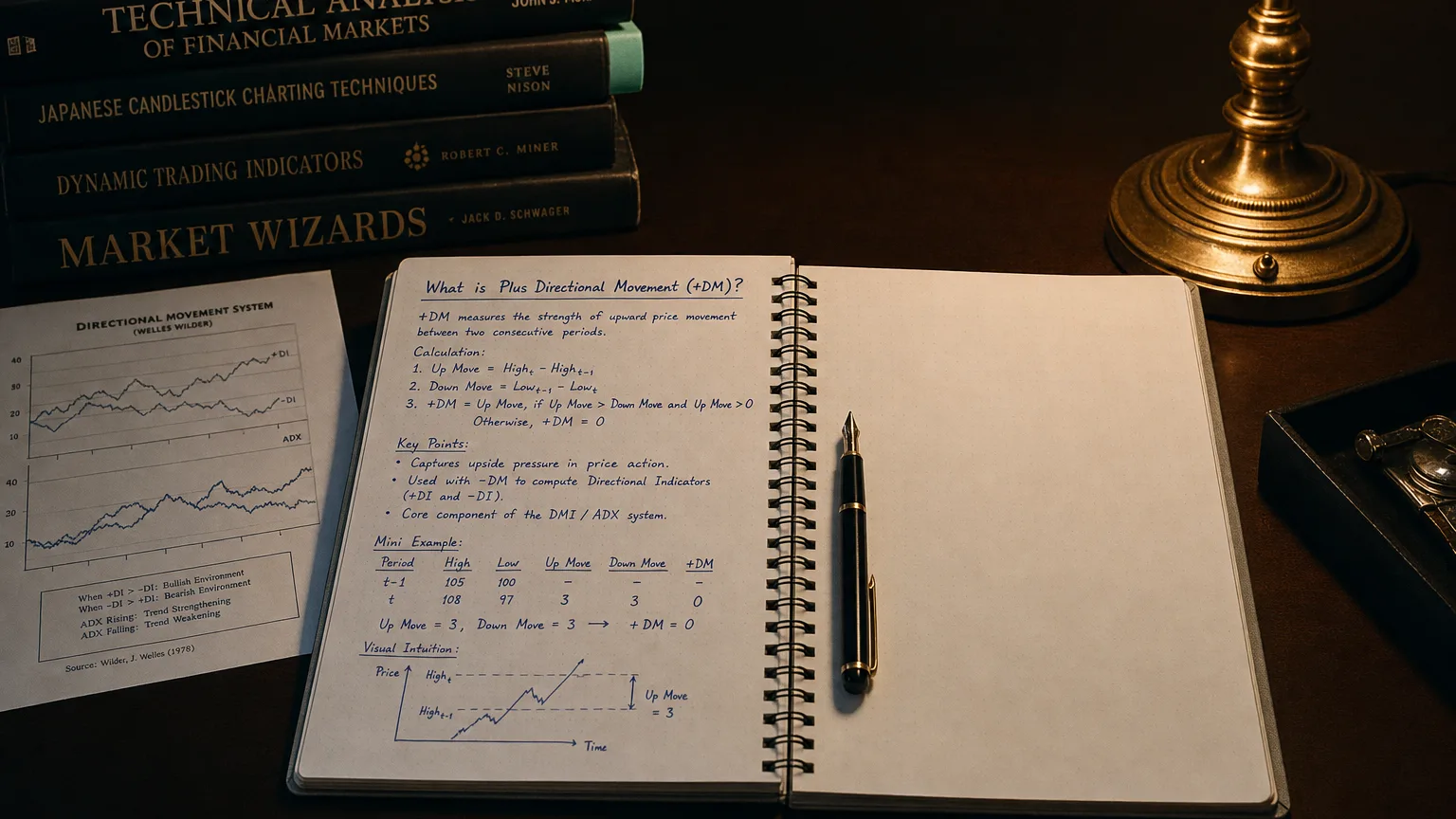
is a financial concept covered in this article. The Raw Upside Explosion Fuel Behind Wilder's +DI
The most important rule of trading is to play great defense, not great offense.
Before we get the polished +DI line on our charts, there’s a scrappier precursor: the Plus Directional Movement (+DM). Created by J. Welles Wilder as part of his Directional Movement System, +DM is the unfiltered measure of pure upward price thrust. It captures how much today’s high blasted past yesterday’s high – the raw material that tells us when buyers are aggressively pushing prices higher. Think of +DM as the bullish rocket fuel; +DI is what happens after we smooth and normalize it. It’s the foundational piece that powers the whole DMI trend-detection machine.
How +DM Is Calculated – Straightforward but Clever
Wilder kept it simple:
- Calculate today’s upward move: Current High − Previous High.
- If that value is positive and greater than the downward move (Previous Low − Current Low), then +DM = that upward move.
- Otherwise, +DM = 0 (even if there’s some upside – downside wins the day).
Result? +DM only lights up on clear bullish expansion days – inside bars or days where downside outpaces upside get zero credit.
Most platforms hide raw +DM and jump straight to smoothed +DI, but understanding the source helps you ‘feel’ why +DI behaves the way it does.
“The most important rule of trading is to play great defense, not great offense.”
— Paul Tudor Jones, Founder of Tudor Investment Corporation, hedge fund manager Market Wizards: Interviews with Top Traders, Jack D. Schwager (New York Institute of Finance, 1989), chapter “Paul Tudor Jones — The Art of Aggressive Trading” (1989)
What +DM Really Reveals
Key insights from watching raw +DM:
- Big +DM spikes: Explosive buying pressure – often at trend starts or breakouts.
- Series of +DM > -DM: Sustained bullish expansion – the engine of uptrends.
- +DM drying up: Buyers losing steam – even if price still drifts higher on inertia.
- +DM consistently zero: No real upside thrust – likely range-bound or bear-controlled.
It’s noisier than +DI, but that rawness can give earlier clues about shifting buyer aggression.
Practical Trading Angles
While most traders use smoothed +DI, raw +DM still has its fans:
- Breakout confirmation: Big +DM bar on breakout volume → higher probability move.
- Trend health check: In an uptrend, watch for shrinking +DM values → potential weakness before +DI even crosses down.
- Custom indicators: Some coders build momentum oscillators directly off smoothed +DM series.
- Combine with -DM: When +DM consistently dominates -DM over recent bars → strong bullish bias.
+DM feeds directly into +DI calculation – strong +DM bursts are what push +DI higher and trigger bullish crosses.
Strengths and Limitations
The Strengths
- Pure, unfiltered measure of upside expansion – no averaging lag yet.
- Great for spotting explosive buying days early.
- Foundational building block of the entire proven DMI/ADX system.
The Drawbacks
- Very noisy – lots of zero days and erratic spikes.
- Not normalized – big stocks/cryptos show huge raw values vs cheap ones.
- Rarely useful standalone – needs smoothing (into +DI) and context (ADX strength).
Your +DM Quick Exploration Checklist
- Plot raw +DM and -DM alongside price to see the ‘explosion’ bars.
- Compare spikes to volume – real buying or just noise?
- Watch how sustained +DM leads to +DI rising and crossing above -DI.
- Use in breakout scanners: filter for recent large +DM values.
- Remember it’s fuel – +DI and ADX turn it into actionable signals.