
How these rare five-candle continuation patterns signal that a trend is just taking a breath before its next big move.
There is nothing new on Wall Street or in stock speculation. What has happened in the past will happen again and again.

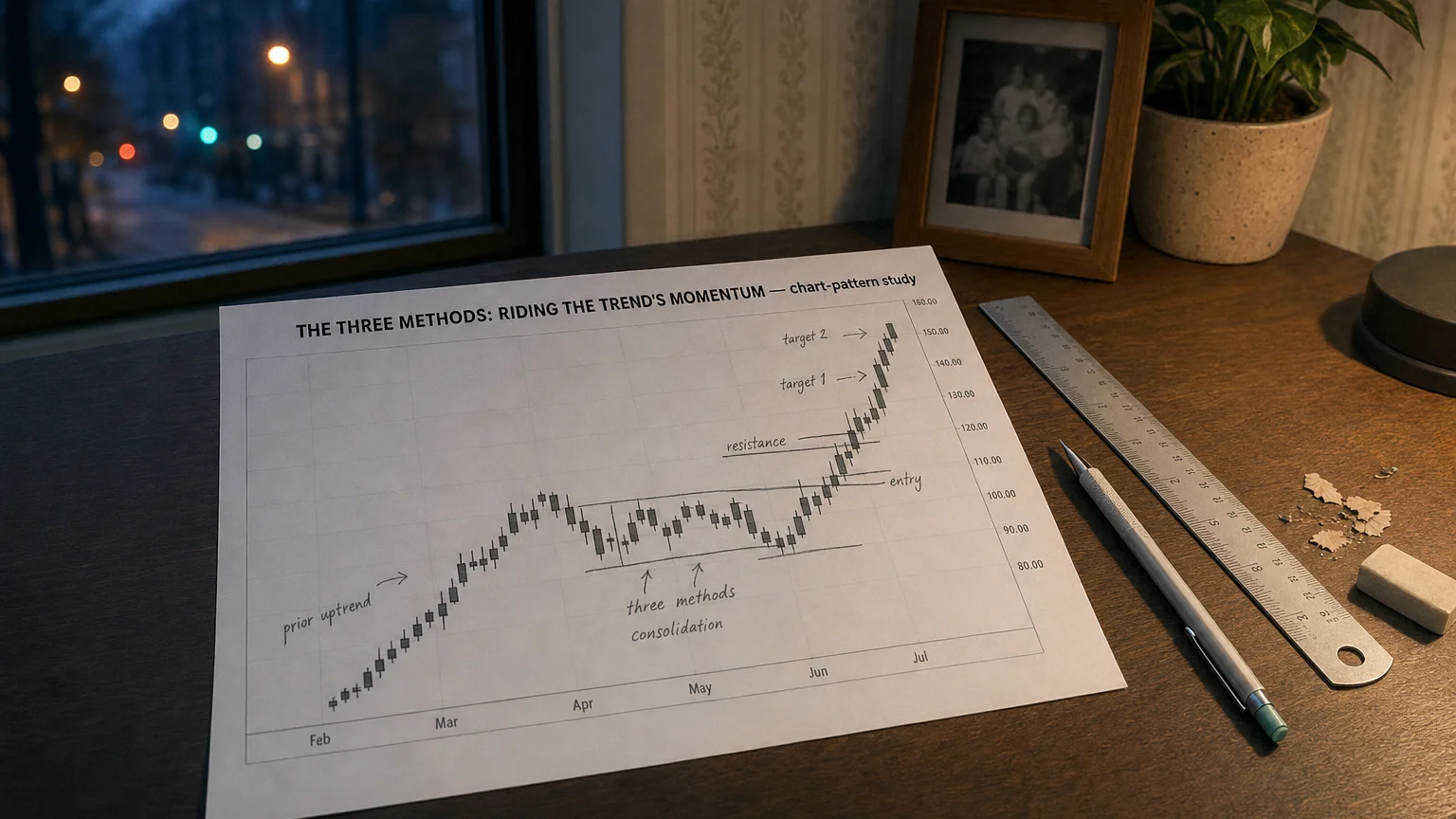
The Three Methods are five-candle continuation formations:
-
Rising Three Methods – pauses inside an up-trend and usually resolve higher.
-
Falling Three Methods – pauses inside a down-trend and usually resolve lower.
Both patterns compress price without letting it escape the “mother-candle’s” range, then thrust in the direction of the primary trend. Tom Bulkowski’s large-sample study confirms the textbook bias: bullish continuation 74 % for the rising setup and bearish continuation 71 % for the falling twin, although they are rare (frequency ranks 88 & 91 out of 103).
Anatomy – 5-bar checklist
| Position | Rising (bullish) | Falling (bearish) |
|---|---|---|
| 1 – Impulse | Long green body, closes near high | Long red body, closes near low |
| 2-4 – Pullback trio | Three small candles drift lower yet stay inside the range of Candle 1 | Three small candles drift higher yet stay inside Candle 1 |
| 5 – Continuation thrust | Long green candle closes above Candle 1 high | Long red candle closes below Candle 1 low |
Extra filters that improve reliability:
-
Candle 2 should open within the top (or bottom) third of Candle 1, keeping the pullback shallow.
-
The pullback trio’s combined volume lighter than Candle 1 or 5.
Market psychology
-
Impulse bar – dominant side (bulls or bears) shows unquestioned control.
-
Controlled digestion – the counter-trend trio reflects profit-taking, but each close stays caged by the impulse bar → opposing side can’t break free.
-
Breakout bar – primary trend traders reload, shorts/late faders cover, producing a fresh momentum burst that “completes the measured-move in miniature.”
Trader’s playbook
| Element | Long (Rising) | Short (Falling) |
|---|---|---|
| Entry | Buy on Candle 5 close or break above its high | Sell/short on Candle 5 close or break below its low |
| Initial stop | Under Candle 4 low or 1 × ATR(14) | Above Candle 4 high or 1 × ATR(14) |
| Targets | 1.5 – 3 R, prior resistance, or measured-move = height of Candle 1 | Mirror for shorts |
| Edge boosters | Rising 20-EMA slope, volume ≥ 1.2× avg on Candle 5, higher-TF up-trend | Declining 20-EMA slope, vol ≥ avg, higher-TF down-trend |
| Time filter | If price fails to gain ≥ 0.5 R in 3-5 bars, tighten or scratch | Same |
Statistical tendencies (Bulkowski, 4.7 M US daily candles)
| Variant | Continuation rate | Frequency rank | Performance rank* |
|---|---|---|---|
| Rising | 74 % bullish | 88 / 103 | 94 / 103 |
| Falling | 71 % bearish | 91 / 103 | 89 / 103 |
*Overall 10-day performance after breakout; low rank driven by scarcity, not accuracy.
Strengths & limitations
Pros
-
Clear, rule-based structure – scanner friendly.
-
Tight invalidation: stops nest just outside Candle 4.
-
High continuation reliability when they appear.
Cons
-
Ultra-rare – expect long waits on liquid symbols.
-
Average post-breakout move modest; best as a timing trigger within an existing trend-following strategy.
-
Edge erodes if middle trio closes outside Candle 1 range or volume is heavy during pullback.
Quick visual cue
-
Rising 3 Methods Falling 3 Methods
-
🟩 long up bar 🟥 long down bar
-
🟥🟥🟥 three tiny pullback 🟩🟩🟩 three tiny bounce
-
🟩 big breakout close↑ 🟥 big breakdown close↓
-
Entry → on bar 5 thrust Stop → just past bar 4 extreme
Summary
The Rising / Falling Three Methods act like a spring coiling inside the trend: a forceful impulse, three tight counter-candles, then a decisive release. Trade with the prevailing trend—enter on the fifth-bar breakout, park your stop behind the pullback floor/ceiling, and look for a quick 1.5–3 R pop. Because the pattern is scarce and the follow-through can be shallow, size conservatively and pair it with volume, momentum, and higher-time-frame confirmation to let the trend do the heavy lifting while you rock that risk control.
Q · 01 What is The Three Methods? +