
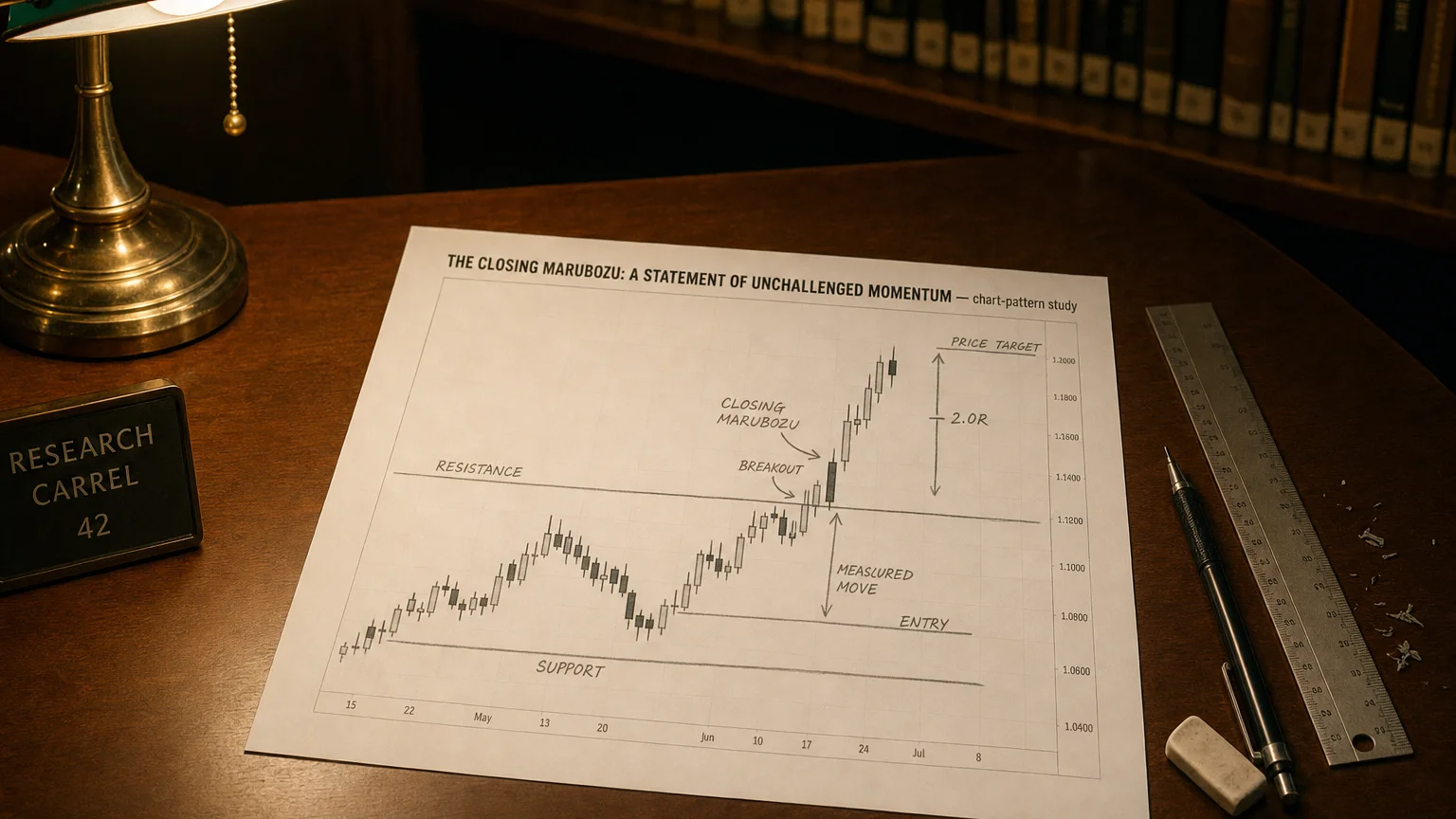
A closing marubozu closes at its absolute high (bullish) or absolute low (bearish) with no wick on the closing side. This absence signals that the dominant party maintained full control through the session’s final moment, indicating unrelenting directional momentum.
There is nothing new on Wall Street or in stock speculation. What has happened in the past will happen again and again.

The Closing Marubozu is a single-candle momentum pattern that signals unrelenting control by either buyers or sellers. This candle doesn’t mess around — there’s no hesitation, no back-and-forth, just raw, directional dominance.
Whether it’s bullish or bearish, the Closing Marubozu says one thing loud and clear:
“One side has taken over the session — and they’re not leaving quietly.”
Structure of the Closing Marubozu
There are two types:
Bullish Closing Marubozu
-
Open: Near or exactly at the low of the candle.
-
Close: At the absolute high of the candle — no upper wick.
-
Body: Long and strong — shows consistent buying all session long.
Bearish Closing Marubozu
-
Open: Near or exactly at the high of the candle.
-
Close: At the absolute low of the candle — no lower wick.
-
Body: Long and solid — nonstop selling pressure start to finish.
Key Signature: No wick on the closing side — the market closed at the most extreme price of the day.
Interpretation and Sentiment Signal
| Candle Type | Market Message |
|---|---|
| Bullish Marubozu | Buyers dominated from start to close |
| Bearish Marubozu | Sellers drove the price down with no mercy |
| No wick at close | Unchallenged momentum — high conviction |
| Appears after trend | Can act as confirmation or reversal candle |
This candle can appear:
-
As a continuation signal in an existing trend (momentum surge).
-
As a reversal candle, especially if it breaks through a key level.
-
Or as a confirmation of a breakout (e.g., from a wedge, consolidation, or news catalyst).
Strategic Use Cases
-
Breakout Confirmation
- Closing Marubozus often show up right after a breakout — telling you, “This is real.”
-
Momentum Entry Trigger
- Great signal for trend-following entries — particularly when paired with volume and directional bias.
-
Risk Calibration Tool
- Allows for tight stop-loss placement beneath/above the candle when initiating trades.
-
Trend Reversal Marker
- When it breaks a major support/resistance level — it may mark the beginning of a reversal trend.
Professional Applications
-
Quantitative Models: Used in candle structure filters to capture clean directional sessions.
-
Volume-Weighted Confirmation Systems: Used alongside VWAP or OBV for trend confirmation.
-
Intraday & Swing Strategies: Found on 5m–1h charts for short-term setups or daily charts for position entries.
-
Institutional Flow Tracking: Large Closing Marubozus on high volume = institutional footprint.
Limitations
-
Needs context: Not every Marubozu is a trade. Check for support/resistance, volume confirmation, and trend alignment.
-
Can signal exhaustion: If it appears after a parabolic move, it might be the last push before a pullback.
-
False triggers in illiquid markets: Look for high volume and clean price action.
Summary
The Closing Marubozu is a pure momentum candle — a laser-clear signal that either buyers or sellers commanded the session from open to close. It’s decisive. It’s aggressive. And when confirmed with volume and market structure, it can be one of the most powerful entry or confirmation signals in any technical trading system.
Q · 01 What distinguishes a closing marubozu from a full marubozu? +
Q · 02 How do traders use the closing marubozu as a risk tool? +