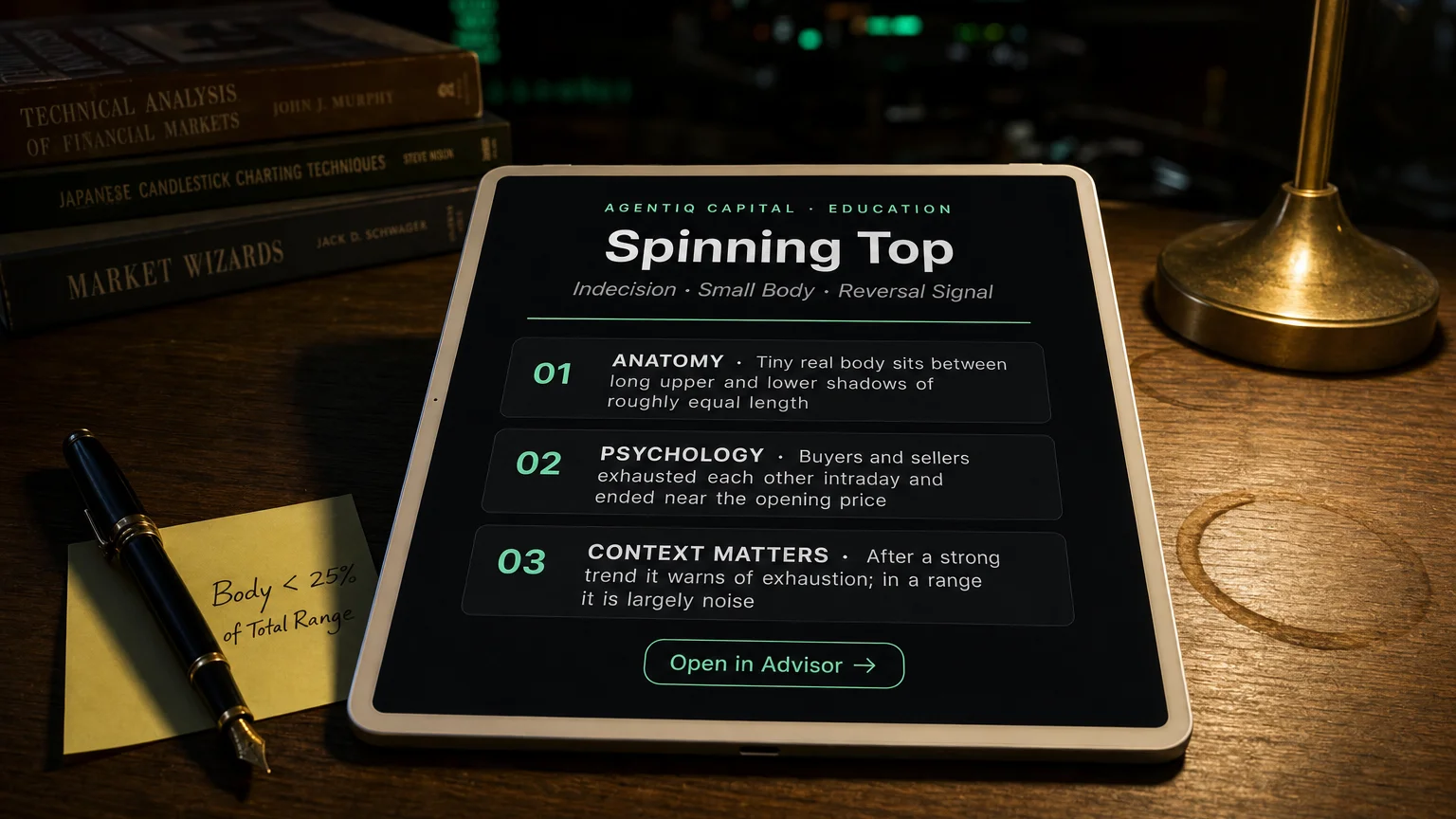
The Spinning Top Candle A Sign of Market Indecision
How to Read and Trade the Market's Stalemate Signal Learn the formula, key examples, and how investors use it in practice.

Overview
How to Read and Trade the Market's Stalemate Signal Learn the formula, key examples, and how investors use it in practice.
A Spinning Top is a candle with a small real body (open ≈ close) and long, roughly equal upper + lower shadows. It signals that neither bulls nor bears won the session: price probed hard in both directions but settled near the starting line, broadcasting market uncertainty.
Identification checklist
| Rule | Requirement | Why it matters |
|---|---|---|
| Body size | ≤ ~⅓ of the candle’s total range | Shows limited net progress |
| Shadows | Upper & lower wicks ≥ body and close to symmetric | Reveals two-sided battle |
| Colour | Green/white or red/black – colour carries little edge | Pattern is neutral |
| Trend context | Appears after any move; meaning comes from follow-through | Sets up either reversal or consolidation |
Tip: distinguish from a Long-Legged Doji (body ≈ zero) and Rickshaw Man (body exactly at range midpoint).
Market psychology
Volatility burst – intraday swings stretch both wicks.
Stalemate close – finish near open = no decisive victor.
Tension coil – stops cluster just outside the candle’s extremes; the next bar’s break often sparks a volatility pop.
Trading blueprint
| Approach | Long idea | Short idea |
|---|---|---|
| Breakout-play | Buy a close above the high on elevated volume | Sell/short a close below the low |
| Mean-revert | Fade upside break if candle sits at major resistance / overbought | Fade downside break at support / oversold |
| Initial stop | Opposite side of the candle or 1× ATR | Mirror |
| Targets | 1.5–3 R or return to 20-EMA | Same |
| Time filter | Scratch if price hasn’t moved ≥ 0.5 R in 3–5 bars | Ditto |
Because the range is tight, R (your risk unit) is small, so even modest follow-through can deliver attractive R-multiples.
Statistical tendencies (Bulkowski, 4.7 M U.S. daily candles)
| Variant | Breakout bias | Frequency rank† | Perf. rank† |
|---|---|---|---|
| Black Spinning Top | 50.5 % up / 49.5 % down – random | 1 / 103 (most common) | 58 / 103 |
| White Spinning Top | 49 % up / 51 % down – random | 2 / 103 | 69 / 103 |
†Lower rank = more frequent / stronger.
Take-away: the candle alone has no directional edge; confirmation and context drive profitability.
Strengths
High frequency – plentiful signals on all time-frames.
Tight stops – small body = narrow risk.
Excellent volatility early-warning when several cluster together.
Limitations & pitfalls
Neutral bias in isolation – must wait for breakout or confluence.
Easily confused with other small-body candles if chart is zoomed out.
News gaps can dwarf the setup, rendering the wick levels irrelevant.
Quick visual cue
┃
small ▓▓┼▓▓ body near centre
┃
long, roughly equal shadows
Break above high → long | Below low → short
Stop just past opposite wick
Summary
A Spinning Top is the market’s spinning compass needle—lots of motion, no net travel. Use it as an alert, not a verdict:
Wait for confirmation – a decisive close beyond the candle’s extreme, ideally on > 1.2× volume.
Set a surgical stop just beyond the opposite wick, keeping R compact.
Target 1.5–3 R or a mean-reversion level, bailing fast if price stalls; the indecision that birthed the candle can return just as quickly.
Apply those rules—and layer on support/resistance or momentum signals—and the humble Spinning Top turns from market shrug into tight-risk opportunity. Rock on and trade smart!