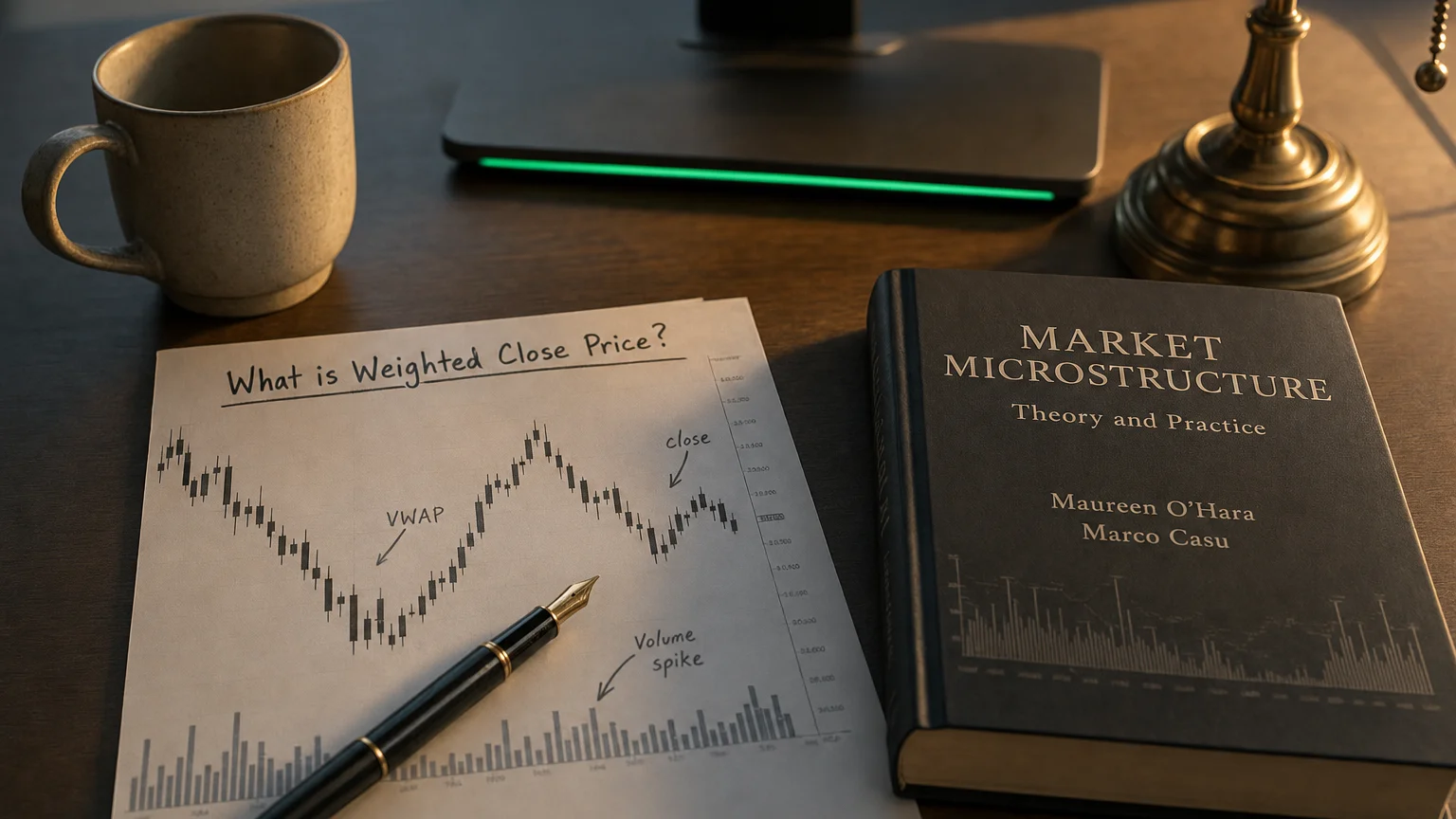
is a financial concept covered in this article. The Close-With-Extra-Emphasis That Gives More Weight to the Final Print
The technician believes that anything that can possibly affect the price—fundamentally, politically, psychologically, or otherwise—is actually reflected in the price of that market.
The Weighted Close Price is a simple but clever average that puts extra emphasis on the closing price while still incorporating the session’s range. By calculating (High + Low + Close + Close) / 4 – or equivalently (High + Low + 2×Close) / 4 – it gives the close twice the weight of high and low. The result is a smoother line than raw closes but one that’s more responsive to where the market actually settled. It’s a favorite input for indicators needing a close-biased yet range-aware price series, and a subtle upgrade for anyone tired of plain close noise.
The Straightforward Formula
Easy math:
Weighted Close = \frac{High + Low + 2 \times Close}{4}
Or equivalently: (High + Low + Close + Close) / 4 – double-counting the close.
Each bar gets a single value biased toward where trading finished.
“The technician believes that anything that can possibly affect the price—fundamentally, politically, psychologically, or otherwise—is actually reflected in the price of that market.”
— John J. Murphy, Technical Analyst & Author Technical Analysis of the Financial Markets (1999)
Why Weight the Close More?
Advantages over alternatives:
- Close emphasis: Many believe close is most important – settlement price matters.
- Smoother than raw close: Incorporates range, reduces single-tick spikes.
- Less extreme than close: High/low pull it toward session center.
- Better than Typical Price: When you want close to lead more than high/low.
Interpreting the Line
Practical reads:
- Price > rising Weighted Close: Close in upper range – bullish intraday control.
- Price < falling Weighted Close: Close in lower range – bearish pressure.
- Weighted Close flattening: Consolidation – balanced but indecisive.
- As pivot: Often soft support/resistance for very short-term moves.
Plot as line – smoother close proxy with range awareness.
Pro Applications
Where it adds value:
- Smoother close series: Use instead of raw close for MAs or oscillators.
- Indicator input: Some strategies prefer Weighted Close for momentum tools.
- Mean reversion: Price far from Weighted Close line → potential snap zone.
- Intraday bias: Quick read on whether close dominated the session.
Classic in some older systems – gives close the respect many traders feel it deserves.
Strengths and Natural Limits
The Wins
- Close-biased yet range-aware – best of both worlds.
- Reduces close noise while keeping settlement focus.
- Simple alternative to raw close series.
- Useful smoothing for short-term analysis.
The Gotchas
- Still influenced by close spikes – less balanced than Typical Price.
- No volume consideration.
- Soft levels – rarely strong S/R alone.
- Backward-looking per bar.
Your Weighted Close Quick-Start
- Plot the line on any chart.
- Compare price position for intraday bias.
- Use as smoother close input for indicators.
- Watch for mean reversion around the line.
- Combine with volume tools for fuller picture.
- Great middle ground between close and full range averages.