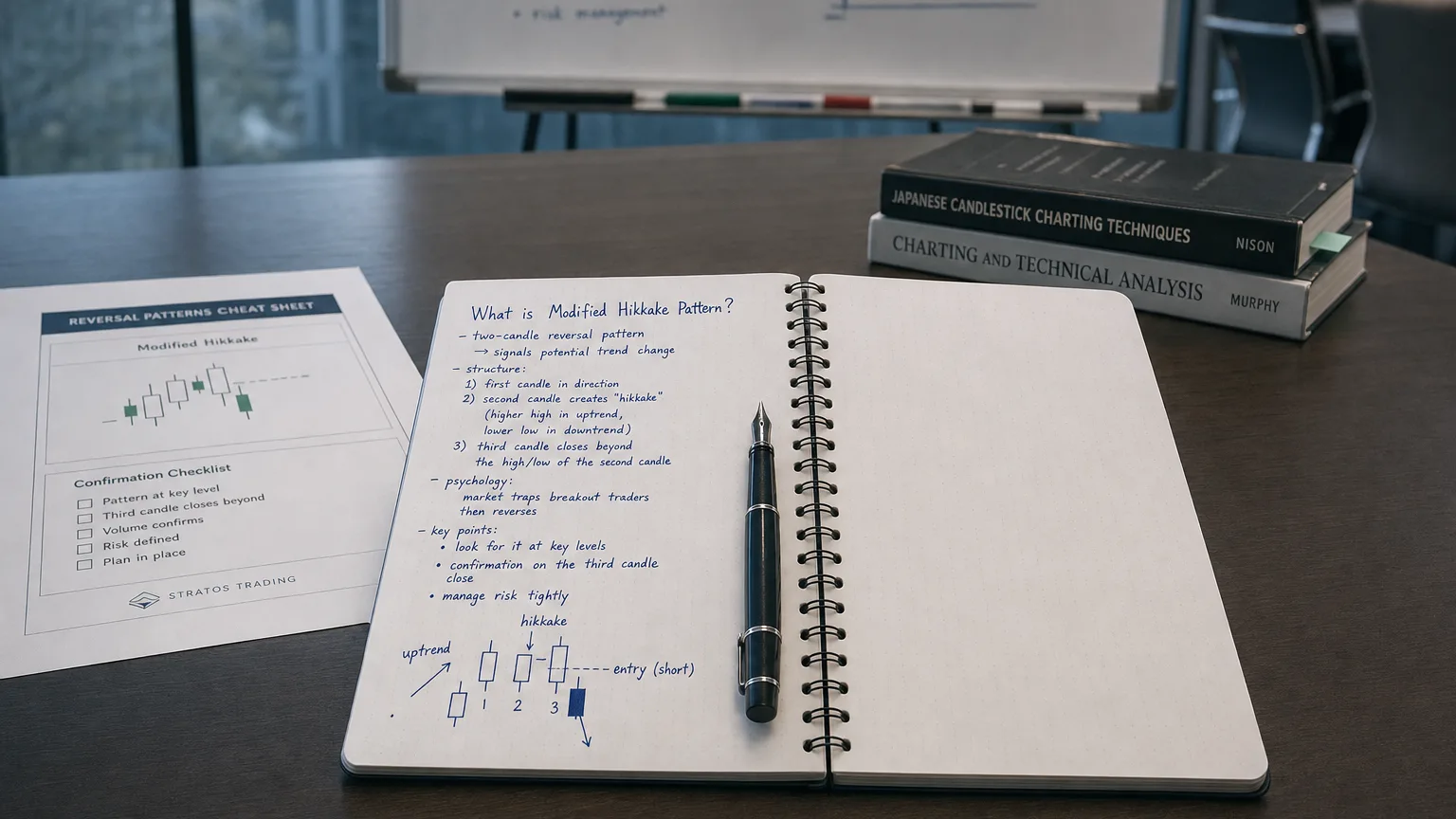
is a financial concept covered in this article. The Pro's Choice for Spotting High-Quality Trend Reversals
The goal of a successful trader is to make the best trades. Money is secondary.

The Modified Hikkake Pattern is a refined version of Dan Chesler’s original Hikkake setup—an inside-bar “head-fake” that traps eager breakout traders. By adding a context filter (a smaller-range bar that closes at an extreme right after a wide “anchor” move), the modified variant deliberately targets trend-exhaustion turning points instead of raw volatility pops. In other words, while the classic Hikkake spots momentum continuations following a false break, the modified recipe looks for moments when a prevailing trend is running out of steam, lures traders into one last push, and then springs a sharp reversal.
What makes this tweak so potent is its tight risk profile and high signal quality. The inside-bar compression, false breakout, and confirmation close are still there, but the prerequisite “context” bar filters out most noise, leaving only those setups where market psychology is primed for a sentiment flip: stops get swept, liquidity thins, and trapped traders fuel the move back through the range. For swing- or position-traders who prefer catching fresh turns rather than chasing late breakouts, the Modified Hikkake offers a disciplined, rule-based trigger with measurable edge—small initial risk, clear invalidation, and outsized reward potential when the crowd is caught offside.
Deploy it on liquid instruments, respect the confirmation close, and layer it on top of higher-time-frame structure or momentum filters; done right, the Modified Hikkake becomes a stealthy reversal tool that keeps you ahead of the shake-outs instead of getting shaken out yourself.
Why the “Modified” twist?
-
Creator & purpose – Dan Chesler (CMT, CTA) published the add-on rules in Active Trader (Apr 2004) to transform the classic Hikkake from a “false-break timing tool” into a dedicated trend-reversal trigger. The tweak adds just two context filters, but they cull a huge chunk of mediocre signals.
-
Frequency vs. quality trade-off – You’ll see roughly 1 modified setup for every 5–7 standard Hikkakes, but the survivors historically deliver a cleaner reward-to-risk profile, especially on daily charts of liquid futures, FX majors and index ETF-pairs.
Pattern anatomy – 5-bar roadmap
| Step | Price action | Bullish Modified | Bearish Modified |
|---|---|---|---|
| –2 “Anchor” bar | Large bar establishing prevailing trend. | Wide-range down bar | Wide-range up bar |
| –1 Context bar (new filter) |
• Closes near low • Range < Anchor range |
✔ | — |
| • Closes near high • Range < Anchor range |
— | ✔ | |
| 0 Inside bar | High ≤ Context high & Low ≥ Context low | Compression | Compression |
| +1 False break | Price pokes below (bullish) or above (bearish) inside range | Liquidity sweep | Liquidity sweep |
| +2/+3 Confirmation | Close back through opposite extreme of inside bar within 3 bars | Close > inside-high | Close < inside-low |
(Some quants allow one extra “drift” candle between the inside bar and the false break; it boosts sample size without diluting edge.)
Market psychology in a nutshell
-
Context bar signals fatigue. Smaller range after a big anchor bar = trend momentum waning.
-
Inside bar = compression. Everybody waits.
-
False break flushes stops & tempts breakout traders the “obvious” way.
-
Snap-back close traps them, flips order-flow and kick-starts the reversal.
Trader’s playbook
| Element | Long setup | Short setup |
|---|---|---|
| Entry | Buy at/above confirmation close or a stop a tick over inside-high. | Sell/short at/below confirmation close or a stop a tick under inside-low. |
| Initial stop | Just under the false-break low or ATR(20)×1 below entry. | Just above false-break high or ATR(20)×1 above entry. |
| Targets | 1.5–3 R or first opposing supply cluster/EMA(50). | |
| Time filter | Bail if price fails to advance ≥ 0.5 R within three bars. | |
| Filters that sharpen edge | - Confirm divergence on RSI/Stoch<40 (bull) or >60 (bear). - Use volume or delta spikes at the false-break. |
Back-test note (Oxford-Strategies, 42 global futures 1980-2024): Sharpe 0.34, CAGR ≈ 2.5 % (20-bar hold) versus basic Hikkake Sharpe 0.01, CAGR -0.15 %.
Strengths & caveats
Pros
-
Pinpoints momentum shifts right at liquidity sweeps → tight stops, juicy R.
-
Objective, easy to screen algorithmically.
-
Avoids 80 % of continuation-only Hikkakes that chop around.
Cons
-
Rare on higher time-frames – patience required.
-
Under-performs in ultra-strong trends (use a trend filter or skip).
-
False positives spike in thin, low-ATR symbols; stay with majors/large-caps.
Quick visual checklist (print this above your monitors)
-
Anchor bar shows directional push
-
Context bar: closes at extreme & smaller range
-
Inside bar contained in Context
-
Price fakes out then closes through the opposite side within 3 bars
-
Volume or order-flow confirmation?
Summary
The Modified Hikkake is the “premium-select” version of the standard trap pattern—designed to catch those sweet, sentiment-flip reversals with minimal risk. Work it into a broader playbook (structure + momentum + volume), keep the confirmation discipline tight, and you’ll have a stealthy, high-octane trigger when the market tries to shake & bake the crowd.